
Top HealthTech Companies in Europe (2026)

Europe’s healthtech market is no longer an emerging category. It is repricing, consolidating and, selectively, preparing for public markets.
That is a useful correction. The companies that matter in 2026 are not simply those with the largest funding rounds or the most polished investor narrative. They are the companies proving that digital health can survive contact with reimbursement, clinical workflow, public-sector procurement, evidence expectations and commercial discipline.
This updated market map profiles the top healthtech companies in Europe in 2026, using verified funding and valuation data where available. Where a private-company valuation is not publicly disclosed or cannot be verified, the article uses the latest disclosed funding round instead.
The visual map highlights 13 selected market leaders by category and commercial maturity. The full article goes wider, covering additional European companies shaping digital health, AI-enabled care, life-sciences infrastructure and workflow automation.

Scale and valuation leaders
Platforms with significant adoption, recognised category positions and late-stage funding or public-market relevance.

Reimbursed and embedded models
Companies integrated into payer, provider or public-sector operating models rather than sitting beside them.
AI, data and workflow infrastructure
Businesses changing how clinical, diagnostic and life-sciences work is performed underneath the customer interface.
Last updated: July 2026. Private valuations are shown only where tied to a named funding round or clearly attributed transaction. They are not live prices.
What Changed Since March 2026
The market has moved. The sourcing standard has as well.
- Alan closed a major 2026 round, with Prosus announcing a €400 million investment as part of a €480 million financing round valuing Alan at €5.5 billion.
- Oura confirmed that it had confidentially submitted a draft Form S-1 registration statement for a proposed IPO, following its October 2025 funding round of more than $900 million at an approximately $11 billion valuation.
- Oviva announced a €200 million Series D to expand reimbursed, AI-enabled care for weight-related and chronic conditions across Europe.
- Isomorphic Labs raised $2.1 billion in Series B funding, moving AI drug design into a different funding class from conventional digital health.
- Consolidation accelerated: Sword Health acquired Kaia Health, while RadNet’s DeepHealth acquired Gleamer.
The pattern: capital is concentrating around businesses with proven payer economics, clinical workflow integration or credible infrastructure value. The market is still funding ambition, but it is asking harder questions about evidence, unit economics and route to reimbursement.
How This Ranking Works
There is no official list of the top healthtech companies in Europe, so the methodology matters.
Companies were selected using five criteria:
- European relevance — founded, headquartered or materially scaled in Europe.
- Commercial traction — revenue, users, enterprise adoption, reimbursement, public-sector contracts or workflow integration.
- Funding or market validation — a disclosed funding round, public-market status, acquisition value or verified valuation.
- Strategic relevance — importance to care delivery, diagnostics, prevention, clinical workflow, payer models, pharma R&D or health-system productivity.
- Commercial maturity — ability to move beyond pilots into repeatable, reimbursed, contracted or embedded operating models.
Valuation policy
Private-company valuations are included only where they are tied to a named funding round, investor announcement, public filing or clearly attributed transaction. Where no valuation was disclosed, the table shows the latest disclosed funding round instead.
- Public companies: public-market status and date-specific financial signals. Market capitalisation is deliberately not fixed in the table because it changes daily.
- Private primary rounds: the valuation set when new capital was invested into the company.
- Secondary transactions: treated separately because they price liquidity between shareholders, not necessarily the company’s growth plan.
- Undisclosed valuation: no estimate is substituted. “Not disclosed” means exactly that.
Commercial maturity scale
- Scaled: substantial adoption, embedded revenue and strong national or multi-country presence.
- Expanding: proven model, actively entering new markets, segments or customer groups.
- Commercialising: revenue-generating, with scale, reimbursement or repeatability still being established.
- Strategic infrastructure: platform value is primarily measured through R&D, enterprise workflow or ecosystem relevance rather than consumer adoption.
This is not a valuation league table. Valuation is a signal. It is not the strategy.
European HealthTech Market Map 2026
The map positions 13 selected companies across three strategic categories and three levels of commercial maturity. It is an executive snapshot rather than an exhaustive directory.
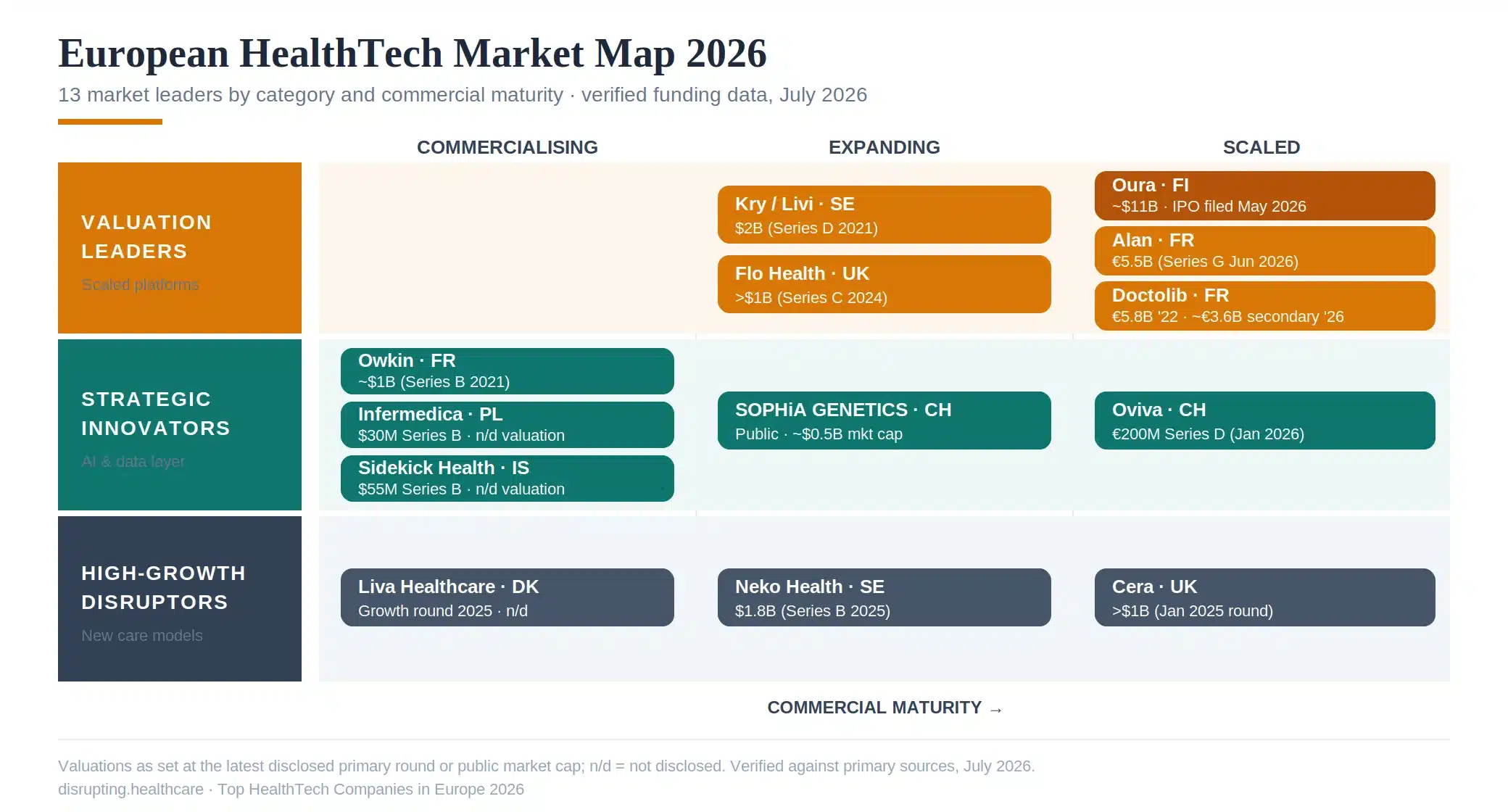
Snapshot: Europe’s Leading HealthTech Companies
The table adds the dimensions that valuation-only rankings miss: funding stage, business model, geographic reach and commercial maturity.
| Company | Base | Segment | Latest verified funding or valuation signal | Business model | Reach | Maturity |
|---|---|---|---|---|---|---|
| Oura | Finnish-founded / US parent | Wearables and preventive health | $900m+ round at approx. $11bn, Oct 2025; confidential draft S-1 submitted May 2026 | Hardware + subscription | Global | Scaled / pre-IPO |
| Alan | France | Health insurance and care platform | €480m round at €5.5bn, Jun 2026 | Employer-paid insurance, prevention, care navigation and member services | France, Belgium, Spain, Canada | Scaled |
| Doctolib | France | Provider workflow and patient access | €500m equity/debt round at €5.8bn, Mar 2022 | Provider SaaS, booking, practice workflow and teleconsultation | France, Germany, Italy and wider European activity | Scaled |
| Kry / Livi | Sweden | Telehealth and hybrid care | More than $300m Series D, Apr 2021 | Digital consultations plus physical and contracted care delivery | Sweden, Norway, UK, France and Germany | Expanding |
| Flo Health | UK | Women’s health / femtech | $200m+ Series C at valuation above $1bn, Jul 2024 | Consumer freemium and subscription | Global | Expanding |
| Oviva | Switzerland / Germany / UK | Reimbursed chronic care | €200m Series D, Jan 2026; valuation not disclosed | Reimbursed digital care with remote clinical teams | Germany, UK and Switzerland | Scaled |
| Cera | UK | AI-enabled home care | $150m financing, Jan 2025; valuation above $1bn reported | Public-sector and commissioned home-care services | Primarily UK | Scaled |
| Doccla | UK / Sweden-founded | Virtual wards and remote monitoring | £35m Series B, Sept 2024 | Managed virtual wards and remote patient monitoring | UK, Ireland and European expansion | Expanding |
| Liva Healthcare | Denmark / UK | Chronic-care coaching | Strategic funding and Momenta acquisition, Feb 2025; amount undisclosed | Digital tools plus human lifestyle coaching | UK, Denmark and Germany | Commercialising |
| Isomorphic Labs | UK | AI drug discovery | $2.1bn Series B, May 2026; valuation undisclosed | AI drug-design engine, internal pipeline and pharma collaboration | Global life sciences | Strategic infrastructure |
| Owkin | France / US | AI biology and drug discovery | $180m Sanofi investment; unicorn status, Nov 2021 | AI R&D platform and pharma partnerships | Europe and US | Commercialising |
| SOPHiA GENETICS | Switzerland | Genomics and multimodal data | Public company; Q1 2026 revenue $21.7m, up 22% YoY | Data-analysis SaaS for hospitals, laboratories and biopharma | Global | Public / expanding |
| Huma | UK | Digital-first care and research infrastructure | Series D financing above $80m; more than $300m total raised, Jul 2024 | Regulated digital-health platform and enterprise modules | Global | Strategic infrastructure |
| Nabla | France / US | Clinical AI assistant | $70m Series C, Jun 2025 | Enterprise clinical documentation and workflow AI | US-led, European-founded | Expanding |
| Infermedica | Poland | AI triage and care navigation | $30m Series B, Jan 2022; valuation not disclosed | B2B licensing and APIs for payers, providers and digital-health platforms | International | Commercialising |
| Ada Health | Germany | AI symptom assessment | Series B closed at $120m, Feb 2022 | AI assessment and care navigation | Europe and US | Commercialising |
| Neko Health | Sweden / UK / US | Preventive diagnostics | $260m Series B at $1.8bn, Jan 2025 | Direct-to-consumer preventive health scans | Stockholm, London, Manchester and New York | Expanding |
| Vitestro | Netherlands | Robotic diagnostic workflow | $70m Series B, Mar 2026 | Autonomous robotic blood collection | Europe first; US pathway planned | Commercialising |
| DentalMonitoring | France | AI orthodontic monitoring | Approx. €84m financing reported, Feb 2026 | Enterprise SaaS and regulated remote monitoring | 50 countries reported by the company | Expanding |
| Sidekick Health | Iceland | Digital therapeutics | $55m Series B, May 2022; valuation not disclosed | Digital therapeutics through pharma, provider and payer partnerships | Europe and US | Commercialising |
Scale and Valuation Leaders
Oura — preventive health at consumer scale
Oura is no longer usefully described as just a smart-ring company. In October 2025, it announced a funding round of more than $900 million at an approximately $11 billion valuation. In May 2026, it confirmed the confidential submission of a draft registration statement for a proposed IPO.
The strategic relevance is the movement from wellness tracking towards continuous preventive-health signals. Oura has already built the difficult consumer assets: habitual use, a subscription layer and a recognised brand. Its next test is whether it can translate that engagement into credible healthcare use cases without confusing consumer adoption with medical utility.

Alan — a prevention and insurance platform
Alan is one of the strongest commercial signals in European healthtech in 2026. Prosus announced a €400 million investment as part of a €480 million round valuing the company at €5.5 billion.
Alan’s model combines insurance, care access, prevention and AI-enabled member services. That makes it strategically different from a digital clinic or wellness application. It is attempting to reshape the payer layer itself, using one customer relationship to connect coverage, navigation and prevention.
The valuation is notable. The operating-model signal matters more. Alan suggests that a European healthtech company can reach substantial scale by controlling both the financing and experience layers of care rather than adding another service beside them.

Doctolib — embedded provider infrastructure
Doctolib remains one of Europe’s most important healthtech companies because it sits inside provider workflow, not merely at the patient-facing front door. Its March 2022 funding round raised €500 million in equity and debt and valued the company at €5.8 billion.
The company says it supports 500,000 healthcare professionals and 90 million patients across Europe. Those numbers are company-reported, but they illustrate the core point: Doctolib is not simply an appointment marketplace. It has expanded into practice management, communication and the administrative coordination layer of care.
Workflow proximity beats consumer awareness in healthcare. Being useful inside the operating model is usually more defensible than being visible outside it.

Kry / Livi — telehealth becoming hybrid care
Kry announced more than $300 million in Series D funding in April 2021 to support further European expansion.
The strategic question is no longer whether video consultation is useful. That question was answered and then largely commoditised. The more important question is whether digital access can become part of an integrated, reimbursed primary-care operating model.
Kry’s development into physical clinics and broader care services shows the direction of travel. Telehealth alone is not a moat. Hybrid care, reimbursement integration and greater ownership of the patient pathway may be.

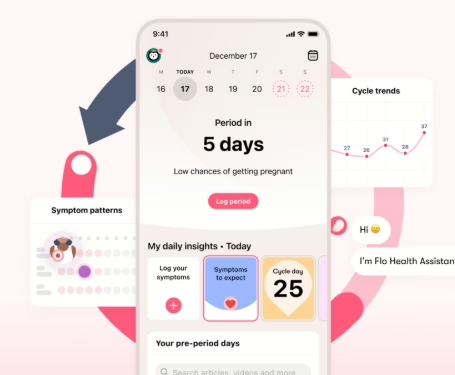
Flo Health — the European femtech scale-up to beat
Flo Health became one of Europe’s clearest femtech scale-up stories when it secured more than $200 million from General Atlantic in 2024, reaching a valuation above $1 billion.
Flo’s model is built around consumer subscription, women’s health education and personalised health insights. The company has scale in a category that has been structurally underfunded. That gives it both an opportunity and a greater burden of trust.
The next phase is not just user growth. It is category depth: perimenopause, menopause, privacy, clinical governance and credible health guidance. Women’s health deserves more than another engagement application. Flo has the scale to build something more durable.
Reimbursed and Health-System Embedded Models
Oviva — reimbursed chronic care at European scale
Oviva is one of the most commercially mature digital chronic-care companies in Europe. In January 2026, it announced a €200 million Series D to expand AI-enabled care for weight-related and chronic conditions.
The operating signals are stronger than the funding headline. Kinnevik stated that Oviva had supported more than one million patients and reached cash-flow profitability in 2025.
This is the model much of European digital health has been trying to reach: evidence-backed, reimbursed, workflow-integrated and AI-enabled without pretending that software alone delivers care. Oviva’s strength is not the application. It is the combination of reimbursement, care teams, evidence and scalable delivery.

Cera — AI-enabled home care in a capacity-constrained system
Cera raised $150 million in debt and equity financing in January 2025, with reporting at the time placing its valuation above $1 billion.
Cera matters because home care is not glamorous. It is simply essential. Ageing populations, hospital-capacity pressure and workforce shortages make care at home one of the hardest operational problems in European healthcare.
A provider that can help keep people out of hospital, support local authorities and use predictive tools to direct scarce human capacity is selling something healthcare systems need to buy. That is a more concrete commercial proposition than a generic AI story.

Doccla — virtual wards as capacity infrastructure
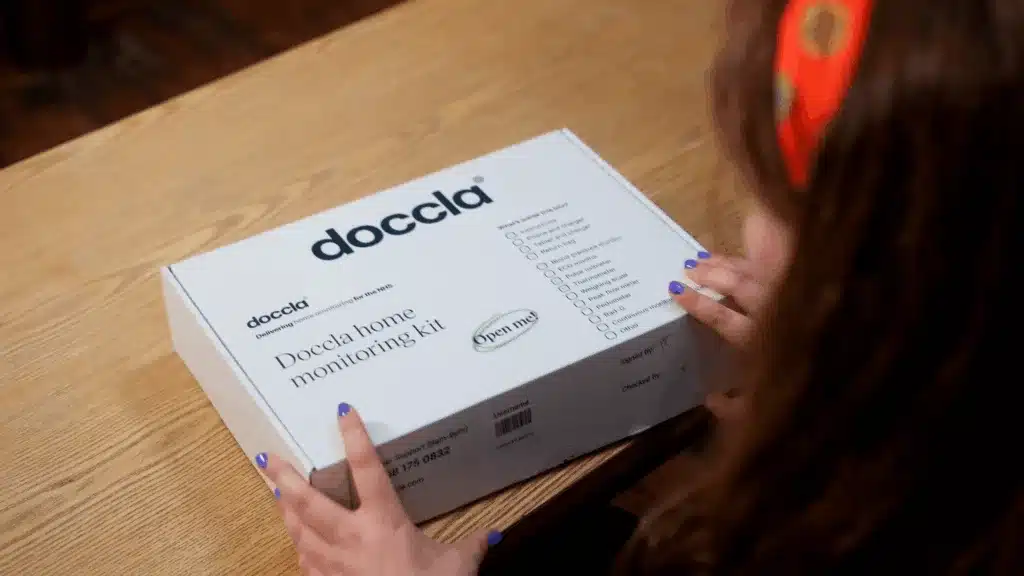
Doccla raised £35 million in Series B funding in September 2024 to expand virtual wards and remote patient monitoring across Europe. At the time, the company reported monitoring more than four million patient days across nearly half of NHS regions.
Virtual wards become commercially important when they stop being a device-and-dashboard proposition and become a capacity-management model. The relevant outcomes are earlier discharge, fewer avoidable admissions and hospital-level monitoring outside the hospital.
Doccla is a useful reminder that the most consequential digital-health models are often operationally unglamorous. The promise is not “engagement”. It is better use of scarce clinical capacity.
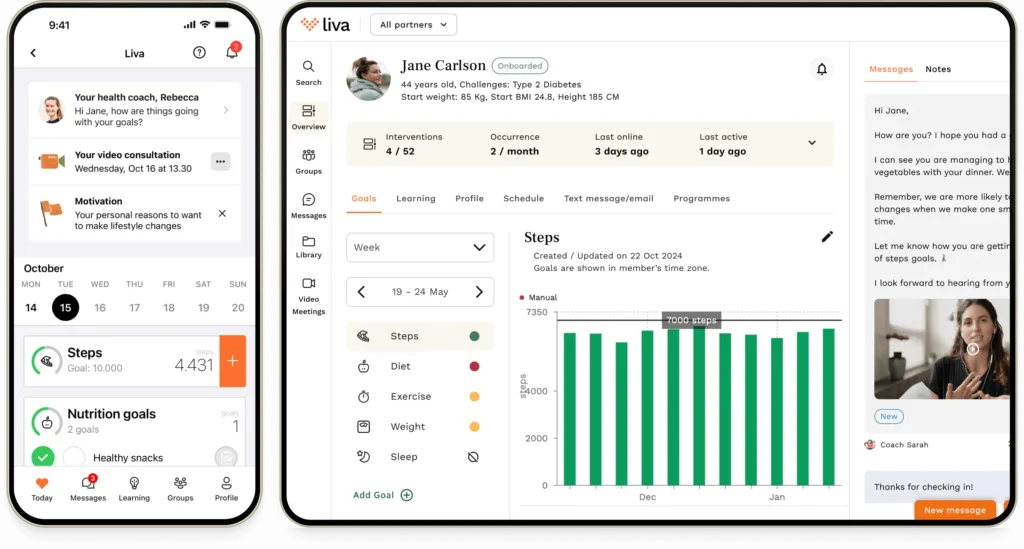
Liva Healthcare — the pragmatic hybrid chronic-care model
Liva Healthcare announced the acquisition of Momenta and additional strategic investment in February 2025. The funding amount was not disclosed.
Liva combines digital tools with human coaching for obesity, diabetes prevention and lifestyle-related chronic disease. That hybrid approach may sound less exciting than fully automated care. It is also more believable.
In chronic disease, behaviour change remains a human problem supported by technology, not a software-only workflow. Liva’s relevance is its fit with public-sector procurement and care-delivery logic rather than valuation headlines.
AI, Data and Life Sciences Infrastructure
Isomorphic Labs — AI drug design at frontier scale
Isomorphic Labs is an outlier in this market because its funding scale is closer to frontier AI infrastructure than conventional healthtech. In May 2026, it announced $2.1 billion in Series B funding to scale its AI drug-design engine, expand globally and progress its pipeline.
If AI drug design moves from research promise into pipeline productivity, the operating-model implications for pharma are substantial: portfolio strategy, target selection, external innovation, evidence generation and R&D partnering all change.
The sensible stance is neither hype nor dismissal. Isomorphic is a major market signal. The proof will be in whether computational promise becomes repeatable clinical translation.

Owkin — federated AI for biology
Owkin became a European AI-healthtech unicorn after Sanofi invested $180 million in the company in 2021 alongside a strategic oncology collaboration.
Owkin sits at the intersection of federated learning, hospital data networks, biology and pharma partnerships. Its commercial maturity cannot be read like a provider SaaS company. The relevant question is whether its infrastructure can repeatedly generate value across discovery, translational research and clinical development.
This is also an area where Europe may hold a structural advantage. Fragmented health systems make scale harder, but regulatory and data-governance expectations can reward architectures that do not require sensitive data to leave the institution.

SOPHiA GENETICS — a public-market reality check
SOPHiA GENETICS is different from most companies on this list because it is public. In Q1 2026, the company reported revenue of $21.7 million, up 22% year over year.
That makes it a useful reality check for private-market optimism. Public markets price healthtech and precision medicine differently from late-stage funding rounds. SOPHiA’s growth demonstrates demand for genomics and multimodal data infrastructure, while its public status exposes it to a level of financial discipline private companies can postpone.
For companies preparing to list, SOPHiA is not just a peer. It is a reminder that public investors eventually replace narrative with quarterly evidence.
Huma — regulated digital-first care infrastructure
Huma completed Series D financing with share issuance above $80 million and total funding above $300 million in July 2024. It also launched the Huma Cloud Platform as configurable infrastructure for regulated digital-first care and research.
Huma’s strategic relevance is the platform thesis. Digital-health and life-sciences teams increasingly need regulatory foundations, device connectivity, disease-management modules, APIs and deployment capability rather than another isolated application.
Infrastructure is less glamorous than a consumer interface. It is also closer to where repeatable enterprise value is created.
Nabla — clinical AI entering the workflow layer
Nabla raised $70 million in Series C funding in June 2025, bringing total funding to $120 million. At the time, the company said its ambient AI was being used by 85,000 clinicians across more than 130 healthcare organisations.
Clinical AI assistants are becoming one of healthcare’s more credible AI categories because documentation burden is real, measurable and expensive. The strategic question is whether ambient documentation remains a point solution or becomes the entry point into wider clinical workflow automation.
The winners will not be decided by transcription accuracy alone. Integration, governance, workflow adoption and the ability to support decisions without creating new risk will matter more.
Infermedica — AI triage as embedded infrastructure
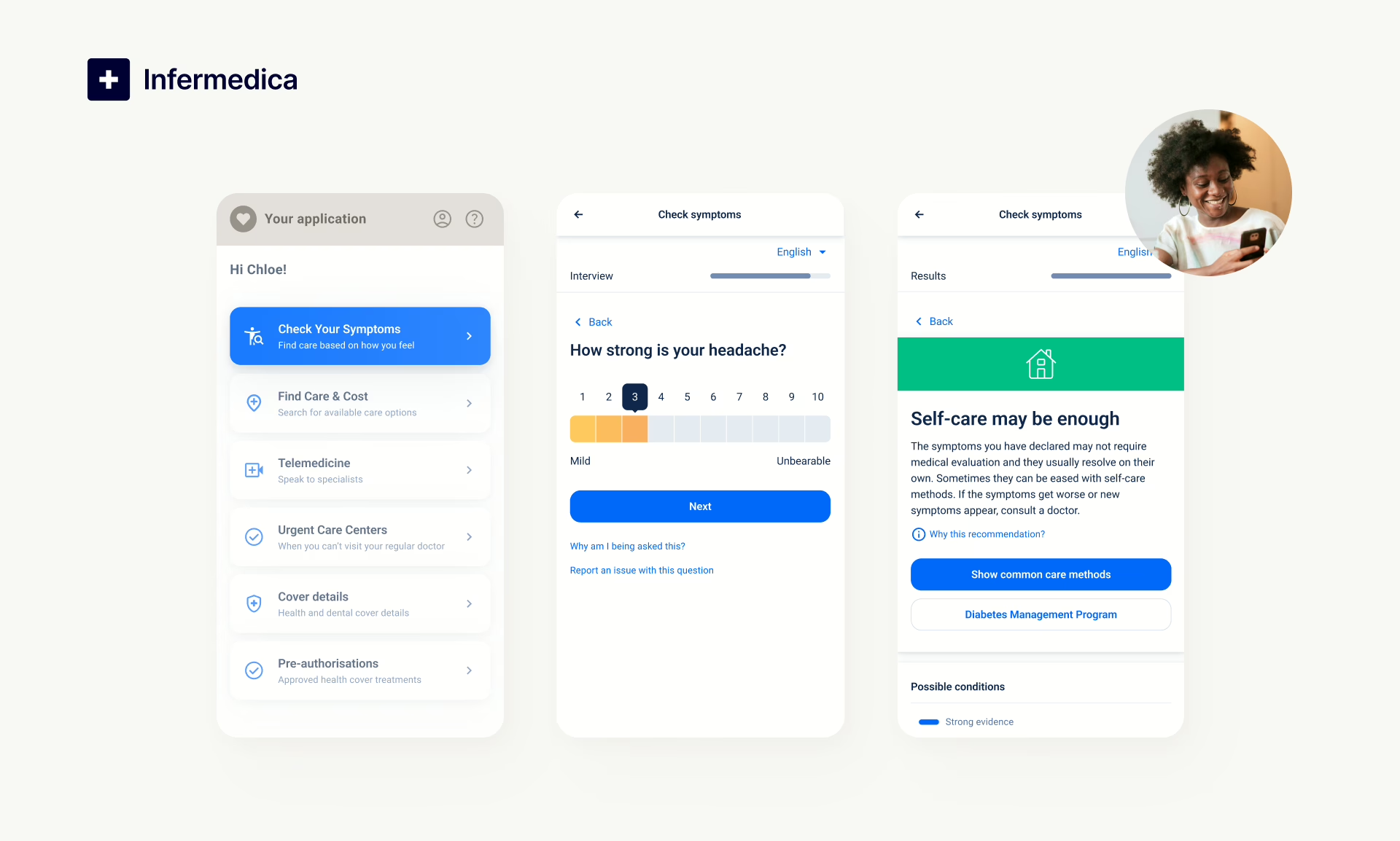
Infermedica raised $30 million in Series B funding in January 2022 to develop its medical-guidance platform.
AI triage is a difficult market because it touches safety, liability, pathway design, patient behaviour and clinical trust. Infermedica’s relevance lies in its B2B model: its capabilities can sit inside payer, provider and telehealth journeys without requiring the company to own the patient relationship.
That may prove more durable than a standalone symptom-checker brand. Infrastructure can be less visible while becoming harder to remove.
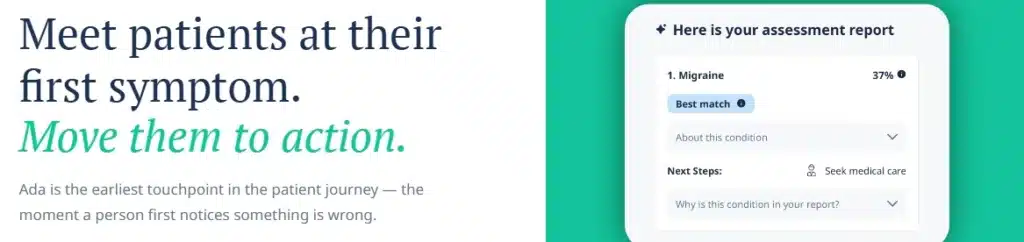
Ada Health — mature AI symptom assessment
Ada Health closed its Series B round at $120 million in February 2022.
Ada remains a recognised European AI-assessment company, but the category has matured. Symptom assessment is no longer judged by novelty. It is judged by integration, escalation logic, clinical governance and whether it improves the pathway rather than simply adding another digital front door.
The commercial lesson is straightforward: AI triage has to make the next step better, not just make the first step digital.
Specialist Workflow and Diagnostics Automation
Neko Health — preventive diagnostics as a consumer clinic model
Neko Health is one of Europe’s most interesting preventive-diagnostics companies because it is not simply selling another test. It is constructing a consumer-facing clinical model around early detection, full-body scanning and a tightly controlled experience.
In January 2025, Neko announced a $260 million Series B at a $1.8 billion valuation. The company reported more than 10,000 completed scans and a waiting list above 100,000 at the time.
The commercial question is whether Neko can move from scarcity-driven demand to clinical and operational scale. Preventive diagnostics becomes considerably harder when evidence, false positives, follow-up pathways and reimbursement enter the room.

Vitestro — robotic phlebotomy and diagnostic automation
Vitestro closed a $70 million Series B in March 2026 to advance its autonomous robotic blood-collection system and commercial readiness.
Vitestro belongs on this market map because workforce automation in diagnostics is becoming commercially relevant. The company is targeting a high-volume clinical workflow where labour constraints, consistency and throughput have direct economic consequences.
This is a more credible automation proposition than many broad AI announcements. Healthcare needs more than smarter decisions. It also needs fewer bottlenecks.
DentalMonitoring — AI monitoring inside a defined commercial workflow
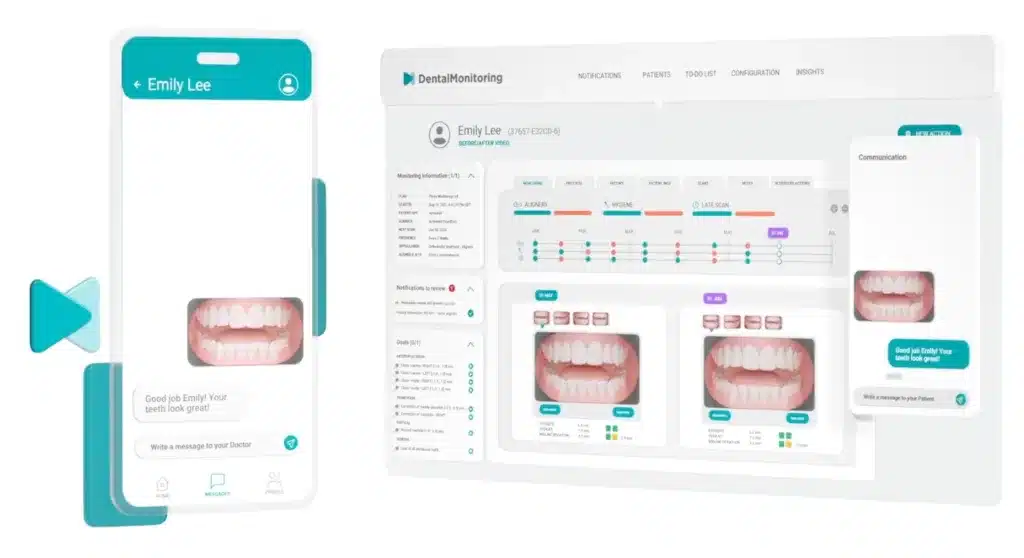
DentalMonitoring provides regulated, AI-powered remote monitoring for orthodontic practices. The company reports more than two million monitored patients, 8,000 registered dental professionals and activity across 50 countries.
Financing of approximately €84 million was reported in February 2026 to support further global expansion.
It is a specialist category, but a commercially instructive one. Orthodontics has clear incentives for remote monitoring: fewer unnecessary appointments, better practice capacity and tighter patient follow-up. The value proposition is specific enough to measure, which is more than can be said for much of the AI market.
Sidekick Health — digital therapeutics after the hype cycle
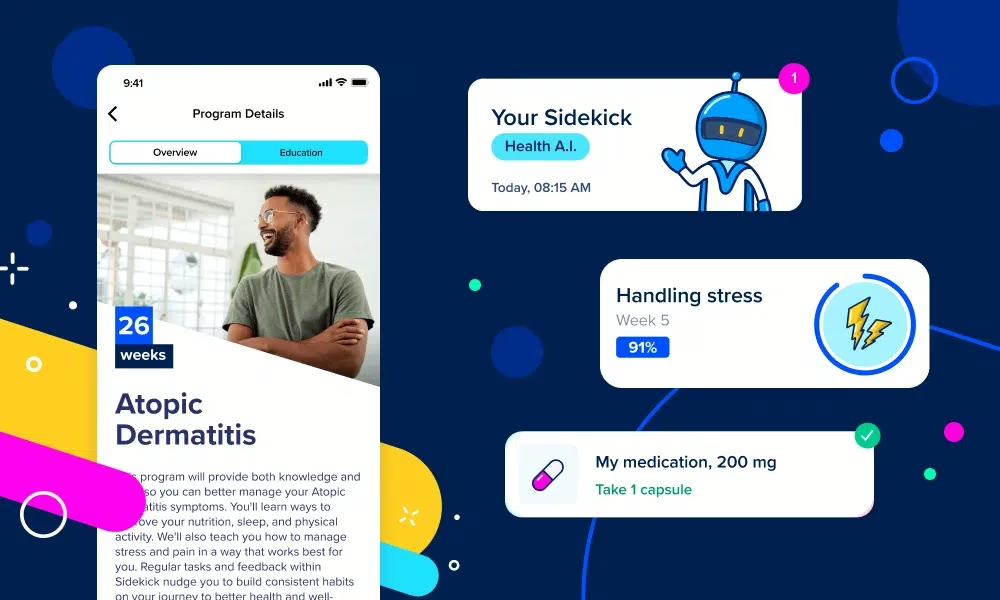
Sidekick Health raised $55 million in Series B funding in 2022 to scale its digital-therapeutics platform.
The company’s strategic relevance is its partnership model with pharma, payers and healthcare organisations. Digital therapeutics remains a difficult category: evidence expectations are high, reimbursement pathways are inconsistent and engagement is hard to sustain.
The companies that survive the correction will be those with evidence, distribution and realistic commercial models. Sidekick is worth watching because it sits directly inside that test.
Companies Reclassified Since March 2026
A market map should change when the market changes.
- Kaia Health — acquired by Sword Health in a $285 million transaction, bringing a European digital musculoskeletal platform into a larger global business.
- Gleamer — acquired by RadNet’s DeepHealth, combining its European radiology-AI footprint with a broader imaging platform.
This is not a downgrade. It is the natural direction of the market. Strong point solutions are increasingly becoming capability layers inside larger platforms.
What the 2026 Market Map Tells Us
Valuation is less useful than maturity
A large valuation can indicate investor confidence, but it is a weak proxy for strategic relevance unless supported by adoption, revenue, reimbursement or workflow integration.
The better question is: where does the company sit in the operating model of care?
Doctolib, Alan, Oviva, Doccla and Cera matter because they are close to delivery, payment or system capacity. That is where commercial durability is created.
Europe is producing infrastructure, not just applications
The strongest companies increasingly look like infrastructure: provider workflow, AI drug design, genomics, virtual wards, chronic-care reimbursement, clinical documentation and diagnostic automation.
The next phase of European digital health will not be won by adding more interfaces. It will be won by companies that change how work is performed underneath them.
Reimbursement and workflow are becoming the real moat
European fragmentation is usually treated as a weakness. It is. It also creates a forcing function.
Companies that can operate across reimbursement systems, procurement environments, clinical workflows and regulatory requirements are harder to copy than companies that scale mainly through paid consumer acquisition.
AI is now an operating-model claim
Almost every company now has an AI narrative. That is no longer differentiating.
The useful question is what AI changes in the operating model. Does it reduce cost-to-serve? Increase clinical capacity? Shorten R&D cycles? Improve patient routing? Remove an administrative bottleneck?
If the answer is vague, it is probably still a feature story. If the answer changes unit economics or workflow capacity, it may be strategic.
Consolidation is no longer theoretical
The Kaia and Gleamer transactions show where the market is heading. Specialist European assets with strong product-market fit may increasingly become acquisition targets for larger global platforms.
That creates opportunities for founders and investors. It also raises a strategic question for Europe: who will own the operating infrastructure of future care?
Europe vs the US: The Structural Difference Still Holds
Europe builds healthtech differently from the US.
Europe
- Deeper integration with public payers and clinical systems
- Slower, nationally fragmented market expansion
- Greater procurement and reimbursement complexity
- Regulatory barriers that can become a moat once cleared
United States
- Deeper capital markets
- Faster commercialisation in large customer segments
- Stronger public-market infrastructure
- Higher potential multiples, with less tolerance once growth slows
The 2026 twist is that the capital gap at the top is narrowing. Alan and Oviva have raised US-scale rounds for Europe-first operating models. The listing gap remains: Europe can build the company, while New York often still prices it.
What Leaders Should Watch in H2 2026
Evidence-backed scale
Watch for reimbursement wins, enterprise renewals, public-sector contracts, clinical evidence, margin improvement and repeatable expansion across markets. Another funding announcement is not enough.
Platform consolidation
The question is not whether consolidation continues. It is whether European companies become the platforms doing the consolidating or the capabilities being acquired.
The operating model beneath AI
AI deployment discipline remains scarce. The companies that matter will make AI useful inside regulated workflows, not simply attach it to a familiar product.
Downloadable Market Map and Data Table
The market map and structured dataset are available for reuse in presentations, investment discussions and market-planning work.
- Download the European HealthTech Market Map 2026
- Download the full European HealthTech Companies 2026 CSV
You are welcome to reuse the map and table with attribution and a link to this page.
Frequently Asked Questions
What is the largest healthtech company in Europe?
By latest disclosed private-market valuation in this article, Oura leads following its October 2025 round at an approximately $11 billion valuation, although it now operates under a US parent. Among Europe-domiciled companies, Alan and Doctolib are among the largest based on Alan’s June 2026 €5.5 billion valuation and Doctolib’s March 2022 €5.8 billion primary-round valuation.
Which European healthtech companies have reached unicorn status?
European or European-founded healthtech companies that have reached a valuation of at least $1 billion at a disclosed or clearly attributed transaction include Oura, Alan, Doctolib, Kry, Flo Health, Owkin, Neko Health and Cera.
Are the valuations on this page reliable?
Each valuation is tied to a named and dated funding round, public filing, investor announcement or clearly attributed transaction. Where a valuation has not been disclosed, the article says so and uses the latest disclosed funding round. Private valuations are not live prices and can differ materially from later secondary-market or public-market pricing.
Which European healthtech companies are preparing for an IPO?
Oura confirmed in May 2026 that it had confidentially submitted a draft Form S-1 registration statement for a proposed IPO. Doctolib is frequently discussed as a potential future listing candidate, but this article does not treat a Doctolib IPO as confirmed. SOPHiA GENETICS has been listed on Nasdaq since 2021.
Why are some companies not shown in the 13-company visual map?
The visual is designed as an executive snapshot rather than an exhaustive directory. Companies including Isomorphic Labs, Huma, Nabla, Ada Health, Doccla, Vitestro and DentalMonitoring are covered in the full article because they add strategically important market signals but do not fit cleanly into the simplified visual structure.
Interested in How the Market Has Evolved?
Compare this market map with the earlier analysis: The Top 10 Most Valuable HealthTech Companies in Europe.
One Thing to Remember
The top healthtech companies in Europe in 2026 are not the companies with the best story about disruption. They are the companies becoming hard to remove from the system.

