AI in Commercial Operations
AI-Powered Commercial Operating Models in Life Sciences: What Actually Changes Beyond the Hype
Every large pharma and MedTech company now has an AI commercial programme.
Very few have a new commercial operating model.
That gap is the whole story.
Who Should Read It?
- pharma commercial leaders
- MedTech marketing and commercial excellence leaders
- digital transformation and omnichannel leads
- medical, legal and regulatory leaders involved in AI-enabled content and engagement
- executive search and strategy leaders assessing commercial transformation capability
Walk into any large life sciences commercial organisation in 2026 and the same stack is taking shape. A next-best-action engine recommending which healthcare professional to contact. A generative assistant drafting content. A decision-support layer promising a single view of the customer. A CRM roadmap now full of agents. A content platform promising faster compliant assets. A dashboard showing that the pilot worked.
The slides are confident. The demos are smooth. The vocabulary has changed.
Then you ask the question that actually matters.
What is the system allowed to decide?
And who owns the decision before it reaches a customer?
That is where the room usually becomes more interesting.
Because in many organisations, the technology has changed faster than the operating model around it. The brand plan is the same. The medical, legal and regulatory queue is the same. The field incentive model is the same. Medical and commercial still run on different data, different rhythms and different definitions of value. The AI recommends. The operating model quietly overrules.
This is the distinction that separates companies getting value from companies getting press.
AI adoption means buying, piloting and deploying tools.
AI-enabled operating model redesign means changing who decides what, on what evidence, within what governance, and how quickly that decision becomes a compliant action in market.
The first is a procurement and implementation exercise.
The second is the actual transformation.
Most organisations are doing the first and describing it as the second.
What Is Agentic AI in Pharma Commercial?
Agentic AI is AI that not only generates content or answers prompts. It can pursue a defined objective, select actions, execute tasks, and adapt based on outcomes inside governed workflows.
In life sciences commercial operations, that may mean supporting insight generation, healthcare professional engagement, field preparation, content routing, campaign orchestration, medical information triage, market access workflows or next-best-action execution.
It should not mean uncontrolled autonomy.
In regulated markets, agentic AI has to operate inside explicit human oversight, compliance controls and escalation rules. The point is not to remove people from commercial decision-making. The point is to make decisions faster, more coherent and better supported by current evidence.
That is already a major shift.
But it is still only useful if the organisation around the AI is designed to absorb it.
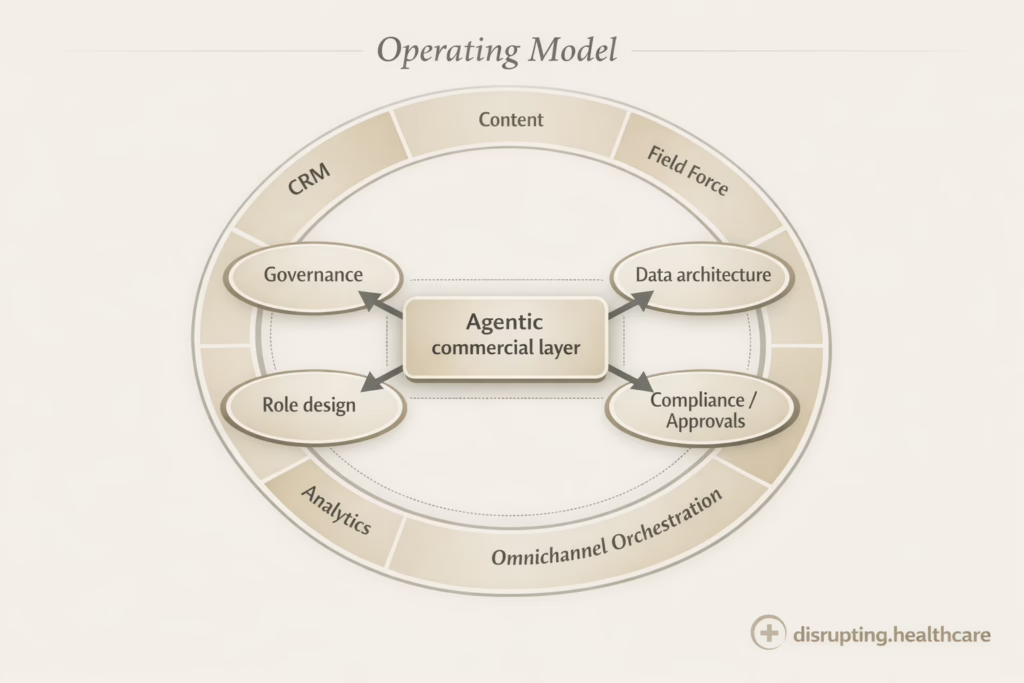
The problem is not the technology. Agentic systems can do what they claim. The problem is that most commercial operating models cannot absorb what these systems require to function. The data architectures are wrong. The decision rights are unclear. The roles were not designed around continuous, machine-executed engagement.
Before your organisation can benefit from agentic AI, it needs to reckon with some structural realities. Not later but before the contract is signed.
Agentic AI does not make omnichannel smarter. It exposes every structural flaw that was already there.
Adoption is not redesign
It is worth being precise here, because the confusion lives in the detail.
Sanofi is one of the clearest examples of a large pharma company publicly committing to AI at scale. The company describes itself as an R&D-driven, AI-powered biopharma company and says it is building AI-based solutions across the value chain, from R&D and manufacturing to patient engagement. Its plai platform gives employees access to real-time decision support and a 360-degree view across company activities. On the commercial side, Sanofi says its Turing engine supports personalised HCP engagement by recommending what to communicate, when and through which channel.
That is meaningful. It is not slideware.
But it also shows the limit of many AI programmes. A next-best-action engine improves the quality of the recommendation. It does not automatically redesign the organisation that receives the recommendation. If the rep still works against the same target list logic, if content still moves through the same approval queue, if incentives still reward activity rather than orchestrated impact, then the operating model remains largely intact.
That is not a criticism of Sanofi. It is the point.
The most advanced companies are not interesting because they have AI tools. Everyone has AI tools now, or soon will. They are interesting because they are beginning to expose the operating-model questions that less mature organisations are still hiding behind the word “pilot”.
Novartis offers another useful signal. In December 2025, Salesforce announced that Novartis had selected Agentforce Life Sciences for Customer Engagement. The stated ambition is to connect patient and HCP experiences and unify engagement across marketing, sales, patient services, medical, market access and other service stakeholders, with a global rollout planned over five years.
The interesting detail is the five-year timeline.
That is the tell.
Unifying previously separate engagement functions onto one orchestration layer is not a software installation. It is a multi-year renegotiation of who owns the customer relationship, who controls engagement logic, how data moves across functions, how compliance is embedded, and how local markets adapt global models without breaking them. The Novartis–Chai collaboration provides a current example of why access to a model is not the same as operating-model change.
The announcement is the easy day.
The operating model is the five years.
A company that understands that is buying transformation. A company that does not, is buying both a licence and a disappointment.
The most common failure mode in commercial AI is mistaking the platform for the operating model.
An organisation installs a modern CRM. It switches on next-best-action. It connects a content platform. It adds generative AI to drafting. It builds dashboards. It declares the model modernised.
But the brand plan still dictates the message. The field team still gets measured on activity. MLR still enters too late. Market access still sits on a parallel planning cycle. Medical still uses a different signal set. Local markets still improvise because the global template does not survive contact with reimbursement, language, access and privacy realities.
The system is technically integrated.
The organisation is not.
This is why life sciences commercial transformation so often looks functional in governance reviews and incoherent in market.
AI makes that harder to hide.
The old model could survive because humans absorbed the friction. A brand lead chased content. A field manager interpreted priorities. A local market adapted the plan. A medical colleague corrected a claim. A campaign manager reconciled the dashboard. A project lead made the thing work by force of personality.
AI cannot depend on heroic interpretation. It needs explicit rules, usable data, clear ownership and defined boundaries.
That is why operating model design becomes more important, not less.
This is also where the difference between multichannel and omnichannel in pharma marketing becomes more than a terminology debate. Multichannel can operate as a coordinated activity across channels. Omnichannel requires shared decision logic. AI does not turn one into the other unless the organisation changes how customer signals, content, field action and governance fit together.
What the demos promise
- Personalised HCP engagement at scale
- Real-time next-best-action decisioning
- Seamless omnichannel orchestration
- Autonomous execution without manual intervention
- Dynamic content optimisation across touchpoints
- Unified customer view across all channels
What commercial ops actually looks like
- Fragmented CRM data updated quarterly
- Decision rights owned by committees, not systems
- Channel teams operating in separate silos
- Approval workflows designed for batch campaigns
- Content libraries that are months out of date
- Identity resolution that fails on a significant share of records
What “agentic” actually means at the commercial operating layer
Goal-driven
An agentic system receives a defined objective — increase engagement quality with this HCP segment — and selects its own actions to pursue it. It does not wait for instructions on which channel to use, which message to send, or when to act.
Persistent
Unlike a one-time recommendation engine, an agentic system maintains state. It tracks what it has tried, adapts based on outcomes, and continues operating between human reviews. This persistence is what makes it powerful and what makes governance hard.products and services.
Operationally connected
Agentic AI is not a standalone analytics tool. It needs read and write access to your CRM, your content management system, your channel execution layer, and your consent infrastructure. If those systems are not integration-ready, the agent cannot act.
Three places AI commercial transformation fails before it starts
Decision rights built for machines, not campaigns
Most commercial organisations allocate decision authority through campaign processes. A brand team decides the message. A medical team approves the content. An operations team configures the channel. A compliance team signs off. Each step takes days or weeks.
Agentic AI breaks this model. When a system makes hundreds of micro-decisions per day — which email to send, whether to trigger a field alert, how to sequence a digital touchpoint — the campaign approval cycle becomes an immediate bottleneck.
Decision rights need to be redesigned before you deploy. This means defining which decisions the agent is authorised to make autonomously, which require human confirmation, and which are off-limits entirely. This is not a technology configuration. It is an organisational design question.
What this means in practice: You need a decision authority matrix that covers machine-executed actions, not just campaign-level approvals. Legal and medical review processes need to be rearchitected around rule sets and thresholds, not document-by-document sign-off.
Data architecture built for continuous decisioning
Next-best-action systems were built to work with periodic data snapshots. A weekly sync from the CRM, a monthly update from the data warehouse, a quarterly refresh of the segmentation model. This cadence was acceptable when humans were making decisions once a week.
Agentic systems make decisions continuously. They need current data. If a physician attended a symposium yesterday, an agentic system should know by this morning. If a digital engagement triggered a CRM update three hours ago, the agent’s next action should reflect it.
Most pharma commercial data architectures are not built for this. They have latency baked into every pipeline. Fixing this is not a small project. It requires rethinking how data flows from source systems into the commercial decisioning layer.
What this means in practice: Audit your data latency before you evaluate agent platforms. If your CRM sync runs weekly, no amount of sophisticated AI will give you the continuous decisioning capability the demos show. The data infrastructure is the long pole in the tent.
The content and MLR model cannot support the speed
A next-best-action engine is only as useful as the content it can actually deploy.
That is where many commercial AI programmes hit the wall.
The model may know that an HCP should receive a specific message through a specific channel at a specific moment. But if the content is not approved, modular, localised, tagged, reusable, or mapped to the right claim logic, the recommendation has nowhere to go.
This is why MLR is one of the most underrated constraints in the AI commercial story.
MLR is often described as a bottleneck. That is true, but incomplete. MLR becomes a bottleneck when the organisation treats review as the point where risk is discovered. By then, the asset has already been briefed, written, designed, adapted, promised and pushed into a timeline. Everyone now wants MLR to be fast.
AI can help. It can support claim matching, reference checking, asset classification, similarity detection, content routing, red-flagging, and reuse identification. Veeva’s MLR Bot, for example, is designed to perform quality checks before medical, legal, and regulatory review, including brand, market, channel, and editorial checks.
That matters.
But it does not remove the deeper issue.
AI can accelerate review. It cannot rescue a poor content model.
If the source claims are weak, if modular content is really just chopped-up long-form content, if markets are rewriting because reuse is impractical, if briefs do not define the decision the asset is meant to support, then AI helps the organisation produce more content that still has to be challenged, rewritten, or rejected.
The future of MLR is not simply faster review.
It is an upstream design.
The better question is not “how quickly can we approve this asset?”
The better question is “why does this asset need to exist, what approved logic does it reuse, and what customer decision is it meant to support?”
That is where content operations becomes a commercial strategy.
A little unglamorous, yes. Also, where the money is.
Who is building toward this — and what they are actually saying
Sanofi
Sanofi is among the most transparent large pharma organisations about its AI commercial investments. Its Turing platform is designed to drive personalised HCP engagement by connecting data signals across channels and triggering next-best-action recommendations at scale. The plai initiative — Sanofi’s real-time, company-wide data layer — is explicitly positioned as the infrastructure layer that makes continuous decisioning possible.
At VivaTech 2025, Sanofi’s leadership addressed the organisational dimension directly. The message was not that AI replaces the commercial model. It was that AI requires the commercial model to change. Investment in data infrastructure, role redesign, and new approval and execution processes were presented as prerequisites, not afterthoughts.
Sanofi is still building toward the operating model these ambitions require. But the framing is notably more honest than most vendor presentations: the constraint is not the technology. It is the organisation.
Sources: Sanofi Digital & AI · Sanofi VivaTech 2025
Novartis
Novartis has articulated a responsible AI framework that is worth reading alongside any vendor proposal for agentic commercial deployment. Their approach distinguishes between AI systems that assist human decision-making and AI systems that execute decisions — and places explicit governance requirements on the latter category.
The distinction matters commercially. Agentic systems sit in the execution category. They are not generating a recommendation for a sales rep to act on. They are acting. Novartis’s framework asks: who is accountable when the system is wrong? Who defines the guardrails? Who can halt the system if something is not working?
These are not regulatory compliance questions. They are operating model questions. The organisations that answer them clearly before deployment will have a measurable advantage over those that answer them after something goes wrong.
Source: Novartis Responsible AI
Watch Sanofi VivaTech 2025 video: All in on AI – How to Change an Organization with AI:
What a genuinely AI-enabled commercial model looks like?
The industry conversation about agentic AI governance has focused almost entirely on regulatory compliance — data privacy, off-label risk, transparency requirements. This is necessary. It is not sufficient. The operational governance question is different, and most organisations have not answered it yet. When a system is making hundreds of commercial decisions per day on behalf of your organisation, the governance structure that managed a dozen campaign approvals per quarter is not fit for purpose.
Who owns decision logic?
The rules and parameters that define what the agent will and will not do need an owner. Not a committee — an accountable individual with the authority to change them.
Who sets thresholds?
Every agentic system operates within thresholds — when to escalate, when to suppress, when to act. These are commercial and clinical judgements, not IT configurations.
Who monitors drift?
Model drift, data drift, and outcome drift are all real risks in deployed systems. Who is watching, on what cadence, with what authority to act when drift is detected?
Who can shut the agent down?
This is not a catastrophe question. It is a day-to-day operations question. If the system starts behaving in ways that conflict with commercial strategy, the answer cannot be “file a ticket.”
The next collision: 30 to 50 parallel pilots
The current state of agentic AI in pharma commercial looks like this: dozens of pilots running simultaneously, often without awareness of each other, each optimising for a different objective, all pointing at the same HCPs.
One pilot is optimising email engagement. Another is managing rep scheduling. A third is running digital ad sequencing. A fourth is handling medical information follow-up. Each has its own data feed, its own success metric, its own oversight structure — or none. The HCP on the receiving end experiences this as noise. The commercial team experiences it as conflicting priorities and finger-pointing when channel budgets don’t reconcile.
- Data ownership conflicts emerge when multiple pilots need the same underlying HCP data with different update frequencies and transformation logic.
- Channel conflicts arise when two pilots are simultaneously trying to influence the same HCP touchpoint.
- Governance gaps accumulate as each pilot is owned by a different team with a different approval framework.
- Success measurement breaks down when pilots use incompatible metrics and attribution models.
- Scaling becomes impossible when each pilot has been built as a one-off rather than as a module in a shared system.
The answer is not to slow down on pilots. The answer is to build the operating model infrastructure that turns pilots into a coordinated portfolio.
What to build before you buy
The organisations that will benefit most from agentic AI in commercial are not the ones racing fastest to the first deployment. They are the ones investing in the operating model changes that make any deployment sustainable.
Three things to build before you sign the next agentic AI contract: a decision authority framework that explicitly covers machine-executed decisions; a data architecture review that maps current latency against what continuous decisioning actually requires; and a role design process that defines who owns agent outcomes and has the authority to change agent behaviour.
None of this requires waiting. Each can be started now, in parallel with technology evaluation. Starting with operating model design also significantly improves technology selection — because you know what you actually need the system to do, and what infrastructure you have to support it.
The organisations that benefit most from agentic AI will not be the ones with the best models. They will be the ones with the most coherent operating model.
The next twelve months matter
The next phase will be uncomfortable because the platforms are converging.
Salesforce, Veeva, IQVIA, Aktana and others are all moving toward orchestrated engagement, agentic workflows, data harmonisation and content-enabled commercial execution. The details differ, but the direction is clear. Commercial technology is moving from systems of record toward systems that recommend, coordinate and increasingly act.
Veeva’s 2026 European Commercial Summit materials frame agentic AI around orchestrated sales, marketing and medical engagement, real-time customer data, complex decision logic and faster compliant content. The vocabulary is moving from platforms to behaviours.
The IQVIA and Veeva resolution of their disputes and long-term partnership is another useful signal. The companies said their agreement allows customers to use software, data, technology and services from both organisations together more easily, including commercial data integrations with Veeva software and AI.
That matters because tooling is becoming a shared substrate.
When everyone has access to similar engines, the engine stops being the differentiator.
What remains is the operating layer underneath it: decision rights, governance, content architecture, MLR design, incentives, data latency, ownership, capability and local execution.
Those take time to build.
They cannot simply be procured.
For the next year or so, the companies that treat AI as an operating-model question rather than a tooling question will have an advantage. Not because their models are magically better. Because their organisations will be more ready to use them.
After that, AI-enabled commercial tooling becomes table stakes.
The harder differentiation will live in the parts that do not come in a licence.
FAQ about AI Commercial Operating Models
What is an AI-powered commercial operating model in life sciences?
An AI-powered commercial operating model is not simply a commercial organisation using AI tools. It is a model in which AI changes how commercial decisions are made, governed, executed and measured.
In life sciences, that includes decisions about HCP engagement, content selection, channel sequencing, field action, MLR pathways, medical-commercial coordination, market access signals and performance management. The operating model defines what AI can influence, who owns the decision, where human oversight is required, and how the organisation learns from outcomes.
How is AI adoption different from operating model redesign?
AI adoption means deploying tools: generative assistants, next-best-action engines, analytics dashboards, CRM agents or content automation.
Operating model redesign means changing the structure around those tools: decision rights, governance, data flows, roles, incentives, content architecture, approval pathways and accountability.
A company can have high AI adoption and still have a weak commercial operating model. That is the risk.
What is agentic AI in pharma commercial?
Agentic AI refers to AI systems that can pursue goals, plan actions, execute tasks and adapt based on feedback inside defined boundaries. In pharma commercial operations, this may include supporting HCP engagement, field preparation, content routing, customer insight generation, campaign orchestration or next-best-action workflows.
In regulated markets, agentic AI should operate within clear guardrails, human oversight and escalation rules.
Why do pharma commercial operating models struggle with agentic AI?
Most pharma commercial operating models were designed around campaign cycles, not continuous decisioning. Approval workflows, data pipelines, and role structures all assume that a human is reviewing and authorising each significant action. Agentic AI makes hundreds of decisions per day across channels and HCP segments. The campaign-era operating model creates bottlenecks, governance gaps, and role conflicts that prevent the system from functioning as designed.
How is agentic AI different from next-best-action?
Next-best-action systems usually recommend an action: which HCP to engage, what message to use, or which channel may be most appropriate.
Agentic AI can go further by helping execute parts of the workflow, coordinate tasks across systems, monitor outcomes and adapt the next step. The difference is not only intelligence. It is operational connection.
That is why agentic AI creates a bigger operating-model challenge than traditional NBA.
Why does pharma struggle to scale AI in commercial operations?
Pharma struggles because commercial operations are often fragmented across functions, markets and systems. Data is not always current or connected. Content is not always modular or pre-cleared. MLR processes often enter too late. Medical, commercial and market access teams may run separate engagement logic. Field incentives may reward activity rather than orchestrated outcomes.
AI exposes these weaknesses because it needs clear rules, usable data and defined ownership to work at scale.
What role should own AI-enabled commercial workflows?
There may need to be a new role or governance layer: the commercial agent owner.
This person or team is not simply a platform administrator. They are accountable for how AI-enabled workflows behave in market: what decisions the system can influence, what it optimises for, where it escalates, how performance is reviewed, and when the logic must change or stop.
Without clear ownership, AI becomes everyone’s tool and nobody’s responsibility.
Why is MLR so important for AI-powered commercial models?
MLR is critical because AI-enabled engagement depends on usable, compliant content. A recommendation engine is only useful if there is approved, modular, tagged and relevant content available at the moment the recommendation matters.
If MLR only appears at the final review stage, it becomes a brake. If MLR logic is built upstream into claims, modular design, risk classification and reuse rules, it becomes part of the operating model.
What metrics matter for AI commercial operating models?
Tool adoption metrics are not enough. Logins, recommendations issued and content volume may show activity, but they do not prove transformation.
More useful metrics include decision velocity, time from insight to compliant action, content reuse quality, field adoption of recommended actions, customer engagement quality, reduction in low-value activity, market readiness and measurable commercial or customer outcomes.
The question is not “did people use the tool?”
The question is “did the operating model make better decisions faster?”
Further reading and sources
- Sanofi, Digital Transformation and Artificial Intelligence
- Salesforce, Agentforce Life Sciences selected by Novartis to drive more personalised customer engagement globally
- Veeva, AI Comes to Vault CRM and Other Industry Advances
- Veeva, Agentic AI Accelerates Precision and Productivity for Next-Generation Engagement
- IQVIA and Veeva, Project Valentine release via SEC filing
- disrupting.healthcare, Navigating MLR with AI
- disrupting.healthcare, Multichannel vs Omnichannel in Pharma Marketing
- disrupting.healthcare, Omnichannel Marketing Metrics That Actually Deliver in Pharma & MedTech
