
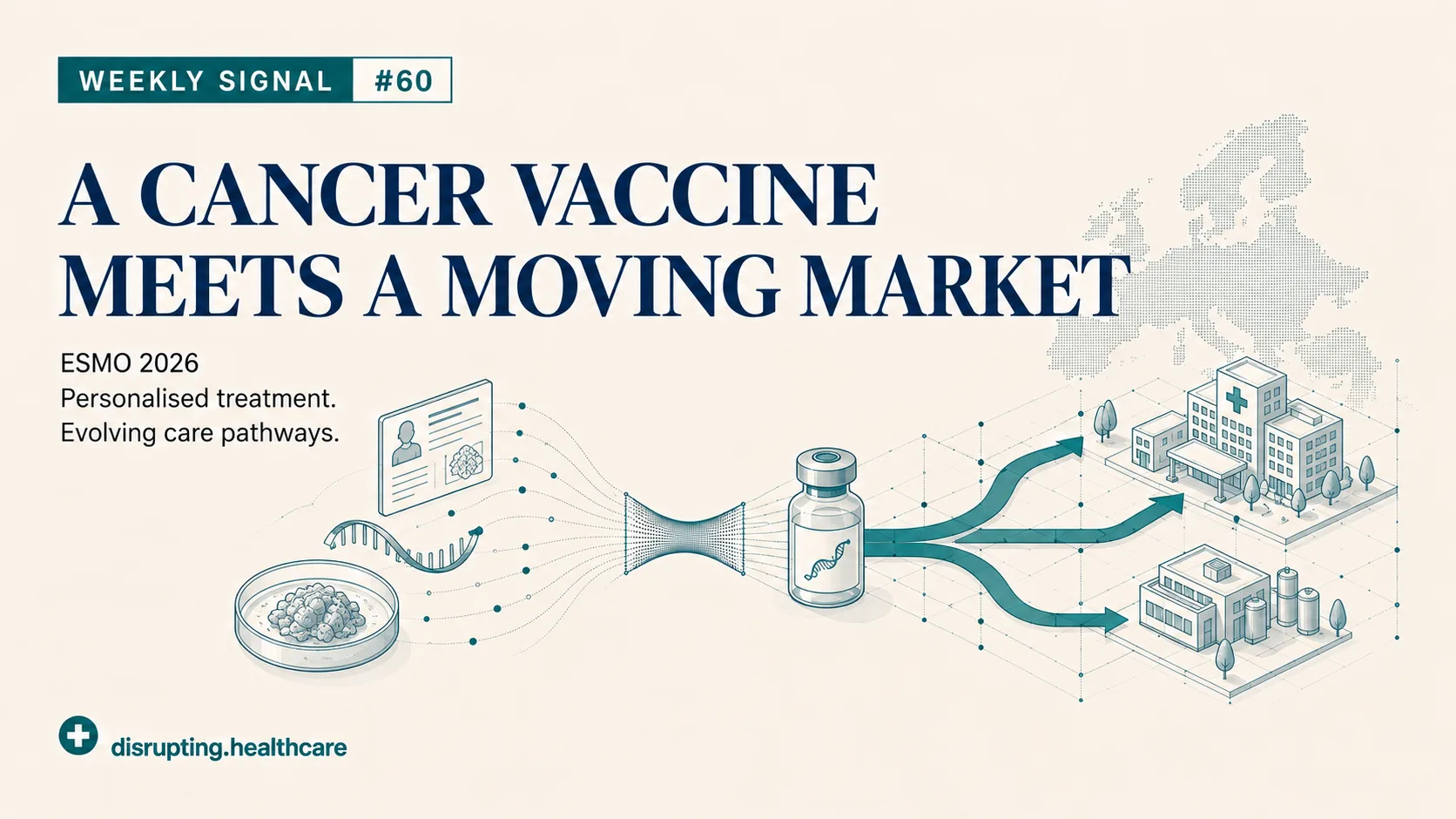
Europe Life Sciences Weekly Signal #60: Moderna’s Cancer Vaccine Meets a Moving Market

Week of 19–25 October 2026 · Evidence checked on 25 October · 4-minute read
Positive melanoma data put treatment sequencing, patient selection and personalised production at the centre of the launch case.
A positive cancer-vaccine trial and a falling share price can both be rational signals. On 22 October, Moderna closed 17.6% lower as detailed results for its personalised melanoma therapy, developed with Merck/MSD, emerged ahead of ESMO. The market reaction makes this a story about expectations as well as clinical progress. Moderna price history.
For commercial leaders, the useful question is where this treatment would earn its place. The addressable market depends on patients’ route through care, the alternatives available at that moment and the cost of delivering an individualised medicine.
What the melanoma result establishes
In the 1,137-patient INTerpath-001 trial, intismeran autogene plus pembrolizumab reduced the hazard of recurrence or death by 42% versus pembrolizumab alone (HR 0.58; 95% CI 0.45–0.75). Patients had completely resected stage IIB–IV melanoma: this was adjuvant treatment after surgery. Two-year recurrence-free survival was 82.2% versus 70.0%, an absolute difference of 12.2 percentage points. INTerpath-001 results.
That is a substantial result, with boundaries. Overall-survival data remain immature, and intismeran is investigational. Grade 3–5 treatment-related adverse events occurred in 14.2% versus 13.4% of patients. This melanoma trial does not establish benefit across other cancers. INTerpath-001 results.
The personalised component matters. Intismeran uses mRNA instructions tailored to an individual tumour’s mutations to direct an immune response; pembrolizumab releases a brake on that response. The proposition is to reduce recurrence risk after visible disease has been removed. Moderna scientific explanation.
A prespecified sensitivity analysis also found a greater treatment effect after six months. Longer follow-up will matter. The primary result remains the 42% reduction across the intention-to-treat population; the later-period estimate answers a different question. Moderna scientific explanation.
The alternative may begin before surgery
The competitive debate includes neoadjuvant immunotherapy: treatment before surgery. In NADINA, published in 2024, patients with resectable, macroscopic stage III melanoma received ipilimumab plus nivolumab before surgery, followed by treatment based on pathological response. Event-free survival improved versus surgery followed by nivolumab, and patients with a major pathological response could avoid postoperative drug therapy. NADINA trial.
That creates a commercial question about the whole course of care: which patients would receive an additional personalised treatment after surgery, and what incremental benefit justifies its burden and cost? It does not establish that neoadjuvant treatment outperforms intismeran. The trials enrolled different populations and used different endpoints; their headline percentages cannot settle that comparison.
An incidence-based forecast would miss this distinction. I would separate patients whose disease supports a presurgical treatment decision from those reaching systemic treatment decisions after resection. For a European launch, the intended patient group, country-level practice and reimbursement assumptions need to be explicit.
Amgen changes a different treatment decision
Amgen’s DeLLphi-305 result deserves attention in its own right. Adding tarlatamab to durvalumab as first-line maintenance in extensive-stage small-cell lung cancer produced estimated median overall survival of 21.1 months versus 12.7 months (HR 0.42) at a prespecified interim analysis. Patients had not progressed after initial chemoimmunotherapy. Survival was measured from maintenance randomisation. This is an overall-survival result in advanced disease, distinct from post-surgical melanoma. DeLLphi-305 paper.
Delivery belongs in that opportunity assessment. Cytokine-release syndrome occurred in about half of patients receiving the combination, mainly grades 1–2. That makes sites’ monitoring capacity and referral arrangements relevant to commercial planning for earlier use, subject to approval. Amgen trial and monitoring details.
Build the forecast around deliverable care
Moderna reports successful manufacture for more than 99% of patients randomised to receive intismeran. That is encouraging evidence from a large trial. Routine commercial volume, cost and turnaround remain questions for the operating model. Moderna scientific explanation.
For a personalised vaccine, delivery begins with an individual tumour sample and a product designed for that patient. My operating recommendation is to make the launch leader accountable for a forecast built jointly with medical, market access and supply. The model should expose assumptions about suitable samples, production turnaround, centre readiness and treatment completion.
The economic case should include the full treatment cost and uncertainty around recurrence, subsequent therapy and longer-term survival. Potential avoided costs require evidence; they are not savings already delivered. Manufacturing and service capacity committed to launch should follow what can be justified for the intended patient group.
The next evidence that would change my view is longer phase III follow-up, clearer positioning against evolving care, and credible routine-care production performance. Other tumour programmes need their own proof.
For the next oncology launch review, I would ask one question: which assumption about the patient pathway could change the revenue forecast most?
Analysis of public evidence available on 25 October 2026. Commercial implications are the author’s interpretation.
