Categories
Uncategorized

Europe MedTech & Digital Health Weekly Brief (Week of Dec 6–12, 2025, #18)

Deal flow picked up: cardiology workflow hardware gets a seasoned chair, obesity tech hits a pivotal milestone, and Europe leans into AI—from a €10m cross-border programme to NICE nudging digital MSK tools forward.

People on the move

CathVision (Denmark): Eric Thepaut (ex-Boston Scientific EMEA) becomes independent chairman; company also ships ECGenius v3.5 to tighten EP lab workflows.

Money Flows

• New funds that will touch healthtech: University2Ventures (U2V) closes first tranche of a €60M fund for European university spin-outs; KBC launches a €100M Start it Fund for Belgian startups from idea to IPO.

Xeltis (NL/CH): €40.3M equity + €9.7M debt (convertible loan + venture debt); to scale restorative cardiovascular implants and advance clinical programs.

FICUS Health (DE): €3M Seed; AI documentation automation for rehabilitation clinics to cut admin time and integrate with German data standards.

Punto Health (UK/ES): $2.7M Seed; building a speech-AI “OS for dementia care,” with pilots across NHS and Spanish centres.

ONEHEALTH (NI/ROI): €10M cross-border programme backed by PEACEPLUS to support AI/digital health projects and SME pilots over four years.

On the press

• NICE moves digital MSK forward — Early Value Assessment for digital tools managing mild-to-moderate hip/knee osteoarthritis reached “Resolution,” with publication due Jan 22, 2026. Signal to SaMD teams: evidence + value proposition now.

Nitinotes (IL/EU) hits pivotal first-patient milestone for EndoZip automated ESG; follows recent CE Mark enabling EU launch. Good read on automation entering bariatric endoscopy.

One thing to remember

The week says “AI with outcomes”: capital is flowing to workflow AI and documentation relief while public funding and NICE processes create room for evidence-led digital rollouts—set your 2026 plan to pair clinical claims with operational ROI and real-world pilots across EU/UK sites.

Categories
Uncategorized

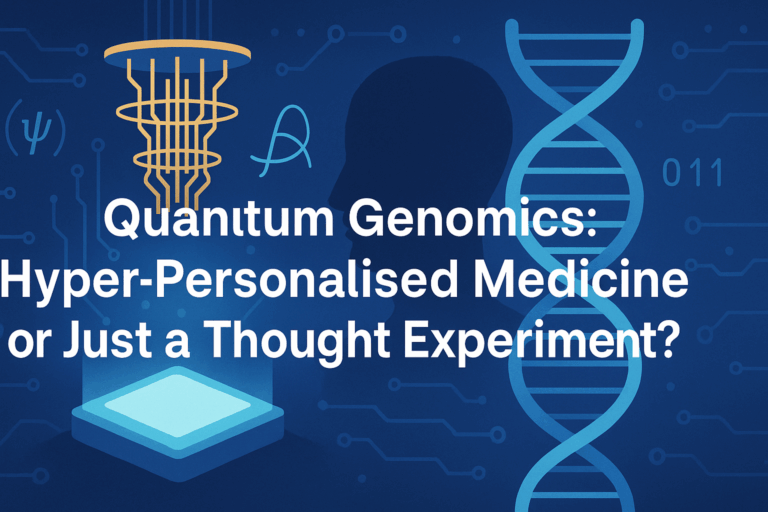
Quantum Genomics: Hyper-Personalised Medicine or Just a Thought Experiment?

The Promise

Genomics is drowning in data. A single human genome contains over 3 billion base pairs, and personalised medicine requires mapping not just one genome but entire populations. Quantum algorithms promise to search and analyse these vast datasets faster than classical methods, identifying subtle gene–disease correlations that underpin cancers or rare conditions.

The pangenome revolution — shifting from one reference genome to mapping genetic diversity across populations — is a perfect candidate. Projects like the UK’s Wellcome Leap Quantum for Bio Challenge are exploring how quantum algorithms might tackle these graph-based models of DNA diversity.

The Reality

The problem isn’t theoretical speedups — it’s practical execution. Encoding massive genomic datasets into qubits is an overhead that dwarfs today’s hardware capabilities. A 2025 systematic review of nearly 5,000 papers found no consistent evidence that quantum machine learning outperforms classical approaches in genomics under real hardware conditions.

For now, genomics is more likely to benefit from quantum-inspired algorithms — classical methods borrowing quantum principles — which can already improve efficiency in sequence analysis without the qubit noise.

The European Edge

Europe has something the US and China don’t: regulation as infrastructure. The planned European Health Data Space (EHDS) aims to harmonise access to clinical and genomic data across member states. Combined with Horizon Europe funding and the Quantum Technologies Flagship’s investment in bioinformatics tools, the EU is building the pipes through which future quantum genomics must flow.

GDPR and the upcoming AI Act also matter: any quantum-enabled diagnostic will be a high-risk AI system, forcing developers to bake in explainability, bias monitoring, and security from day one. That makes EU-born solutions more exportable in a world increasingly wary of black-box healthtech.

Strategic Takeaway

Quantum genomics is not tomorrow’s clinic-ready technology. But Europe’s bet should be clear:

  • Short-term: focus on quantum-inspired tools that deliver efficiency now.
  • Mid-term: fund pilots like pangenome analysis that prove “quantum utility.”
  • Long-term: leverage EHDS + quantum infrastructure for hyper-personalised care.

Europe’s advantage is not just in building qubits, but in building the trusted, regulated data ecosystems where quantum genomics can eventually thrive.