
Europe Life Sciences Weekly Signal #55: Europe Has Changed the Biosimilar Entry Model

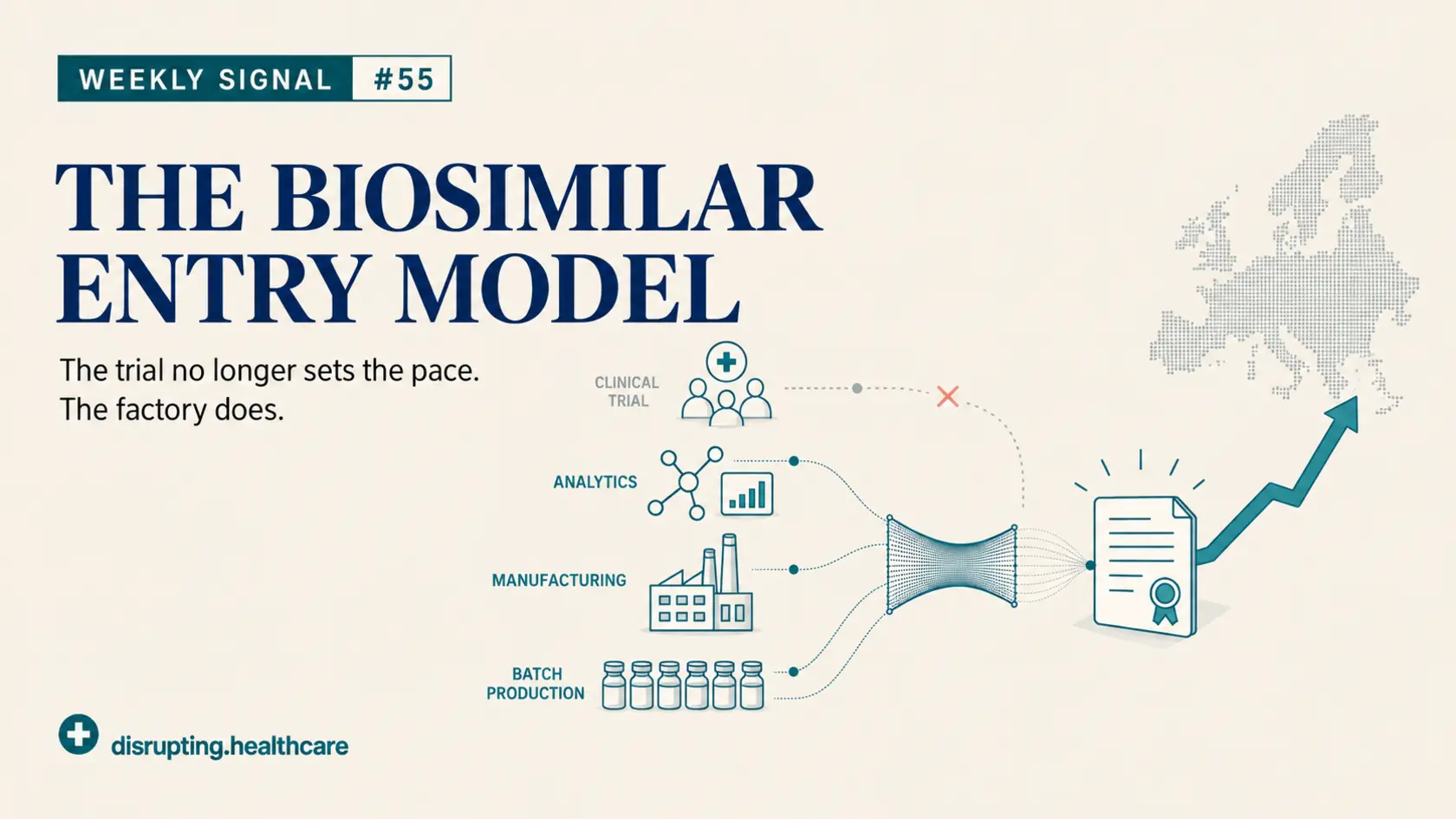
Europe has recommended its first biosimilar under a pathway that no longer expects a comparative efficacy trial as the default. The evidence burden has moved into analytics and manufacturing, and the next wave of entrants is already being designed that way. Loss-of-exclusivity plans built on the old entry model need re-testing.
The signal: one molecule, two evidence routes
On 17 September, the European Medicines Agency’s human medicines committee (CHMP) recommended Pebrilzo, a biosimilar of Roche’s breast cancer antibody Perjeta (pertuzumab), for approval. EMA described it as the first biosimilar recommended following its tailored clinical approach.
Pebrilzo will not be Europe’s first pertuzumab biosimilar. The European Commission approved Henlius and Organon’s Poherdy in April, on a package the companies said included comparative clinical studies. Same reference product, two evidence routes, five months apart.
The new route comes from a reflection paper CHMP adopted on 16 March. Comparative efficacy studies are no longer expected for biosimilars that can be thoroughly characterised with state-of-the-art analytical methods, and EMA expects the approach to apply to most candidates. A comparative pharmacokinetic study remains essential. The full reflection paper is available from EMA.
This is not “less evidence”. The waiver requires a well-understood mechanism of action, orthogonal analytical and functional characterisation, a validated manufacturing process and control strategy, and a similarity assessment plan fixed before the data arrive. The comparison should rest primarily on commercial-scale product: usually six or more biosimilar batches against at least ten reference batches, with 15 to 30 often optimal. Where analytics are not sensitive enough or the mechanism is poorly understood, the waiver is not acceptable.
The operator’s take: the moat moves from the trial budget to the plant
The interesting story is rarely the announcement; it is what the announcement reveals about the operating layer underneath. Here, that layer is the plant and the analytical laboratory.
The European Commission’s staff working document accompanying the European Biotech Act puts numbers on the old model. Between 2012 and 2022, all 36 monoclonal antibody and fusion-protein biosimilar applications included a Phase III comparative efficacy study, yet in no case did the clinical data determine the regulatory decision. Each study cost an estimated €19–26 million and added 12 to 24 months. European Commission, SWD(2026) 450.
Remove the trial and the barrier shifts to capabilities the trial budget used to mask: running a commercial-scale process early, sampling the reference product over time, and deciding in advance what happens when a critical quality attribute falls outside range.
The same document models the consequence. Assuming wide use of the tailored approach, it projects 35 to 55 biosimilar applications a year in 2030–2038, with 70–80% using a waiver and net industry savings of €293–700 million a year. These are scenarios, not forecasts. Manufacturing cost, tender prices, intellectual property and national uptake still decide whether a biosimilar earns a return.
The operating-model implication: the next wave is already in scientific advice
One figure in the Commission’s document deserves attention. In 2025, more than 70% of EMA’s adopted scientific-advice procedures for biosimilars incorporated a tailored clinical approach, while about 8% of biosimilar applications submitted that year proposed one.
I read that gap as a lead indicator, not proof of what every programme will eventually file. Scientific advice comes before submission, so many candidates likely to reach EMA over the next few years are already being designed without an efficacy trial.
For originators, this matters twice. Exclusivity and patents still set the earliest launch date, but a cheaper, shorter programme can leave more entrants ready on that date, including late starters that older analogues would have ruled out. The most visible early warning, a registered equivalence trial in patients, may also be replaced by a pharmacokinetic study that is shorter and easier to miss.
The queue is observable if someone is looking. EMA’s September list of applications under evaluation included two for pertuzumab: Pebrilzo and another whose evaluation began in June.
For a European brand facing loss of exclusivity within five years, I would change four things:
- Re-test entrant scenarios against the tailored pathway, not against analogues in which every serious competitor carried a Phase III trial.
- Broaden the intelligence routine. Trial registries still matter; add EMA’s monthly under-evaluation list and pharmacokinetic-study registrations.
- Make ownership explicit. Regulatory intelligence surfaces the signal, market access turns it into tender and pricing scenarios, and commercial leadership owns the integrated erosion forecast.
- Bring supply into the same review, because a different entrant pattern changes inventory and transition planning.
The route will not fit every molecule, and a positive opinion does not guarantee uptake. But the right response is not to update the regulatory slide. It is to re-test the erosion curve.
Last week’s Signal examined how clinical opportunity becomes funded care at launch. This week’s lesson sits at the other end of the lifecycle.
When the efficacy trial becomes optional, the manufacturing process becomes the evidence. Plan for more competitors at loss of exclusivity, with less warning, than your analogues assume.
Independent analysis by Piotr Wrzosinski. Developed with AI assistance for research, source checking and editing. Sources are linked. Commercial scenarios and operating-model recommendations are the author’s interpretation of public evidence.
