
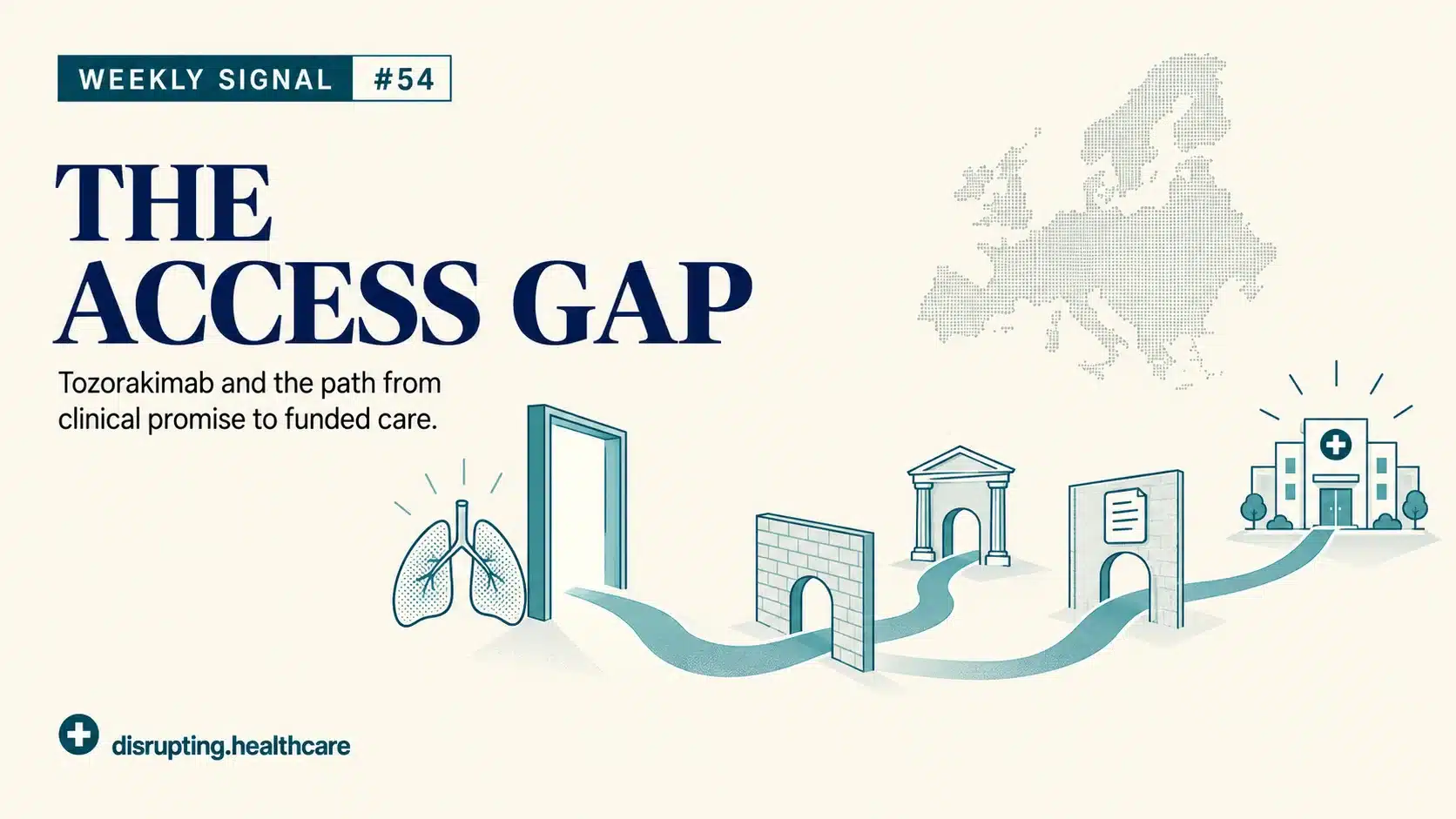
Europe Life Sciences Weekly Signal #54: Tozorakimab and the Gap Between Eligibility and Access

Week of 7–13 September 2026 · Evidence checked through 12 September · 5-minute read
AstraZeneca’s COPD results strengthen the case for treating patients beyond today’s biomarker-defined populations. Launch forecasts still need to account for reimbursement, clinical assessment and service capacity.
The signal: broader COPD evidence, an unsettled market
A successful trial can expand the potential market overnight. The capacity to treat that market takes longer to establish.
On 8 September, AstraZeneca presented detailed Phase III results for tozorakimab, its investigational chronic obstructive pulmonary disease (COPD) biologic, at the European Respiratory Society Congress. The results were also published in the New England Journal of Medicine. Positive headline findings had been announced in March; this week added detail for evidence and launch planning. AstraZeneca announcement.
OBERON and TITANIA tested tozorakimab against placebo, added to inhaled maintenance therapy, in patients with a history of exacerbations. Enrolment did not require elevated blood eosinophils. In former smokers, the primary population, moderate or severe exacerbation rates fell by 29% and 34%. Across current and former smokers, the reductions were 30% and 29%. These trials establish neither superiority over another biologic nor a mortality benefit. Trial publication.
AstraZeneca also reported pooled results by baseline eosinophil count:
| Blood eosinophils, cells/µL | Reported reduction in moderate or severe exacerbation rate versus placebo |
|---|---|
| Below 150 | 23% |
| 150 or above | 34% |
| 300 or above | 43% |
The last two groups overlap: patients at 300 or above are also included in the 150-or-above group. These point estimates alone do not establish statistically different treatment effects between subgroups. Company-reported pooled analysis.
Tozorakimab remains under EU review. AstraZeneca reports US Priority Review using a voucher, with a decision date anticipated in Q1 2027. Its eventual European indication and reimbursement conditions remain unresolved. Regulatory update.
The operator’s take: model the funded population separately
The competitive context matters. Dupixent and Nucala already have EU COPD indications specifying raised blood eosinophils and inadequate control on specified inhaled treatment. Nucala’s approval came in February 2026. Those are regulatory indications, not evidence of uniform funding across Europe. EMA: Dupixent; GSK: Nucala approval.
A plausible scenario is that reimbursement for a future broader indication could still favour particular subgroups. But the largest relative reduction does not automatically identify the best value for money. Baseline risk, absolute benefit, uncertainty, alternatives, price and treatment costs all affect that calculation.
My commercial reading is therefore to build separate access scenarios before committing to a single uptake curve. Model broader and narrower funded populations, then specify what evidence would support each. A manufacturer can prepare those scenarios; it cannot decide the payer’s answer.
England supplies a concrete example of the work beyond reimbursement. NHS England’s COPD biologics guidance describes specialist assessment, supervised initial dosing, self-administration support and subsequent reviews. Its model places the initiation decision at week 52, assuming diagnosis and optimisation beforehand. That is a planning assumption, not a mandatory year-long wait for every patient. The pathway allows local adaptation. NHS England business-case guidance.
This guidance predates the tozorakimab results and does not specify its future pathway. Its relevance is operational: a treatment needs a service that can initiate and support it. England’s model illustrates that requirement; it does not establish how every European market will respond.
The operating-model implication: forecast four populations
A useful launch review should distinguish four populations rather than move directly from epidemiology to revenue:
- Potentially eligible: patients within a clearly stated regulatory scenario, later updated to the approved indication.
- Identifiable: patients who can be recognised through routine clinical processes, with relevant treatment and exacerbation histories available.
- Assessed and funded: patients who can complete the necessary clinical assessment and obtain reimbursed access.
- Initiated and retained: patients whom the service can start, support and review over the forecast period.
For each transition, record the evidence behind the assumption, the time required, and the capacity available. Medical should own the scientific interpretation, market access the reimbursement scenarios, and commercial leadership the resulting forecast. Providers retain responsibility for individual patient identification and treatment decisions. Appropriate aggregate information can inform planning without transferring patient-level records to commercial teams.
Then allocate resources according to the constraint. If assessments are delayed, more awareness may generate a queue. If appropriate referrals are incomplete, additional specialist promotion may achieve little. If funded access is narrow, a larger audience estimate cannot compensate for the missing economic case.
The constraint will vary by market. Existing services may absorb demand quickly, especially with compelling evidence and an attractive price. Where that is supported locally, the forecast should reflect it. Capacity is something to establish, not assume absent or unlimited.
Last week’s Signal examined the enterprise decisions behind pricing. This week’s lesson sits closer to the patient: the launch forecast must connect clinical opportunity to funded, available care.
A broader trial population creates an opportunity. The launch plan earns its credibility by showing how appropriate patients can reach treatment.
Independent analysis by Piotr Wrzosinski. Views are my own. Developed with AI assistance for research, source checking and editing. Sources are linked. Commercial scenarios and operating-model recommendations are the author’s interpretation of public evidence.
