
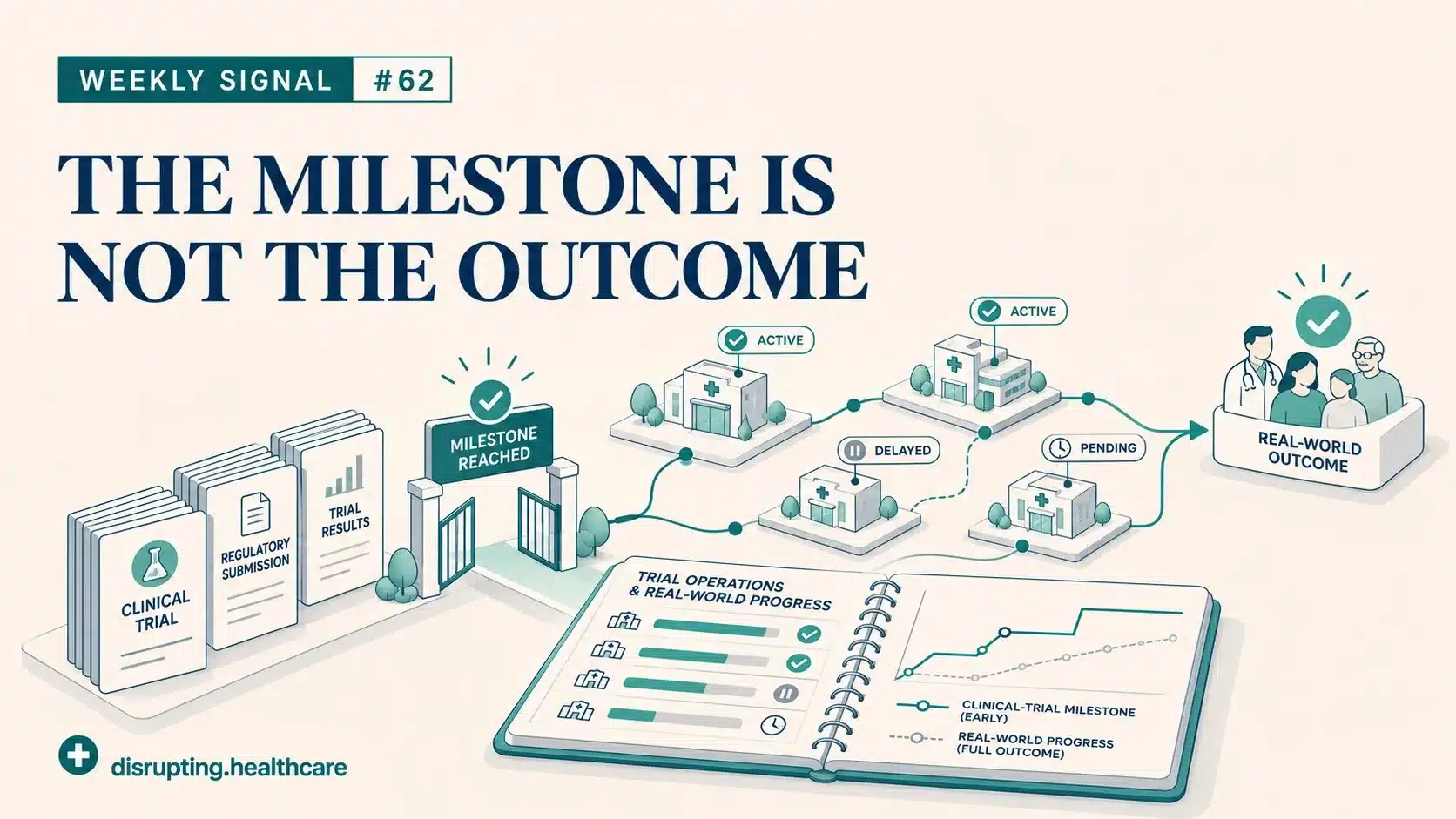
Europe Life Sciences Weekly Signal #62: The Milestone Is Not the Outcome

Week of 2–8 November 2026 · Evidence checked 8 November · 7-minute read
The UK is approving and starting clinical trials faster, yet industry recruitment keeps falling. Two cardiovascular programmes moved their intended biomarkers without improving clinical outcomes. A prevention study shows why measuring the right intermediate step can still matter.
The most dangerous metric in a life-sciences dashboard is not necessarily an inaccurate one. It is a correct number promoted into proof of a result it does not measure.
This week brought three different versions of that problem: an NHS trial system getting faster at its first milestone, two late-stage cardiovascular programmes demonstrating powerful biological effects without the expected patient benefit, and a long-acting HIV prevention study testing whether people can stay on treatment. The distinction is not academic. It changes what can legitimately go into a launch plan, a payer case and an investment forecast.
UK clinical trials: faster at the first site, still losing participants
On 5 November, the Association of the British Pharmaceutical Industry (ABPI) published its 2026 annual clinical trials report. It is tempting to read the headline as an argument about slow regulation. The data tell a more interesting story.
In August 2026, 100% of combined regulatory review decisions were made within 60 days. The published approval clock pauses while a sponsor answers regulatory queries, so it is not the full elapsed time from submission to decision. For the selected group of higher-recruiting commercial trials covered by the government’s set-up measure, median time to the first patient at the first site fell to 112 days in 2025/26, from more than 250 days in 2022. That benchmark covers roughly a quarter of commercial interventional trials, not the full portfolio. The UK Health Research Authority also reports progress, citing 100 days for January–March 2026; it is a different reporting period, not a contradiction.
But recruitment to commercial contract trials in the NHS fell for a fifth consecutive year, to 17,618 people in 2025/26, down from 19,507 the previous year. Those studies accounted for just 3.8% of all interventional research participants, compared with 13.2% in 2017/18. Overall interventional trial participation has grown over the recent period; the commercial share has not.
The gap becomes visible when the measurement moves past the first site. In 2025, only 35% of commercial studies opened to recruitment within 60 days of regulatory approval, against a 90% target. Only 53% enrolled their first participant within 30 days of opening.
The ABPI also publishes a comparison of selected phase II–III trials from 2024, measuring time from first-site opening to all sites opening: 210 days in the UK, 126 in Spain, 113 in France and 144 in Poland. These are medians from different selected trial portfolios, not a controlled ranking of otherwise identical studies. They nevertheless highlight the management question missing from a first-site-only dashboard: how long does the rest of the network take to become usable?
This is not exclusively an NHS execution failure. The ABPI notes that part of the interval between site confirmation and readiness includes sponsor preparation. Dedicated commercial research centres show encouraging early results, but their performance is not a randomised test of what caused the improvement. The operational task is to separate sponsor-controlled waiting time, site capacity and recruitment capability, then give each a named owner.
For a commercial leader, the analogy to a product launch is useful as an analogy, not as evidence that trial geography determines sales. Marketing authorisation, national reimbursement and the first treated patient matter. So do the delays before subsequent eligible patients can be identified, referred and treated. If the plan measures only its first milestone, it can miss the distribution of access across the system.
Cardiovascular trials: two biomarkers move, outcomes do not
The American Heart Association’s 7 November presentations offered a sharper example of the same distinction. The phase III Lp(a)HORIZON trial tested Novartis and Ionis’s pelacarsen in more than 8,300 adults with elevated lipoprotein(a) and established cardiovascular disease. Lp(a) levels fell by approximately 78%. The trial did not demonstrate fewer major adverse cardiovascular events.
In ZEUS, Novo Nordisk’s ziltivekimab reduced free interleukin-6 by around 76% and high-sensitivity C-reactive protein by 64%, relative to placebo. But the primary cardiovascular event occurred in 17.6% of participants receiving the medicine and 17.7% receiving placebo (hazard ratio 0.99). The full AHA readout details a large effect on inflammatory measures without the hoped-for clinical effect.
Neither failure was first disclosed this week: Novo announced the ZEUS top line in July, and Novartis announced the Lp(a)HORIZON miss in September. What changed on 7 November was the depth of published evidence, not the direction of the result. Nor do these findings invalidate Lp(a) or inflammation as biological pathways across other therapies, doses or patient populations.
For pipeline and portfolio decisions, the distinction is expensive. A biomarker effect can justify research and a trial hypothesis. It cannot, on its own, support a demonstrated patient-benefit claim, a reimbursement premium or a launch forecast built on an outcome that the pivotal study did not show.
HIV prevention: a measure closer to the behaviour that matters
The contrast is Gilead’s PURPOSE 5 study, reported on 6 November. In the randomised, open-label phase II study in France and the UK, 85.6% of assessed participants receiving twice-yearly injectable lenacapavir remained persistent with pre-exposure prophylaxis at 52 weeks, versus 46.3% receiving daily oral emtricitabine/tenofovir disoproxil fumarate. That is a 39.3-percentage-point difference in the reported analysis (154/180 versus 37/80).
PURPOSE 5 was designed to compare persistence, not to establish superiority in HIV-incidence prevention. Zero infections were observed in the injectable group and one in the oral group, but those counts are not a head-to-head efficacy conclusion. The study also assessed persistence differently for the two regimens, using on-time visits and injections for one and drug-level measures for the other.
The finding is relevant because sustained use is part of the real prevention problem. It does not remove the need to plan for clinic appointments, follow-up testing, reliable supply, affordability and equitable access. A dosing advantage becomes a population-health advantage only if the service model can sustain it.
One European access checkpoint worth separating
On 6 November, the European Commission published the joint clinical assessment (JCA) of AstraZeneca’s camizestrant, marketed as Etcamah. EU marketing authorisation was granted on 20 July, and the JCA was endorsed on 19 August. Publication this week was a new public evidence milestone, not a fresh approval or national reimbursement decision.
The operating implication is familiar: common European clinical assessment helps structure evidence, while country-level appraisal, funding and patient access remain separate decisions. A launch plan should not compress them into one green status.
Practitioner’s lens: measure the whole path to value
The UK trial report and the AHA readouts are not the same kind of evidence. One measures system performance; the others test clinical hypotheses. They expose the same governance error when an intermediate result is allowed to stand in for the outcome that matters.
For 2027 planning, I would make every material metric pass three tests. First, name what the number actually measures: first site, all sites, biomarker, persistence, clinical event or reimbursed patient. Second, specify the decision it can support today, without borrowing certainty from a later step. Third, identify the remaining pathway and its accountable owners, including where the sponsor, provider, payer or patient must do something before the intended benefit exists.
That leads to different dashboards. Trial operations need activation distributions and recruitment, not only first-patient dates. Portfolio reviews need an explicit boundary between biological signal and proven outcome. Prevention launches need persistence alongside coverage and service capacity. European launches need distinct regulatory, clinical-assessment and country-access milestones.
The question for a 2027 investment review: which impressive number on page one is still several decisions away from the result on page ten?
Analysis based on public primary sources available on 8 November 2026. Interpretations about commercial planning and operating models are editorial judgments, not claims made by the source organisations. Research and editing were supported by AI tools; the source claims were checked. Views are personal.
Previous issue: Weekly Signal #61: Four Pharma Results, One Budgeting Question.
About the author. Piotr Wrzosinski is a life sciences commercial transformation leader with more than 20 years of experience across pharma, MedTech and consulting. He writes independently about operating models, market access, AI and commercial transformation in Europe.
