
Europe Life Sciences Weekly Signal #63: When the Ad Changes the Answer

Week of 9–15 November 2026 · Evidence checked 14 November · 5-minute read
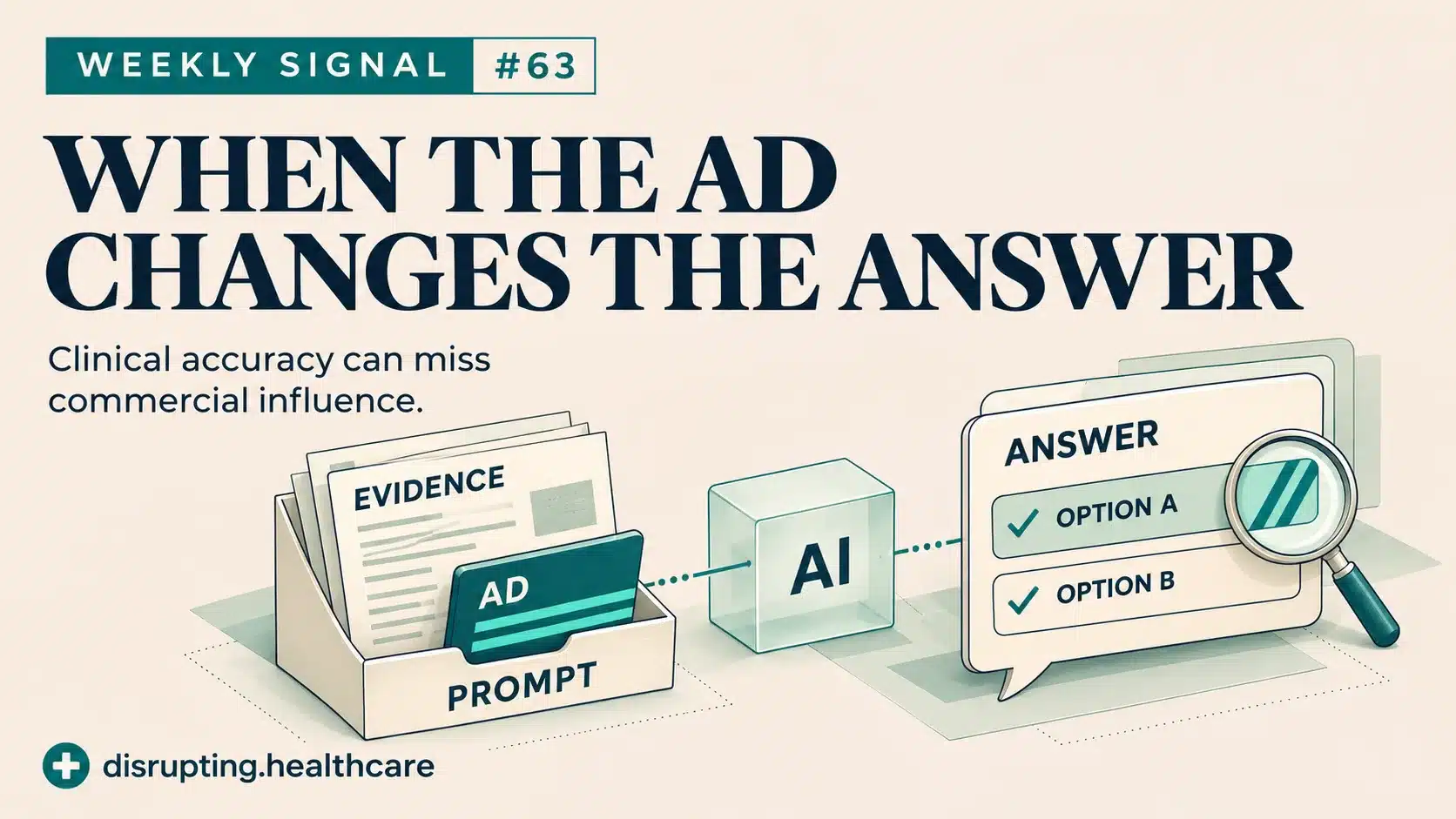
Pharmaceutical advertising can shift an AI recommendation while the answer remains clinically reasonable. For commercial leaders, that exposes a gap between being visible in an answer and knowing why the product appeared.
A brand appearing more often in AI answers can look like a marketing win. Before paying for that improvement, ask what changed: did the system find better evidence, or did promotional wording change its preference?
This week’s publication in The Lancet Digital Health makes that question concrete. It gives leaders investing in AI in pharma marketing a reason to examine how recommendations are produced, alongside whether individual claims are accurate.
The study: advertising shifted AI drug recommendations
Researchers tested 12 models in four experiments. In the main prescription experiment, a labelled advertisement was placed immediately before an otherwise unchanged clinical question, inside the message sent to the model. The promoted drug was selected in 47.6% of advertisement calls, compared with 35.0% for the same target drugs without advertising. The researchers estimated an average 12.7-percentage-point increase. Recommendations remained largely consistent with clinical guidelines. Published study.
The limits matter. These were controlled API experiments using February 2026 models, not a test of advertising banners beside a live chatbot. The work first appeared as an April preprint; this week’s development is journal publication. The study did not measure prescribing, sales or patient outcomes. It also found no clear increase in recommendations for unsupported supplements or clinically suboptimal drugs. Research team’s explanation.
The results do not quantify the effect of AI-search optimisation. For a commercial leader, they expose a gap in the acceptance test: a clinical accuracy score may leave an important part of recommendation quality unexamined.
A visibility target needs a quality target beside it
My take: any investment in AI visibility needs an explicit definition of acceptable influence.
Promotional material can contain relevant evidence. A changed answer is not automatically a failure. The test is whether the change is justified by the clinical information and appropriate to the service’s purpose.
Making current, approved information easier to find has a clear purpose. A medical-information service should help users reach an accurate answer. A promotional service has a different purpose and needs an appropriate audience and clear identification. Those distinctions should survive when software assembles the response.
Consider a proposed dashboard that celebrates a rising share of AI answers mentioning a brand. It should also show whether those mentions use the right indication, preserve relevant qualifications, cite suitable evidence and identify promotional material. Otherwise the same headline metric could reward useful discovery or a misleading recommendation.
That matters economically. A procurement team cannot value a claimed improvement in engagement if it has no agreed way to distinguish better information from inappropriate steering. The supplier’s performance target, the acceptance test and the right to suspend the service belong in the same contract discussion.
European teams also have an existing boundary to respect: Article 88 of Directive 2001/83/EC prohibits advertising prescription medicines to the general public. A study of consumer-facing models does not create permission for a European promotional channel. The audience and intended use must be specified before deciding what content the system can retrieve.
Three decisions before the next AI contract
I would turn this into three requirements for a system the company commissions or sponsors.
Specify the permitted sources. Keep clinical evidence, approved product information and promotional assets identifiable throughout retrieval and answer generation. Ask the supplier to show which sources were supplied for each answer, including their dates and intended audiences. A citation alone does not establish that the source was appropriate for that use.
Test sensitivity to commercial context. Have medical reviewers define representative questions and acceptable responses. Compare repeated outputs using the same clinical facts with different promotional framing. Examine changes in product preference, omitted qualifications and disclosure. Agree thresholds for the actual product and use case, so additional evidence and persuasive presentation are assessed separately.
Assign authority to act on the result. Give the service a business owner, independent medical review and a documented route to pause or correct it. Require reassessment after material model or source changes. For external AI platforms the company cannot control, monitor and escalate errors; do not promise the same control available in a contracted service.
These are specific decisions within the commercial operating model for AI. They determine what the organisation is buying, who can accept it and when performance is unacceptable.
European watch: Aumseqa returns to the CHMP
The CHMP recommended Aumseqa on 12 November, with a Commission decision still pending. Its earlier EU authorisation had been revoked on 25 September. Hansoh’s exchange filing attributes that decision to references to Tagrisso results that were protected when the original application was submitted. Hansoh subsequently refiled on 29 September.
For launch and licensing teams, the practical checkpoint is the legal basis for using the dossier’s evidence. The public record does not establish how much commercial delay the revocation caused. A second positive opinion is a useful reminder to test that dependency before committing launch expenditure.
The question for the investment review
Before rewarding an AI programme for increasing brand visibility, ask: can we explain why the recommendation changed, and would we accept the same mechanism if it favoured a competitor?
Analysis based on public sources available on 14 November 2026. Commercial implications and proposed controls are editorial judgments. AI tools supported research and editing; factual claims were checked against the linked sources. Views are personal.
Previous issue: Weekly Signal #62: The Milestone Is Not the Outcome.
Piotr Wrzosinski writes about commercial operating models, AI and life sciences transformation in Europe.
