
Europe Life Sciences Weekly Signal #64: The $4 Billion Adoption Test

Week of 16–22 November 2026 · Evidence checked 22 November · 5-minute read
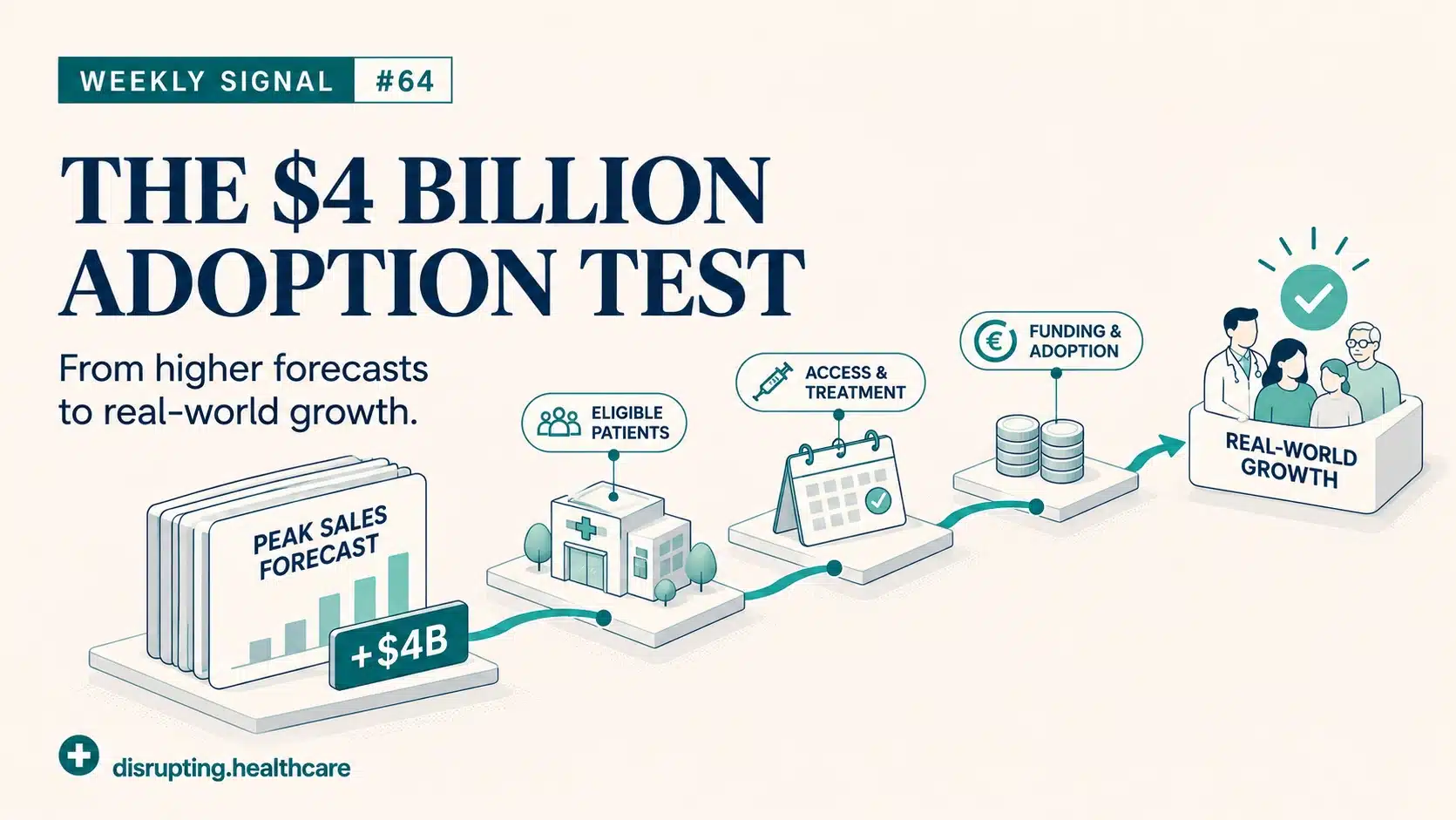
Novartis has increased the peak-sales forecasts for three marketed medicines by a combined $4 billion. Its CEO reportedly credited commercial traction rather than new clinical data. The question for 2027 planning is what must change between an improved forecast and a patient receiving treatment.
At its London investor event on 19 November, Novartis raised forecasts for Kesimpta, Scemblix and Leqvio while projecting approximately 5% annual sales growth at constant currencies through 2031. Stronger expectations for individual products do not remove loss-of-exclusivity pressure elsewhere.
The signal: $4 billion more peak potential, not $4 billion in sales
Novartis’s disclosure raised Kesimpta’s peak annual sales forecast from $6 billion to $8 billion, and both Scemblix and Leqvio from $4 billion to $5 billion. That is a $4 billion aggregate increase in product-level peak forecasts—not realised revenue, not a 2027 sales target and not necessarily peaks occurring in the same year.
According to Fierce Pharma’s account of the event, CEO Vas Narasimhan attributed the upgrades to commercial traction rather than new clinical data. The company’s formal release confirms the revised numbers but does not independently explain the change in those terms.
Fierce reports Scemblix approaching 50% of US new-to-brand share in first-line chronic myeloid leukaemia—an adoption indicator, not overall market share or a European forecast.
The new 5% projection covers 2026–2031, rather than the earlier 5–6% range for a different forecast period. Novartis also expects its largest loss-of-exclusivity impact in 2026. Individual brand upgrades must be understood against that erosion.
The operator’s take: patients encounter a pathway, not a forecast
A peak-sales forecast is partly a statement about clinical value and market opportunity. For a product already approved, it is also a set of assumptions about who starts treatment, who stays on it and whether the care system can deliver it.
Leqvio makes that distinction tangible. After initiation and a dose at three months, maintenance injections are given every six months by a healthcare professional. The commercial system must connect eligible-patient identification, referral, administration appointments, funding and follow-up.
In 2021, Novartis and NHS England announced a community-based population-health approach that aimed to treat around 300,000 eligible patients over three years. That was an ambition stated at the time, not evidence that the target was met.
Fierce now reports work on an autoinjector. Such a device could eventually change where or by whom treatment is administered, but it is not an approved change to the European care model. Leqvio already has a pre-filled syringe presentation and the current EU product information specifies healthcare-professional administration.
A new presentation may require evidence, authorisation, reimbursement, training and patient support before changing adoption. Development work alone cannot justify adding that benefit to a forecast.
Nor does US prescribing share transfer unchanged to Germany, France or Poland. Eligibility, care pathways, funding and capacity must be modelled country by country.
Three decisions worth making in 2027 brand planning
1. Show the bridge from run-rate to peak. Separate assumptions for eligible patients, new starts, persistence, net price, indication expansion and market access. For each material growth driver, identify the evidence, country-level milestone and accountable owner. Do not count an expanded eligible population as treated patients.
2. Treat a change in administration as a new access case. If a product presentation changes, assess who can give it, where the patient goes, what the provider must learn and who pays. Work through regulatory status and country funding before adding an adoption benefit to the base case.
3. Allocate investment against the remaining opportunity. Compare the incremental return from each intervention with its cost, timing and loss-of-exclusivity exposure. The question is not only how much more a brand might sell at peak, but which decisions could still deliver value within its commercially protected life—and under what competitive assumptions.
As Signal #61 argued, launches, in-market expansion and mature franchises need separate investment cases.
European watch: discovery capital and the policy timetable
London — $5 billion for AI drug discovery. Isomorphic Labs announced a $5 billion Series C on 17 November, co-led by Greenoaks and Sequoia Capital, to expand its AI drug-design platform and advance candidates towards clinical trials. The announcement offers no human efficacy results. Capital is arriving upstream; Novartis’s announcements show the separate task of extracting value once treatments reach the market.
Strasbourg — major medicines votes ahead. The European Parliament’s research service says MEPs are scheduled to vote on the EU pharmaceutical package and the Critical Medicines Act on Wednesday, 25 November. Those votes are still ahead; the proposed rules on protection and supply are not yet in force.
The question for the next brand review
Which part of your biggest growth forecast depends on an access, treatment or funding change that does not yet have an owner—and what evidence would let you fund it?
Independent analysis of public information available on 22 November 2026. Product forecasts are company projections; the commercial interpretation and recommended decisions are editorial judgments. Research and editing were supported by AI. Views are personal.
Previous issue: #63 — When the Ad Changes the Answer.
