
Categories
Digital Health MedTech

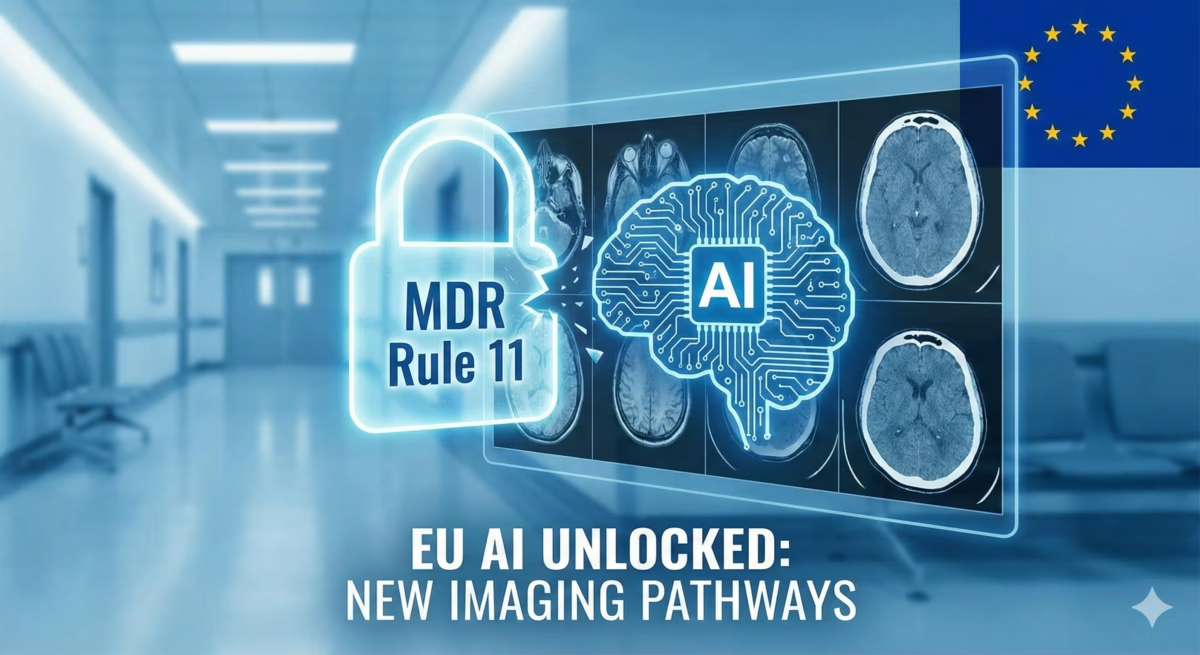
Breaking the “Rule 11” Bottleneck: The New Era for AI in Medical Imaging

For years, European imaging AI founders have been trapped by Rule 11 of the MDR, which effectively pushed almost all diagnostic software into Class IIa or higher. However, the regulatory landscape shifted dramatically this week as the European Commission’s simplification proposal moved toward implementation, signaling a fundamental win for the digital health sector.

Full Text of Rule 11

Software intended to provide information which is used to take decisions with diagnosis or therapeutic purposes is classified as class IIa, except if such decisions have an impact that may cause:
– death or an irreversible deterioration of a person’s state of health, in which case it is in class III; or
– a serious deterioration of a person’s state of health or a surgical intervention, in which case it is classified as class IIb.
Software intended to monitor physiological processes is classified as class IIa, except if it is intended for monitoring of vital physiological parameters, where the nature of variations of those parameters is such that it could result in immediate danger to the patient, in which case it is classified as class IIb.

All other software is classified as class I. [Source]

1. The End of the “IIa-by-Default” Nightmare

The core of the recent reform (Obelis (Jan 28, 2026)) addresses the “classification nightmare,” in which even low-risk software was subjected to the same scrutiny as invasive devices.

  • The Change: Software used for monitoring, prediction, or diagnosis that does not carry a risk of death or serious deterioration may now be eligible for Class I.
  • Impact: This allows for self-certification in many triage and screening applications, slashing time-to-market from 18 months to weeks and saving startups an average of €150k–€300k in initial audit fees.

2. Perpetual Certificates for Adaptive AI

Traditional MedTech regulation was built for hardware that doesn’t change. Software, particularly Adaptive AI, requires constant iteration.

  • The proposal to replace the fixed 5-year certificate validity with a risk-based, continuous surveillance model means that software updates will no longer be held back by fear of triggering a full re-certification cycle.

3. The “Fast Lane”: Breakthrough Device Status (MDCG 2025-9)

Recent guidance (Johner Institute (Jan 21, 2026)) and analysis this week highlight the power of the Breakthrough Device (BtX) designation.

For imaging AI targeting life-threatening conditions (e.g., automated stroke detection or rare oncology), this status offers:

  • Priority Review: Notified Bodies are now encouraged to prioritize these files.
  • Scientific Advice: Direct access to EU Expert Panels to validate clinical evidence strategies before full submission.

4. AI Act vs. MDR: Clearer Boundaries

A critical clarification emerged this week (Osborne Clarke (Jan 28, 2026)): AI-based medical devices will likely be treated as lex specialis. High-risk AI requirements from the AI Act will be integrated into the MDR/IVDR process, ensuring that imaging companies face a single conformity assessment rather than duplicative audits.

Checklist: Is Your AI Ready for the “Breakthrough” Path?

Use this 5-point assessment based on the new MDCG 2025-9 framework:

  1. Criticality: Does your tool address a life-threatening or irreversibly debilitating condition?
  2. Innovation: Can you prove a high degree of technological novelty compared to the current “state of the art”?
  3. Clinical Impact: Is there a reasonable expectation of significant improvement in patient outcomes (e.g., faster time to treatment)?
  4. Evidence Lifecycle: Do you have a robust plan for Post-Market Clinical Follow-up (PMCF) to manage residual uncertainty?
  5. Regulatory Maturity: Is your Quality Management System (QMS) ready for the intense “structured dialogue” with Notified Bodies required for BtX status?
Categories
Digital Health MedTech

Why SaMD Launches Fail in Europe

Common Pitfalls

  1. Vague intended use leading to misclassification
  2. No QMS or weak cybersecurity
  3. Poor clinical evidence strategy
  4. Failure to engage clinicians or users

Fixes:

  • Start regulatory early
  • Build real clinical value
  • Design with adoption in mind

Learn more at Scaling MedTech: From Product to Market

This post is part of SaMD Europe Launch Guide.

This content has been enhanced by GenAI tools.

Categories
Digital Health MedTech

Investment Trends in European Digital Health

Where Capital Flows

Investors favor:

  • AI-powered platforms
  • Value-based care tools
  • Female health (menopause, hormones)

Valuation Benchmarks:

  • 4–6x revenue for most healthtech
  • 6–8x for AI/diagnostics
  • 10–14x EV/EBITDA for EBITDA-positive firms

Learn more at Scaling MedTech: From Product to Market

This post is part of SaMD Europe Launch Guide.

This content has been enhanced by GenAI tools.

Categories
Digital Health MedTech

Post-Market Surveillance for SaMD

Staying Compliant Post-Launch

Post-market surveillance (PMS) is required for all devices.

Requirements:

  • Plan for data collection
  • Trend analysis and signal detection
  • Regular updates to clinical files
  • Vigilance reporting (e.g. EUDAMED)

For Class IIa+, submit PSUR every 1–2 years.

This post is part of SaMD Europe Launch Guide.

This content has been enhanced by GenAI tools.

Categories
Digital Health MedTech

SaMD Market Access & Reimbursement in Europe

CE Mark ≠ Reimbursement

Each EU country has its own reimbursement process.

Highlights:

– Germany (DiGA): Fast track, 12-month provisional access

– France: Multiple programs (ETAPES, PECAN)

– UK: NICE approval + local commissioning (ICBs)

Evidence needs differ, it can be Randomized Controlled Trials (RCTs) or real-world evidence depending on system.

Learn more on Scaling MedTech: From Product to Market

This post is part of SaMD Europe Launch Guide.

This content has been enhanced by GenAI tools.

Categories
Digital Health MedTech

Clinical Evidence for SaMD in the EU

MDR Requirements

SaMD must show:

  • Clinical association (medical logic)
  • Analytical validity (correct processing)
  • Clinical validation (real-world benefit)

Documentation:

  1. Clinical Evaluation Plan (CEP) = how you’ll gather evidence
  2. Clinical Evaluation Report (CER) = full evaluation
  3. Post-Market Clinical Follow-up (PMCF) = follow-up after launch

Use real-world evidence, literature, or clinical studies.

This post is part of SaMD Europe Launch Guide.

This content has been enhanced by GenAI tools.

Categories
Digital Health MedTech

The CE Marking Process for SaMD

Get CE Mark

Most SaMD is Class IIa or higher—requiring Notified Body involvement.

Key Steps:

  1. Prepare tech documentation (Annex II, III)
  2. Implement QMS (ISO 13485)
  3. Create clinical evaluation plan (CEP) and report (CER)
  4. Work with a Notified Body

Class-specific routes:

  • Class I: self-certify
  • Class IIa-III: Notified Body review + ongoing surveillance

This post is part of SaMD Europe Launch Guide.

This content has been enhanced by GenAI tools.

Categories
Digital Health MedTech

SaMD Cybersecurity and GDPR

Security = Safety

Under EU MDR, cybersecurity is a General Safety and Performance Requirement. Failure to secure software is a patient safety risk.

Technical Steps:

  • Secure architecture and testing (MDCG 2019-16)
  • Access control, encryption, logging
  • Vulnerability management and patches

GDPR Considerations:

  • Health data = special category
  • Explicit consent and purpose limitation
  • DPIA (Data Protection Impact Assessment) required if high-risk AI involved

This post is part of SaMD Europe Launch Guide.

This content has been enhanced by GenAI tools.

Categories
Digital Health MedTech

Building a Compliant QMS for SaMD

To enter the EU market, your SaMD must be developed under a Quality Management System (QMS) that complies with ISO 13485.

What You Need

  • ISO 13485: General quality framework
  • ISO 14971: Risk management integration
  • IEC 62304: Software development lifecycle

Best Practices

  • Build your QMS, don’t buy a generic one
  • Ensure continuous documentation and audits
  • Tie QMS to real clinical risk management

Cybersecurity Integration

Use MDCG 2019-16 as a guideline for secure development. Cybersecurity is considered a safety issue under EU MDR, it is not just IT hygiene.

Learn More:

This post is part of SaMD Europe Launch Guide.

This content has been enhanced by GenAI tools.

Categories
Digital Health MedTech

Rule 11 Explained: Classifying SaMD in the EU

EU MDR’s Annex VIII, Rule 11 determines how software is classified:

  • Class IIa: Most diagnostic and therapeutic decision-support tools
  • Class IIb: Tools whose incorrect use may lead to serious harm
  • Class III: Life-critical functions (e.g., software controlling pacemakers)

What Determines the Class?

  • The intended use and severity of the condition it addresses
  • Whether the software makes decisions or just informs them
  • If a human-in-the-loop can reliably override the software

Example:

  • Software interpreting chest X-rays → Class IIa or IIb
  • Sepsis detection app triggering alerts → Class IIb or III

References:

This post is part of SaMD Europe Launch Guide.

This content has been enhanced by GenAI tools.