
Europe Life Sciences Weekly Brief #29 — AI in Hospitals, Cyber Risk, Diagnostics Consolidation

This week wasn’t about innovation. It was about whether innovation survives contact with reality.
- AI moving into hospital operations, not pilots
- Infrastructure becoming the real battleground
- Scale players tightening control over diagnostics and data
Executive Memo
Zoom out, and the pattern is operational control.
- Parallel is taking the hospital revenue cycle.
- Rivia is taking clinical trial data infrastructure.
- Abbott is taking population-scale cancer diagnostics.
- Stryker demonstrated (involuntarily) that operational resilience is now a commercial differentiator, not an IT budget line.
- And JenaValve showed that the CE-first strategy produces FDA exits, not just European market access.
The thread connecting all five: in 2026, the companies winning in European MedTech are not the ones with the best technology. They are the ones embedded deepest in the workflows that keep healthcare systems running and getting paid. Procurement, integration, and reimbursement remain the three tests everything must pass. This week, five different stories said the same thing.
People & Strategic Moves
Health Lean Analytics × Novanta (Spain / US)
Barcelona-based Health Lean Analytics closed a €2.1M round combining a €1.4M oversubscribed seed from family offices (Inderhabs, Namarel Ventures, Braincats) and an ENISA participative loan with Novanta, a US-listed medtech company, joining as strategic and technology partner with a board seat.
Novanta’s angle is explicit: its RFID and sensing hardware generates the data HLA’s AI engine processes. This is a vertical integration play from sensor to insight, not just a financial bet.
For early-stage European founders, this is a rare example of aligning hardware infrastructure, AI software, and a credible US market entry path in one transaction at seed stage
Why it matters?
This is more than a funding story. It combines:
- hospital workflow software
- medtech hardware ecosystem access
- a credible US expansion path
Early-stage European startups rarely align all three this early.

Money Flows — Where Capital Is Actually Going
Parallel (France) — $20M Series A
What happened: Paris-based Parallel raised $20M led by Index Ventures less than a year after its $3.5M seed, to accelerate AI agent deployment across hospital administration, starting with medical coding and billing, then admissions.
Why it matters: Parallel doesn’t replace hospital systems. It runs on top of them automating the revenue cycle layer that determines whether hospitals get paid accurately and on time. Medical coding is the financial backbone of every European hospital; getting it wrong means systematic under-reimbursement. Several dozen French public and private hospitals are already live.
What it may signal: The real AI wedge in European healthcare isn’t diagnosis; it’s operations. Companies that integrate into existing workflows without demanding IT transformation will win procurement faster than those requiring system replacement.

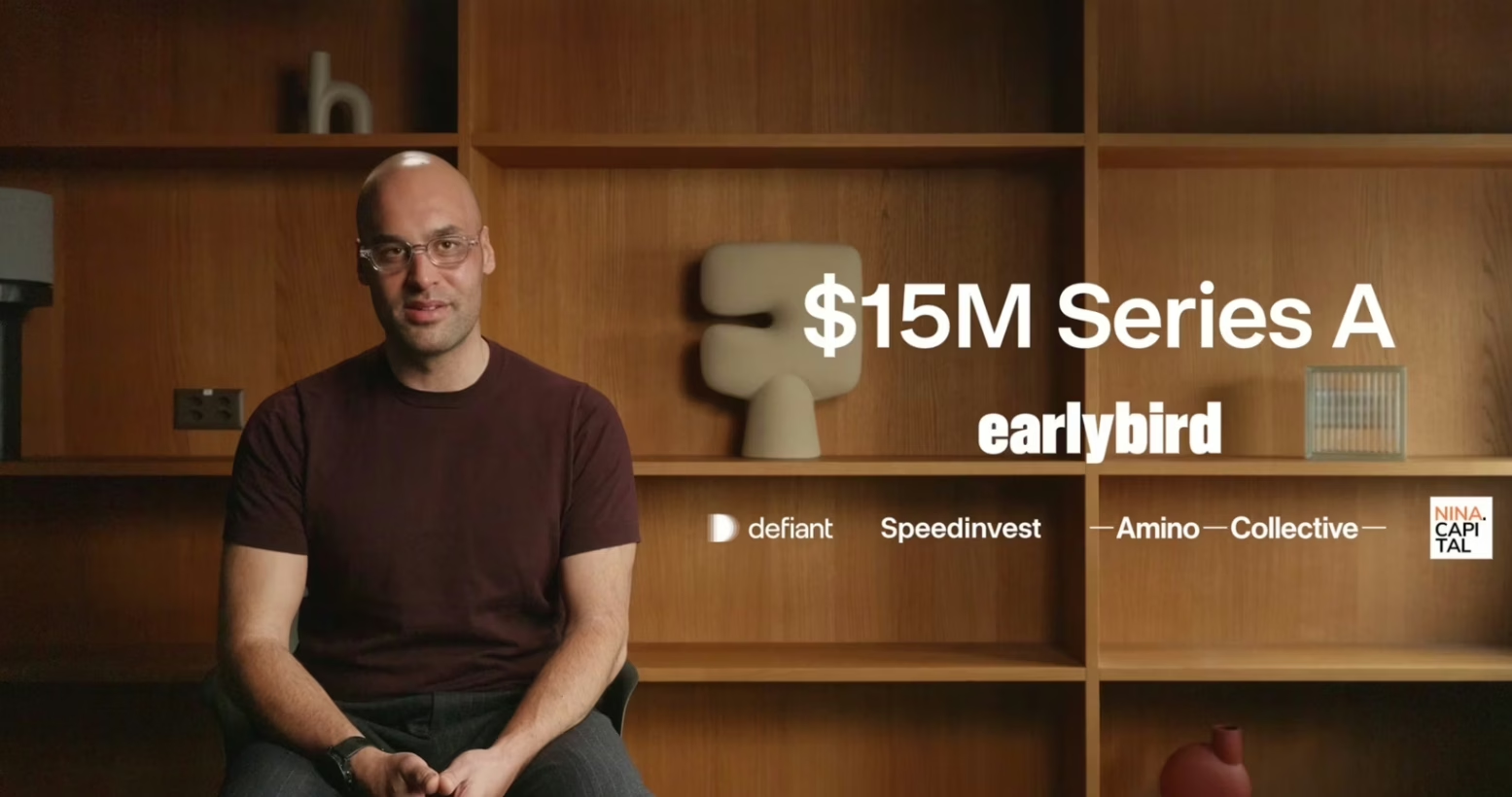
Rivia (Switzerland) — $15M Series A
What happened: Zurich-based Rivia raised $15M Series A (led by Earlybird, following a €3M seed from Speedinvest) to build unified clinical trial data infrastructure: a single intelligence layer across fragmented trial datasets.
Why it matters: Clinical trials are drowning in data and starving for insight. Rivia provides real-time, integrated visibility across trial data, oversight tooling, and analytics: the infrastructure that determines whether a biotech makes good decisions mid-trial or discovers problems post-enrollment. While AI drug discovery attracts headlines, Rivia is fixing how trials actually run.
What it may signal: Infrastructure-layer bets in clinical operations are becoming a distinct category. Investors backing Rivia are not betting on a therapy they’re betting on the plumbing that makes all therapies faster and cheaper to validate.
Signals to Watch

Abbott × Exact Sciences — closing March 23, 2026
Abbott confirmed it will close its acquisition of Exact Sciences on March 23, following receipt of all regulatory approvals.
The deal is valued at approximately $19.84B and is expected to add ~$3B in incremental sales to Abbott in 2026.
The strategic logic is unambiguous: Abbott is buying ownership of multi-cancer early detection (MCED) at population scale, positioning ahead of reimbursement expansion for Cologuard and next-generation liquid biopsy.
For European diagnostics players — and hospital procurement teams building cancer screening pathways — this consolidation sets the commercial benchmark and raises the evidence bar for any competitor entering the space.
Stryker — Wiper Attack, March 11–17
On March 11, Iran-linked threat actor Handala assessed by Palo Alto Unit 42 as affiliated with Iranian MOIS used a compromised Microsoft Intune administrator account to remotely wipe approximately 80,000 Stryker devices in hours, without deploying any malware. Operations across ordering, manufacturing, and global shipping were disrupted; Stryker confirmed containment on March 17 and stated no patient-connected products were affected.
The mechanism is the story: this was not ransomware, it was credential abuse via a legitimate management tool, which means perimeter defenses provided zero protection.
For every medtech commercial and operations leader, the question is no longer “are we protected from malware?” but “who has admin credentials over our endpoint fleet, and what can they do with them?”

JenaValve — Trilogy™ THV System, March 18
Munich-founded JenaValve received FDA Premarket Approval for the Trilogy Transcatheter Heart Valve System — the first and only transcatheter device in the US indicated specifically for native, symptomatic severe aortic regurgitation. The Trilogy had CE Mark since 2021 and has been used in over 1,200 commercial procedures in Europe.
This is the CE-first, FDA-second playbook working exactly as designed: build clinical volume and commercial proof in Europe, then use that evidence base to cross the FDA finish line. For European cardiovascular device founders, JenaValve is a concrete reference model not a one-off.
EUDAMED — Mandatory from May 28, 2026
EUDAMED becomes legally mandatory for all EU MDR/IVDR manufacturers in ten weeks. Manufacturers still treating EUDAMED registration as optional will face procurement exposure: hospital systems in Germany and France are beginning to request EUDAMED IDs as vendor pre-qualification criteria.
This is no longer a regulatory checkbox but a commercial readiness question.
What Leaders Should Watch Next
Parallel’s international expansion
The company has announced plans to enter the Netherlands and Belgium. Watch whether French hospital reimbursement logic translates to DACH and Benelux procurement models — the first cross-border contracts will test whether this is a France story or a European one.
Abbott’s EU integration playbook
ith Exact Sciences closing, watch how Abbott positions Cologuard and MCED pipelines in EU markets — reimbursement strategy across HTA bodies (HAS, G-BA, NICE) will define whether the $3B sales guide includes meaningful European contribution.
Stryker’s endpoint security disclosure
As the investigation continues, any formal SEC or regulatory disclosure on the full scope of data exfiltration will reset the industry’s standard for cyber due diligence in medtech M&A and procurement.
Strategic Question for the C-Suite
If your product disappeared from hospital systems tomorrow — would operations halt, revenue drop, or would anyone notice only in the next quarterly review?
One Thing to Remember:
In European MedTech, value is no longer created at the edge of the system. It is created inside the workflows that determine whether hospitals function, get paid, and stay online.
FAQ
Get Europe MedTech News in your inbox
A weekly executive read on the most relevant medtech and digital health signals in Europe, with a focus on commercialization, evidence, and operating reality.
