Europe Life Sciences Weekly Signal #48: The Reallocation Quarter

WEEK OF 27 JULY–2 AUGUST 2026 · 14-MINUTE READ
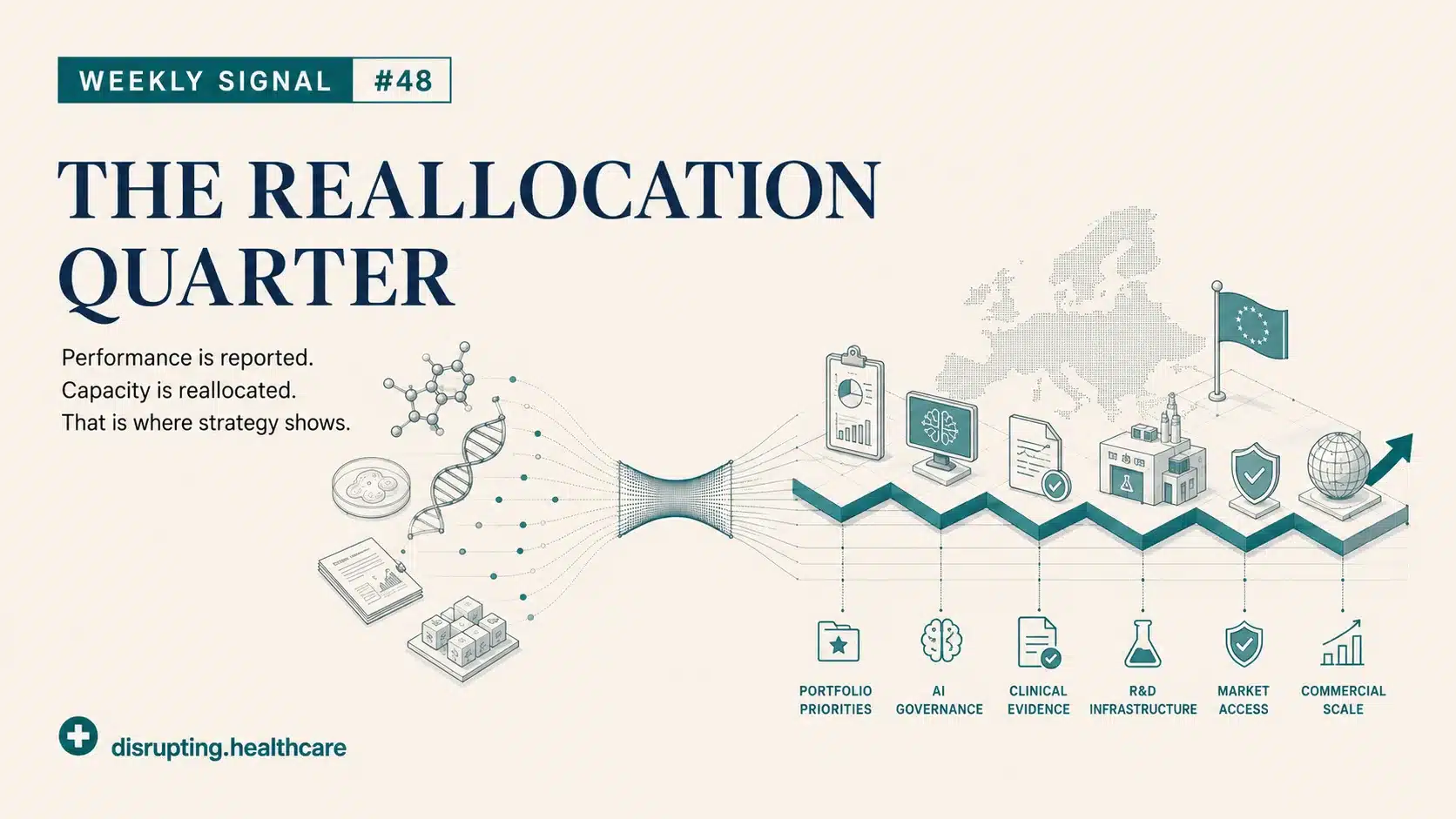
Reported performance tells you what happened.
Reallocation tells you what the organisation believes will matter next.
Last week’s signal argued that the route through which science reaches the market has become part of the strategy.
This week showed what leaders must move to build that route.
Sanofi reported 17.8% sales growth and discontinued three development programmes in the same release. GSK reported core operating profit up 7% and total operating profit down 75%, then announced £1.9 billion in annual savings intended largely to fund more than twenty phase III trial starts. argenx committed $2.2 billion to an autoimmune asset that will test how far the commercial capabilities built around VYVGART can travel. Novo Nordisk’s ziltivekimab produced the expected biological effect and no cardiovascular-outcome benefit.
Philips and Siemens Healthineers both benefited from US tariff refunds, although their demand signals moved in different directions. And the EU’s AI Omnibus entered into force on 27 July, extending the timetable for high-risk systems while leaving transparency and enforcement obligations live from 2 August.
These are not merely earnings, pipeline, property or regulatory stories.
They are decisions about where capital, talent, evidence-generation capacity and management attention go next.
Most organisations are good at announcing additions. They are much less reliable at proving what stopped, what capacity was released and whether it reached the new priority.
That is the operating test behind this week’s headlines.
IN THIS ISSUE
Week in figures • Commercial moves • Portfolio capacity • Evidence • R&D • AI regulation • MedTech • Watch list • Practitioner’s Lens
The Week in Figures
| Disclosure | Reported signal | Operating question underneath |
|---|---|---|
| argenx / Forte Biosciences | $2.2bn, $77 per share, all cash | Which capabilities can be shared across neurology, dermatology and gastroenterology, and which require a second commercial architecture? |
| Sanofi Q2 | Sales +17.8% CER; guidance upgraded | Can launch-led growth become a reusable capability while resources move from three discontinued programmes? |
| GSK Q2 | Core operating profit +7%; total operating profit −75% | Will £1.9bn of savings reach the late-stage portfolio as quickly as it leaves the existing organisation? |
| Novo Nordisk ZEUS | Hazard ratio 0.99; 95% CI 0.88–1.11 | How quickly is readiness work triaged when mechanism fails to become outcome? |
| EU AI Act | High-risk deadlines moved to Dec 2027 and Aug 2028 | Will organisations use the extension to build ownership or defund the work? |
| Philips Q2 | Adjusted EBITA margin 16.4%, including a 4.2-point refund benefit | Which part of the improvement is repeatable? |
| Siemens Healthineers Q3 | EPS guidance raised; revenue-growth guidance cut | Can Diagnostics restore growth while platform migration consumes capacity? |
The table separates the reported event from the operating decision it creates. That distinction is the organising logic for the issue.
Commercial Moves
ARGENX · FORTE BIOSCIENCES
argenx bought a molecule. The larger bet is that selected parts of its commercial machine can travel with it.
On 27 July, argenx agreed to acquire Forte Biosciences for $77 per share in cash, valuing the company at approximately $2.2 billion. The transaction will be funded from cash on hand and is expected to close in the third quarter.
The principal asset is FB102, a first-in-class antibody targeting CD122. Forte has generated early clinical evidence in vitiligo and coeliac disease, with potential development in alopecia areata and other autoimmune conditions.
The obvious interpretation is pipeline expansion. The more consequential interpretation is capability expansion.
VYVGART generated approximately $2.8 billion in product sales during the first half of 2026. That success has built specialist engagement, referral-pathway experience, patient support, evidence capabilities and market-access infrastructure around severe autoimmune disease.
Some of that should travel well. Shared immunology science, data, governance and patient capabilities can create leverage across indications.
The customer-facing architecture may not.
Vitiligo is primarily a dermatology market. Coeliac disease sits within gastroenterology. Their specialists, diagnostic pathways, payer logic and treatment volumes differ materially from neuromuscular disease.
The integration trap is to assume that therapeutic-area adjacency implies commercial adjacency. The better design is likely a shared backbone with market-specific front ends: common evidence, data and governance, but distinct specialist, field and access models where the disease architecture requires them.
The acquisition premium prices confidence in the molecule. The return will depend on whether argenx knows which capabilities to reuse—and which to build again.
Commercial Performance and Portfolio Capacity
SANOFI · GSK · ASTRAZENECA
Sanofi’s growth and its pipeline cuts are the same strategic decision viewed from opposite ends.
On 30 July, Sanofi reported second-quarter sales growth of 17.8% at constant exchange rates and business earnings per share of €2.09, up 33.3%. Full-year sales guidance was raised to approximately 10% growth.
The composition matters:
- Dupixent sales increased 37.6% to €5.154 billion.
- Pharma-launch sales increased 48.3% to €1.305 billion.
- Vaccines declined 4.7%.
- R&D expenditure rose 17.9%, including pipeline-prioritisation costs.
- Selling and general expenses increased 9%, mainly because of recent acquisitions and one-offs.
Sanofi also confirmed that amlitelimab would not progress to global submission and discontinued itepekimab and balinatunfib. It recognised €1.031 billion in impairment expense, including €952 million related to amlitelimab.
Exceptional growth and three programme stops are not opposing signals. They are the same allocation model.
Launch-led growth consumes medical-affairs capacity, access negotiations, field attention, supply planning, analytics and leadership bandwidth. Late-stage programmes draw evidence planning, regulatory work, manufacturing preparation and launch readiness long before approval.
Stopping an asset should release meaningful capacity. In practice, those people, budgets and decision rights often disappear into functional overhead instead of moving visibly behind the remaining priorities.
Sanofi’s next test is therefore not whether the stops demonstrate discipline. They do. It is whether the released capacity reaches Dupixent, the launch portfolio and the pipeline investments expected to create the next growth engine.
A stop becomes strategic only when the organisation can show where the released capacity went.
GSK has made that movement explicit—and therefore measurable.
GSK reported second-quarter sales of £8.4 billion. Core operating profit increased 7%; total operating profit fell 75%, driven primarily by a £1.3 billion impairment related to camlipixant and other adjusting items.
Both figures matter. One describes the continuing commercial business. The other records the consequence of earlier portfolio assumptions that did not work.
GSK now expects more than twenty phase III starts in 2026, compared with a previous expectation of ten. To help fund that acceleration, its three-year Accelerate Growth programme targets £1.9 billion in annual savings by 2029 at an expected cost of £2.4 billion.
The company says the savings will be enabled by technology and AI and generated through support-service streamlining, process redesign, reallocation from established products to Specialty Medicines, and simplification of the supply chain and site network.
This is intended as reallocation, not merely cost reduction. That distinction matters because savings can be captured quickly while the receiving teams wait for funded roles, data access and decision rights. The cost leaves; the capability arrives late.
The programme’s credibility will depend on whether both sides move on the same timetable: what stops, what is released, where it goes, who can deploy it and which outcome proves the move worked.
GSK has also made “AI-enabled efficiency” more testable than usual by attaching it to a public number and horizon. But AI sits in the same sentence as procurement, support-function and site simplification. Leaders should ask which named processes are being redesigned around AI, what the baseline cost and cycle time were, and how much of the benefit comes from better work rather than simply less capacity.
An AI-enabled savings commitment should be measured twice: once in cost removed, and once in capability created.
AstraZeneca shows the advantage of diversified growth—and the danger of confusing diversification with proliferation.
AstraZeneca reported first-half revenue of $30.672 billion, up 6% at constant exchange rates, with core EPS up 11%.
Growth in Oncology and Rare Disease offset pressure from Farxiga’s US loss of exclusivity, procurement changes in China and setbacks elsewhere in the portfolio. Full-year guidance and the $80 billion 2030 revenue ambition were reconfirmed.
The company also disclosed two July licensing agreements originating in China: $600 million upfront for worldwide rights to Zegfrovy and $200 million upfront for rights outside China to TQC3721.
Discovery risk can increasingly be sourced externally. The work does not disappear; it moves into integration, regulatory translation, evidence generation, manufacturing alignment, access planning and launch readiness.
Diversification means several credible growth engines supported by evidence and commercial capability. Proliferation means many assets competing for the same medical, regulatory, access and launch resources.
The first absorbs failure. The second creates congestion.
External sourcing is a capital-allocation decision. Converting sourced science into a repeatable business remains an operating-model capability, and conversion capacity is finite.
Evidence Discipline
NOVO NORDISK · ZEUS
Ziltivekimab produced the expected biological effect. It did not produce the outcome that defines value.
On 31 July, Novo Nordisk reported headline results from the phase III ZEUS trial.
Ziltivekimab inhibited the IL-6 pathway and reduced free IL-6 and high-sensitivity C-reactive protein as expected. It did not reduce major adverse cardiovascular events versus placebo. The hazard ratio was 0.99, with a 95% confidence interval of 0.88–1.11.
ZEUS enrolled more than 6,300 people with atherosclerotic cardiovascular disease, chronic kidney disease and inflammation. Serious infections occurred more frequently with ziltivekimab. Two other outcomes trials: HERMES in heart failure and ARTEMIS following acute myocardial infarction will continue, with results expected in the first half of 2027.
The scientific interpretation should remain narrow: in this population, inhibiting the pathway and lowering the selected biomarkers did not improve the specified cardiovascular outcome.
The operating lesson is broader.
Life-sciences organisations must begin evidence, access and launch preparation before definitive outcome data are available. That means resources are committed around a mechanism and intermediate evidence before the endpoint that decides the market has read out.
This is unavoidable. Allowing the preparation to survive unchanged after the evidence changes is not.
Any ZEUS-specific readiness work now needs explicit triage: which assumptions no longer hold, which capabilities remain useful for HERMES and ARTEMIS, what should pause and who can redirect the resources quickly.
The organisational cost of a late-stage miss is not only the impairment. It is the capacity accumulated around the expected launch, and the time required to release it.
R&D Infrastructure
GSK · CAMBRIDGE BIOMEDICAL CAMPUS
GSK’s Cambridge move is an operating-model decision presented through real estate.
On 28 July, GSK announced a £400 million investment in a new 300,000-square-foot R&D centre on the Cambridge Biomedical Campus.
The site is expected to house more than 1,000 scientists. GSK will vacate its Stevenage R&D site through a phased move by 2029, upgrade laboratories at Ware and move some employees there to connect drug development more closely with commercial manufacturing scale-up.
The company has not published a like-for-like headcount bridge between Stevenage, Cambridge and Ware. It would be premature to describe the move as a simple numerical reduction.
The strategic concentration is clear enough.
Cambridge offers proximity to hospitals, universities, research organisations and hundreds of biopharma, biotech and AI companies. But proximity creates value only when it shortens the path between a signal and the person authorised to act on it.
The operating questions are whether discovery gains faster access to clinical evidence, external science enters portfolio decisions earlier, development connects to manufacturing before late-stage problems emerge and negative evidence triggers faster resource movement.
The transition also carries predictable risks. Some experienced employees will not move. Tacit knowledge may leave before it is identified as critical. Teams will operate across old and new sites for years.
A campus creates proximity. Only the operating model converts proximity into decision speed—and GSK has three years to design that before the buildings decide it by default.
AI Regulation and Operating Models
EU AI ACT · AI OMNIBUS
The high-risk deadline moved. Accountability did not.
The EU AI Omnibus entered into force on 27 July 2026, extending the application timetable for high-risk AI systems.
Rules for stand-alone high-risk systems under Annex III will apply from 2 December 2027. Rules for AI embedded in regulated physical products under Annex I—including medical devices—will apply from 2 August 2028.
The extension addresses a real problem: standards, guidance and supporting tools were not mature enough for consistent conformity assessment against the original timetable.
But 2 August 2026 still changed the operating environment. Transparency requirements and enforcement responsibilities began applying. Users must understand when they are interacting with AI, and certain synthetic or manipulated content must be marked or disclosed.
For life-sciences organisations, the implication reaches beyond product teams. The same company may be the manufacturer of an AI-enabled device, the deployer of an HCP assistant, the operator of a patient-support chatbot, the user of a general-purpose model in medical or commercial work and the publisher of AI-assisted content.
Those systems sit across quality, regulatory affairs, medical, commercial, communications, HR and technology. A central policy does not resolve that distribution of accountability.
The immediate requirement is a usable inventory: which systems exist, whether the organisation is provider or deployer, which decisions they influence, what must be disclosed, who monitors them and which named function is accountable when something goes wrong.
The deferral creates a capacity decision. Leaders can preserve the teams already mobilised and use the additional time to build lifecycle controls. Or they can release the funding, lose expertise and rebuild the programme under pressure later.
The compliance date moved. The need to assign ownership did not.
MedTech Economics
PHILIPS · SIEMENS HEALTHINEERS
Tariff refunds materially improved profitability. They did not create demand.
On 28 July, Philips reported second-quarter sales of €4.4 billion, with comparable sales growth of 4%.
Adjusted EBITA reached €717 million, producing a 16.4% margin. That included a US tariff-refund benefit worth effectively 4.2 percentage points. Excluding the refund, adjusted EBITA decreased slightly as inflation, tariffs and mix offset higher sales and productivity improvements. Comparable order intake declined 1%, which Philips attributed to the timing of large North American orders.
This was not a weak quarter disguised as a strong one. Philips produced genuine sales growth and €132 million in savings. But the refund materially changed margin, cash flow and the outlook without changing customer demand or competitive position.
Three days later, Siemens Healthineers made the divergence explicit.
The company reported an equipment book-to-bill ratio of 1.27 and comparable revenue growth of 2.8%. Diagnostics revenue declined 5.5%, and its adjusted EBIT margin fell to 4.1%.
Siemens Healthineers reduced its full-year comparable revenue-growth outlook from 4.5–5.0% to 3.5–4.0%. It simultaneously raised adjusted EPS guidance from €2.20–€2.30 to €2.35–€2.45, explicitly attributing the increase to tariff refunds.
The revenue downgrade says part of the commercial system is producing less growth than expected. The earnings upgrade says the financial consequence is being offset this year by an item unrelated to demand.
Diagnostics is also migrating customers to a new laboratory platform. That transition consumes field capacity, service resources, customer confidence and installed-base retention effort. Its cost appears quickly. The benefit appears only if customers migrate successfully and the new platform supports stronger recurring economics.
The refund works in the opposite direction: its benefit appears immediately and cannot be repeated by the commercial organisation.
An earnings bridge buys time. It does not create demand, retain an installed base or complete a platform migration.
What Leaders Should Watch?
Whether argenx builds a second front end on a shared backbone
Watch whether it distinguishes reusable immunology capabilities from the field, access and patient architecture required by dermatology and gastroenterology.
Whether Sanofi’s three stops produce visible resource movement
The stronger proof of discipline will be identifiable movement of people, budget and leadership attention behind the remaining portfolio.
Whether GSK’s savings and reinvestment arrive together
Watch whether accelerated assets gain funded roles, data access and decision rights—not merely strategic endorsement.
Whether the Cambridge transition preserves tacit knowledge
The decisive indicators will be retention, knowledge transfer and whether the Cambridge–Ware model actually shortens development and scale-up decisions. Note: GSK cuts their staff now.
Whether Novo Nordisk triages ZEUS-specific readiness explicitly
HERMES and ARTEMIS continue. ZEUS-specific assumptions and work should nonetheless be reviewed rather than quietly absorbed.
Whether AI governance remains funded through the deferral
Transparency obligations are live now. Watch whether organisations treat the extension as build time or permission to pause.
Whether MedTech plans against normalised performance
Philips and Siemens Healthineers disclosed the refunds clearly. The internal test is whether next year’s targets remove them before judging what the organisation can reproduce.
PRACTITIONER’S LENS
Reallocation is harder than addition because somebody must surrender what they control today.
There is a comfortable way to read this week.
Pharma delivered mixed-to-strong quarters. argenx bought a biotech. GSK announced savings and a new research site. Novo Nordisk had a trial miss. Europe delayed parts of the AI Act. MedTech benefited from tariff refunds.
Every statement is accurate. Together, they explain very little.
The more useful reading is that European life sciences has entered a period in which growth is increasingly funded not by adding more, but by moving what already exists.
Sanofi is attempting to redirect capacity from three programmes into Dupixent, launches and its next pipeline priorities. GSK is attempting to move £1.9 billion of annual cost into more than twenty phase III starts, business development and a concentrated R&D network. argenx is using cash generated by one franchise to build another. AstraZeneca is moving innovation risk from discovery into the conversion of external assets. Novo Nordisk must decide which readiness assumptions survive a result that validated the mechanism but not the outcome. Siemens Healthineers is spending Diagnostics capacity on platform migration while a refund supports the earnings line.
Reallocation is harder than addition for a simple reason.
Addition needs a decision and a budget.
Reallocation needs a decision, a budget and the surrender of something by someone who controls it today.
That is why prioritisation is frequently announced and rarely observable. The stopped programme appears in the press release. The released capacity often has no named destination, receiving owner or date by which the move must occur.
A year later, the pipeline is smaller, the cost base has barely changed, and nobody can explain precisely where the capacity went.
The “reported versus underlying” lens from the earlier drafts remains valuable, but it is a consequence of this deeper issue.
Reported performance tells us what happened during the period. Reallocation tells us what management believes can happen next.
A launch surge may flatter growth while consuming non-repeatable intensity. A refund may flatter margin while the commercial system weakens. A restructuring may improve cost ratios before the receiving organisation acquires the capability the savings were meant to fund.
The organisations that manage this well practise two unglamorous disciplines.
First, they maintain a capacity ledger. For every material stop, consolidation or efficiency programme, they record what is being released, where it is going, who receives it, when the move becomes effective and what result will prove it worked. This applies to people, budget, leadership attention, development slots, field capacity and decision rights—not only cash.
Second, they maintain a normalised performance view. They strip out what the commercial and operating system did not cause and ask what remains: repeatable demand, reusable launch capability, productive scientific capacity, faster decisions, stronger evidence, and an operating model that does not depend on a one-off event or a single heroic leader.
That view is usually less flattering than the reported one.
It is also more useful.
The companies that outperform the next cycle will not necessarily have the broadest pipelines, the most AI pilots or the largest transformation programmes.
They will be the ones that can answer three questions without resorting to a strategy slide:
01
What did we genuinely stop?
02
Where did the released capacity go?
03
What outcome proves the reallocation worked?
Reported performance is what the market sees today.
Where the capacity went is what the market discovers eighteen months later.
ONE THING TO REMEMBER
Strategy is not only what an organisation funds. It is what it stops—and where the released capacity goes.
Savings are captured quickly. Reinvestment arrives slowly, if at all. The gap between them is where transformation credibility disappears.
The leadership question is not:
What else should we start?
It is:
What have we genuinely stopped, who received the released capacity, and what result will tell us the move worked?
Sources are linked inline to primary or authoritative sources. Financial figures and performance statements attributed to companies are company-reported. Clinical findings reflect sponsor-reported headline results pending full scientific presentation. Regulatory dates reflect the amended EU AI Act timetable in force from 27 July 2026. Interpretation and operating-model conclusions are the author’s. This publication is independent and does not accept sponsored placement.
