Europe Life Sciences Weekly Signal #49: The Operating Model Gets Priced

WEEK OF 3–9 AUGUST 2026 · 15-MINUTE READ
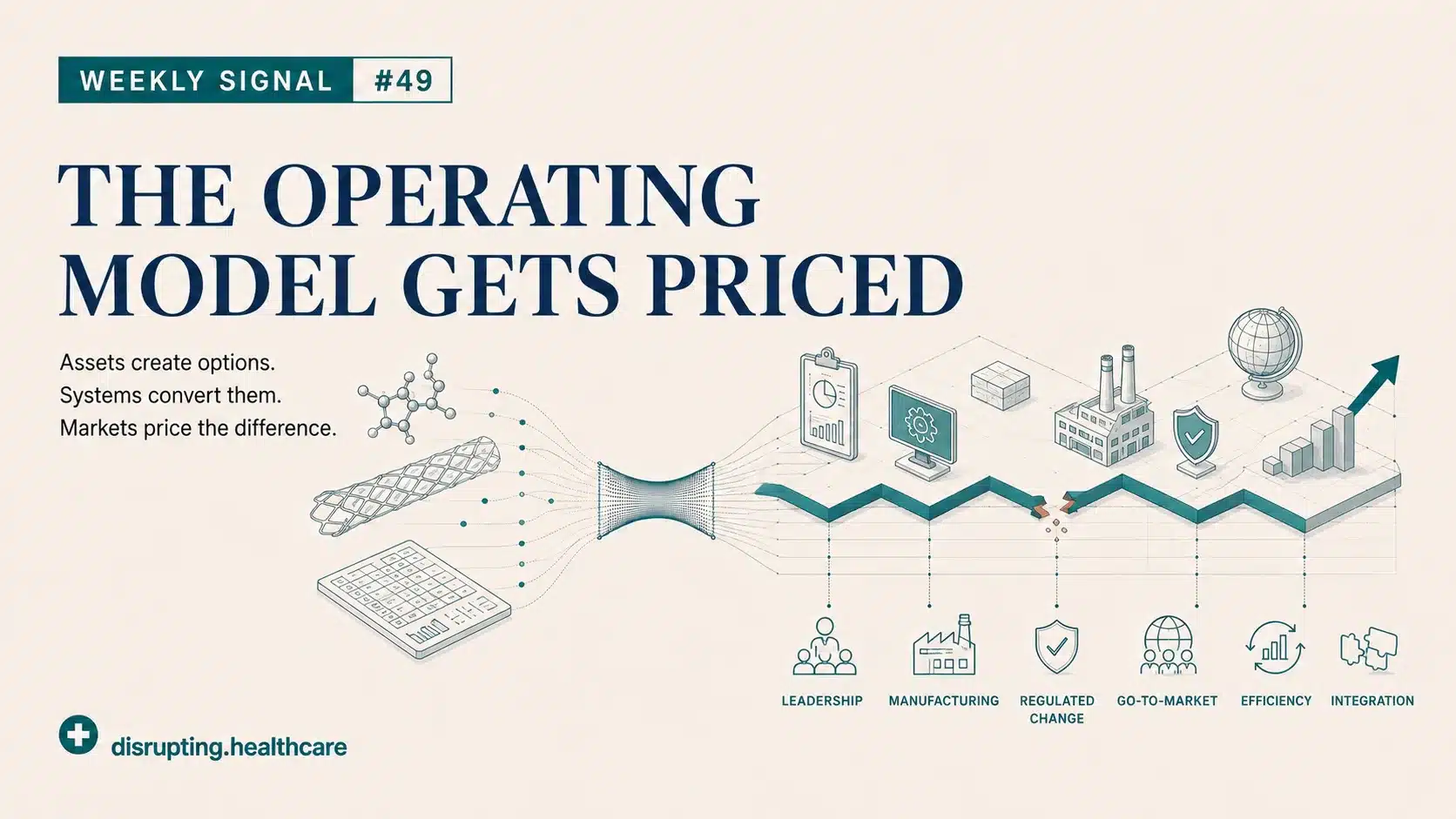
This week, markets distinguished assets from systems.
Life sciences companies are rich in assets: molecules, platforms, factories, data, intellectual property and cash.
What they are often short of is conversion capacity: the ability to turn those assets into repeatable commercial outcomes across the hand-offs between science, capital, operations and the market.
This week made that distinction unusually visible.
BioNTech selected a new chief executive for the transition from scientific platform to multi-product company. KKR agreed to pay $5.7 billion for Integer Holdings, a MedTech manufacturing platform whose value sits in engineering, quality and customer integration. Proscia announced an FDA clearance that turns future interoperability changes into a controlled regulatory process. Merck KGaA linked Life Science growth to a new go-to-market model. Smith+Nephew showed how efficiency savings can hold profit when revenue does not. Oxford Biomedica showed how quickly customer-process changes and a six-month site delay can reach guidance.
These are different events in different parts of the industry. Together, they make one point.
The operating model is not an organisational diagram behind the strategy. It is an economic asset. Markets price it through acquisition premiums, leadership choices, growth, guidance and the cost of delay. A regulator can also make it visible by authorising not only a product, but a governed process for changing it.
Nobody pays a separate line item for a coherent operating model. They pay for the performance it produces, or discount the friction created when it is missing.
Last week’s Signal argued that strategy becomes visible in what an organisation stops and where the released capacity goes. This week showed the next test: does that capacity land inside a system that can convert it into outcomes—and can the result be repeated?
The week in figures
| Signal | Reported event | Operating question underneath |
|---|---|---|
| BioNTech Q2 | €105.6m revenue; €820.8m net loss; €16.6bn cash and securities | Can the company build a multi-product commercial institution before its oncology pipeline reaches the market? |
| KKR / Integer Holdings | $5.7bn enterprise value; $127 per share | Is outsourced engineering and manufacturing becoming a strategic control point in MedTech? |
| Proscia Concentriq AP-Dx | Company-announced FDA 510(k) clearance with a predetermined change control plan | Can interoperability become a governed lifecycle capability rather than a new submission for every component? |
| Merck KGaA Life Science | €2.4bn sales; 8.0% organic growth; Process Solutions +14.7% | How much value comes from the portfolio, and how much from making it easier to buy and use as a workflow? |
| Smith+Nephew | Revenue-growth guidance cut from about 6% to about 4%; profit, cash and ROIC guidance maintained | If efficiency closes the gap this year, what closes it next year? |
| Oxford Biomedica | 2026 revenue guidance cut to £180–200m; Durham readiness delayed six months | How quickly can strong demand become revenue when procurement, programme timing and site readiness move? |
The numbers are not directly comparable. The mechanism is.
Each event reveals whether an organisation can convert assets into outcomes, and whether the mechanism supporting the result is durable or finite.
Leadership and commercialisation
BIONTECH
BioNTech has hired for the journey from scientific platform to multi-product company.
BioNTech appointed Guido Oelkers to succeed co-founder Uğur Şahin as chief executive by 1 February 2027 at the latest.
The company’s description of the appointment is unusually explicit. It emphasises Oelkers’ record in scaling global organisations, disciplined execution, focused capital allocation and commercial operations—particularly in the United States. During nine years leading Sobi, BioNTech says he more than quadrupled revenue while strengthening profitability and the late-stage pipeline.
That profile matches the transition BioNTech must now make.
Its second-quarter results showed revenue of €105.6 million, down from €260.8 million a year earlier, and a net loss of €820.8 million. Softer COVID-19 vaccine demand and milestone revenue no longer expected in 2026 led the company to reduce its full-year revenue guidance from €2.0–2.3 billion to €1.6–1.9 billion.
The balance sheet remains formidable: €16.6 billion in cash, cash equivalents and security investments at the end of June. The pipeline has fourteen pivotal trials underway, and the ambition is to become a company with multiple approved products by 2030.
Cash and science are therefore not the immediate constraints.
The constraint is conversion.
BioNTech must prioritise a broad oncology portfolio, build market-shaping and launch capabilities, establish access and evidence models across several tumour types, decide which capabilities to own, and create a commercial institution that does not depend on a single product or its founders.
That does not mean replacing scientific leadership with “commercial people”. That caricature is how companies destroy the thing they are trying to scale. It means designing an organisation in which scientific judgment, capital allocation, late-stage development and launch preparation reinforce one another.
The CEO appointment is therefore more than succession. It is operating-model design conducted through leadership.
The governance challenge is sharper because both founders are transitioning to lead a new independent company, and BioNTech is also searching for a successor to chief medical officer Özlem Türeci. The company says it wants late-stage clinical-development experience and a record of advancing complex candidates.
That creates a twin design problem: add commercial scale without severing scientific judgement from portfolio and launch choices. Oelkers’ appointment says how BioNTech intends to scale. The next chief medical officer appointment will show how it intends to keep science structurally present while doing so.
The test will be whether BioNTech can preserve the speed and ambition of a founder-led science company while adding the prioritisation and repeatability of a global biopharma business.
MedTech infrastructure
KKR · INTEGER HOLDINGS
KKR paid for the layer between device ambition and a manufacturable product.
KKR agreed to acquire Integer Holdings in an all-cash transaction with an enterprise value of approximately $5.7 billion.
Integer shareholders will receive $127 per share. That represents a 51.8% premium to the closing price before Integer announced a strategic review in April and a 28.8% premium to the 30-day volume-weighted average price at the end of July.
Integer is one of the world’s largest medical-device contract development and manufacturing organisations. Its 11,000 employees support cardio and vascular, neuromodulation and cardiac-rhythm-management products through engineering, components, manufacturing and finished-device capabilities.
This is not a glamorous place in the value chain. That is precisely why it matters.
Device companies are managing more complex products, tighter quality requirements, specialised materials, connected features and pressure to move from concept to reliable supply without carrying every capability internally. The partner that controls critical engineering and manufacturing interfaces becomes harder to replace as the product matures.
KKR is not simply buying capacity. It is buying accumulated process knowledge, customer integration, quality credibility and positions inside long product lifecycles.
Those capabilities can create a platform. They can also create concentration risk.
Under private ownership, Integer will have more flexibility to invest in capacity, technology and acquisitions. Customers should watch whether that investment improves speed, reliability and innovation—or whether platform consolidation reduces choice and increases dependency at a layer already difficult to switch.
The wider signal for MedTech leaders is clear: outsourced capability is not automatically non-strategic capability.
If a partner owns the engineering knowledge, quality history and manufacturing route that determine whether a product can launch and scale, that partner sits inside the product’s operating model whether the organisation chart admits it or not.
The more useful diligence question is not what percentage of manufacturing is outsourced. It is which products could not be moved to another qualified supplier inside eighteen months—and what that dependency becomes worth under new ownership.
PROSCIA
Proscia turned future product change into a regulated operating process.
On 6 August, Proscia announced a new FDA 510(k) clearance for its Concentriq AP-Dx digital-pathology platform. The clearance adds compatibility with the Leica Aperio GT 450 DX slide scanner, permits cloud deployment and includes a predetermined change control plan, or PCCP.
The plan allows Proscia to validate and add support for further FDA-cleared scanners, associated image formats and pathology displays without filing a separate 510(k) for each addition, provided the change remains inside the authorised plan.
This is not deregulation and it is not a blank cheque.
The regulatory framework described by Proscia defines eligible changes, evidence requirements, acceptance criteria, risk controls and labelling updates in advance. Each component still has to pass the applicable validation protocol.
That distinction matters for laboratories buying an “open” digital-pathology platform. Architectural compatibility is only the first claim. The harder capability is to introduce a new scanner, format or display without breaking diagnostic performance, configuration control or the regulatory status of the system.
For buyers, the diligence therefore moves beyond the current compatibility list. What is inside the PCCP? How will the laboratory be notified of a change? Which local validation, training and configuration records must follow it? How quickly can a failed change be isolated or reversed?
Integer illustrates how markets price accumulated execution capability. Proscia illustrates how regulated change can be designed as a repeatable capability. In both cases, the asset is not merely what the system can do today. It is how reliably the system can absorb what comes next.
Commercial execution
MERCK KGaA, DARMSTADT, GERMANY
Merck showed the operating model through the result, not the reorganisation announcement.
Merck KGaA reported second-quarter sales of €5.4 billion, up 4.1% organically, and EBITDA pre of €1.6 billion, up 9.3% organically. It upgraded full-year guidance.
The Life Science business delivered €2.4 billion in sales and 8.0% organic growth. Process Solutions grew 14.7% organically; Discovery Solutions grew 2.1%; Advanced Solutions grew 4.4%.
The interesting sentence in the release was not the largest number. Merck attributed the Life Science performance partly to “strong commercial execution under the new go-to-market model”, while noting early benefits from that model in Discovery Solutions.
This deserves attention because go-to-market reorganisations are usually announced long before they can be observed in customer behaviour or financial results.
Merck reorganised Life Science around Process Solutions, Discovery Solutions and Advanced Solutions at the beginning of 2026, with the stated aim of aligning more closely to customer needs. Its proposed $11.3 billion acquisition of Bio-Techne would extend that logic across research, bioprocessing and advanced therapeutics.
The strategic idea is integrated workflow control: become more useful across the customer’s scientific journey rather than selling a wider catalogue through separate product structures.
That can create real commercial leverage. A customer does not experience a supplier through a portfolio map. It experiences search, advice, contracting, ordering, integration, technical support, quality and the resolution of problems. A structure that connects those moments can improve cross-sell and retention without turning every customer conversation into a product parade.
But the acquisition will multiply the integration burden. Merck will need to decide which Bio-Techne capabilities remain specialist businesses, which enter shared workflows, how commercial ownership is assigned and where a supposedly integrated offer would actually make the customer journey more complicated.
Merck’s quarter is encouraging, not conclusive.
The new model appears to be producing early commercial benefit. The larger proof will come when the organisation must absorb a major acquisition without adding back the complexity it just redesigned.
SMITH+NEPHEW
Revenue guidance fell. Profit guidance held. The bridge between them is finite.
Smith+Nephew reported first-half revenue of $3.097 billion, up 2.3% on an underlying basis, and trading profit of $566 million, up 8.1% on a reported basis. Second-quarter underlying revenue growth was 1.6%, which the company described as lower than anticipated.
It then reduced expected full-year revenue growth from about 6% to about 4%, while maintaining guidance for trading profit, free cash flow and adjusted return on invested capital.
The bridge is explicit, which is to the company’s credit.
Smith+Nephew expects to offset the profit impact of lower revenue growth through an additional $50 million of efficiency savings identified for 2026, taking total savings for the year to approximately $200 million. Tariff refunds also mean the year-on-year tariff impact is now expected to be broadly neutral to trading profit rather than a headwind.
The rest of the bridge depends on a second-half revenue acceleration to 5.0–5.5%. That requires several operating events to land: stabilisation in US skin substitutes, continued Sports Medicine momentum, greater deployment of Orthopaedics sets, and the launch of the cementless LANDMARK knee.
None of this makes the maintained profit guidance artificial. Efficiency is a legitimate operating capability, and Smith+Nephew has executed it well. The distinction is between a durable improvement and a finite substitution.
The company has already achieved $330 million of cumulative savings from its 12-Point Plan and zero-based budgeting programme against a 2027 target of $325–375 million. The programme is therefore closer to its declared destination than to its beginning.
That changes the planning question.
If efficiency closes the revenue gap in 2026, the 2027 baseline should not assume that the same pool can close it again. Next year’s plan needs Orthopaedics and Advanced Wound Management to carry more of the result through demand, mix and launch execution.
This is where adjusted performance can mislead even when every adjustment is properly disclosed. A reported result answers: what did the company deliver? A repeatability test asks: which part can the commercial system produce again without another savings step-up, refund or one-off bridge?
Leaders need both answers.
Execution and integration
OXFORD BIOMEDICA
Pipeline strength could not compensate for interface failure in the current year.
Oxford Biomedica reported good underlying demand: first-half revenue grew approximately 9%, seventeen new clients were signed, and the non-risk-adjusted new-business pipeline increased about 30% year on year to approximately $713 million.
It also reduced 2026 revenue guidance to £180–200 million. Reuters reported that the previous range was £220–240 million. Shares fell more than 24% on 7 August.
The causes sat at organisational interfaces:
- selected client programmes were deferred or delayed after strategy or clinical-data changes;
- a larger client changed procurement strategy and approval pathway;
- operational readiness at the Durham, North Carolina site came six months later than planned.
None of these means the cell-and-gene-therapy CDMO thesis is broken. OXB kept its 2027 growth ambition and its 2030 revenue target.
They do show why commercial momentum and revenue conversion are different things.
A signed client, a large pipeline and a technically capable site do not become reported revenue until programme timing, procurement approval, operational readiness, quality processes and production slots align. Each hand-off introduces latency. Several individually reasonable shifts can become one large guidance change.
This is the other side of the premium paid for platforms such as Integer.
Infrastructure earns strategic value because it can remove execution risk for customers. It loses value quickly when its own integration and readiness create that risk instead.
Demand is not the same as conversion capacity. Pipeline is not the same as throughput. A global footprint is not the same as an operating network.
What leaders should watch
How BioNTech designs commercial readiness before approval
The key signals will be leadership below the CEO, launch sequencing, market-access capability, and whether resources concentrate behind the assets most likely to define the first oncology franchise.
What KKR builds on top of Integer
Watch investment in capacity and technology, but also bolt-on acquisitions. A broader platform could improve end-to-end support or increase customer dependence and integration complexity.
Whether Merck’s go-to-market gains survive Bio-Techne integration
The proof will not be a larger portfolio. It will be a customer journey that remains simple as the portfolio becomes broader.
Whether Proscia’s PCCP produces practical interoperability
The proof will be the first additional component introduced through the plan: how much regulatory time it removes, what validation remains, and whether laboratories can adopt the change without rebuilding local workflow controls.
Whether Smith+Nephew’s second-half step-up arrives on schedule
Guidance now depends on specific product and operating milestones. Watch whether growth in Orthopaedics begins before the efficiency programme runs out of incremental room.
Whether OXB converts backlog without another readiness delay
Watch the Durham site’s first GMP run, the conversion of staged orders and whether client procurement changes are isolated events or a wider CDMO pattern.
Practitioner’s Lens
The operating model is priced through repeatability, not activity.
The comfortable way to read this week is through familiar categories.
A biotech CEO succession. A private-equity take-private. A regulated change plan. A strong quarter. Maintained profit guidance. A revenue warning.
The operator’s reading is more useful.
BioNTech is acquiring leadership capacity before a multi-product launch problem arrives. KKR is paying for engineering, quality and manufacturing integration that customers cannot easily reproduce. Proscia has put a controlled process around future interoperability changes. Merck is beginning to show customer-aligned commercial design in the numbers. Smith+Nephew is using a well-executed but finite savings programme to bridge softer revenue. OXB showed what happens when customer decisions and site readiness fail to align in time.
Six stories. Four tests.
01 · Conversion capacity
Can the organisation turn an asset into a measurable customer, patient or financial outcome?
Cash, pipeline, factories and product breadth create options. They do not create conversion. BioNTech’s challenge is to build launch and access capability before its science needs it. Integer’s premium reflects capabilities that already convert device designs into reliable supply.
02 · Interface load
How many hand-offs must succeed before value reaches the customer?
OXB’s update is an interface story: client strategy, clinical evidence, procurement, approval pathways, site readiness and manufacturing. Every hand-off can be individually reasonable and collectively slow.
Interface load is not reduced by telling functions to collaborate harder. It is reduced through explicit ownership, fewer decision gates, shared data and escalation rules that activate before the commercial date moves.
Measure the distance between evidence and authority as well as the number of hand-offs. A site-readiness deviation or procurement change becomes visible locally before it reaches group guidance. The useful metric is the elapsed time from the first recorded deviation to the person authorised to change capacity, sequence or commitment—and whether bad news travels more slowly than good news.
03 · Absorption capacity
How much new complexity can the organisation take on without degrading the system already producing value?
Merck’s Bio-Techne acquisition will test whether a customer-aligned model can absorb a broader portfolio without rebuilding the silos it was designed to remove. The right question is not whether two portfolios are adjacent. It is whether the combined organisation can make better decisions and simpler customer journeys at greater scale.
04 · Repeatability
What held the result—and can the same mechanism hold it again?
The most useful discipline here is to separate performance that can repeat from a bridge that cannot.
Smith+Nephew’s additional savings are real performance. They are also finite. If the revenue gap persists after the identified savings pool has been used, the next plan needs a different mechanism.
That is why leaders should maintain a substitution register alongside the capacity ledger introduced last week.
For every material variance closed by something other than underlying demand or throughput, record:
- what closed the gap and how much it contributed;
- whether the mechanism is structural, recurring or one-off;
- when it expires or reaches diminishing returns;
- what must change in the operating system before it does.
This is not an argument against cost discipline, accounting adjustments, legal protection or balance-sheet action. All may be correct. It is an argument against using a non-repeatable bridge as the baseline for repeatable performance.
The companion discipline is a substitution-adjusted baseline: strip out the incremental savings step-up, refund, transaction or temporary timing benefit and ask what the operating system produced underneath.
That number may be smaller than the reported result. It is also the more honest input to next year’s plan.
The sequencing implication is blunt: operating-model design must precede an acquisition, launch architecture, reorganisation or major platform decision—not arrive afterwards under the label of integration. By then, the structure has already fixed most of the interfaces.
Before committing, leaders should therefore answer five questions:
- Which decision becomes materially better or faster?
- Which hand-off disappears?
- Which capability remains deliberately separate?
- What result—and by what date—will prove the model works?
- Which part of that result can be repeated without another substitution?
If those answers arrive only after the deal closes, the organisation is announced or the annual plan is locked, the sequence is already wrong.
For a deeper treatment, see AI-Powered Commercial Operating Models in Life Sciences and the H1 2026 synthesis of European commercial transformation.
One thing to remember
A result is valuable. A repeatable result is an operating asset.
Assets create options. Capital creates capacity. Approval creates permission. Savings create room.
The operating model determines whether the organisation can convert any of them into outcomes—and do it again after the one-off bridge has gone.
The leadership question is not only:
Did we hit the number?
It is:
What produced it, can the system repeat it, and what happens to the value if conversion is six months late?
Sources are linked inline. Financial and operating metrics attributed to companies are company-reported unless otherwise stated. Interpretation and operating-model conclusions are the author’s. This publication is independent and does not accept sponsored placement.
