Europe Life Sciences Weekly Signal #47: The Route Is the Strategy

WEEK OF 20–26 JULY 2026 · 12-MINUTE READ
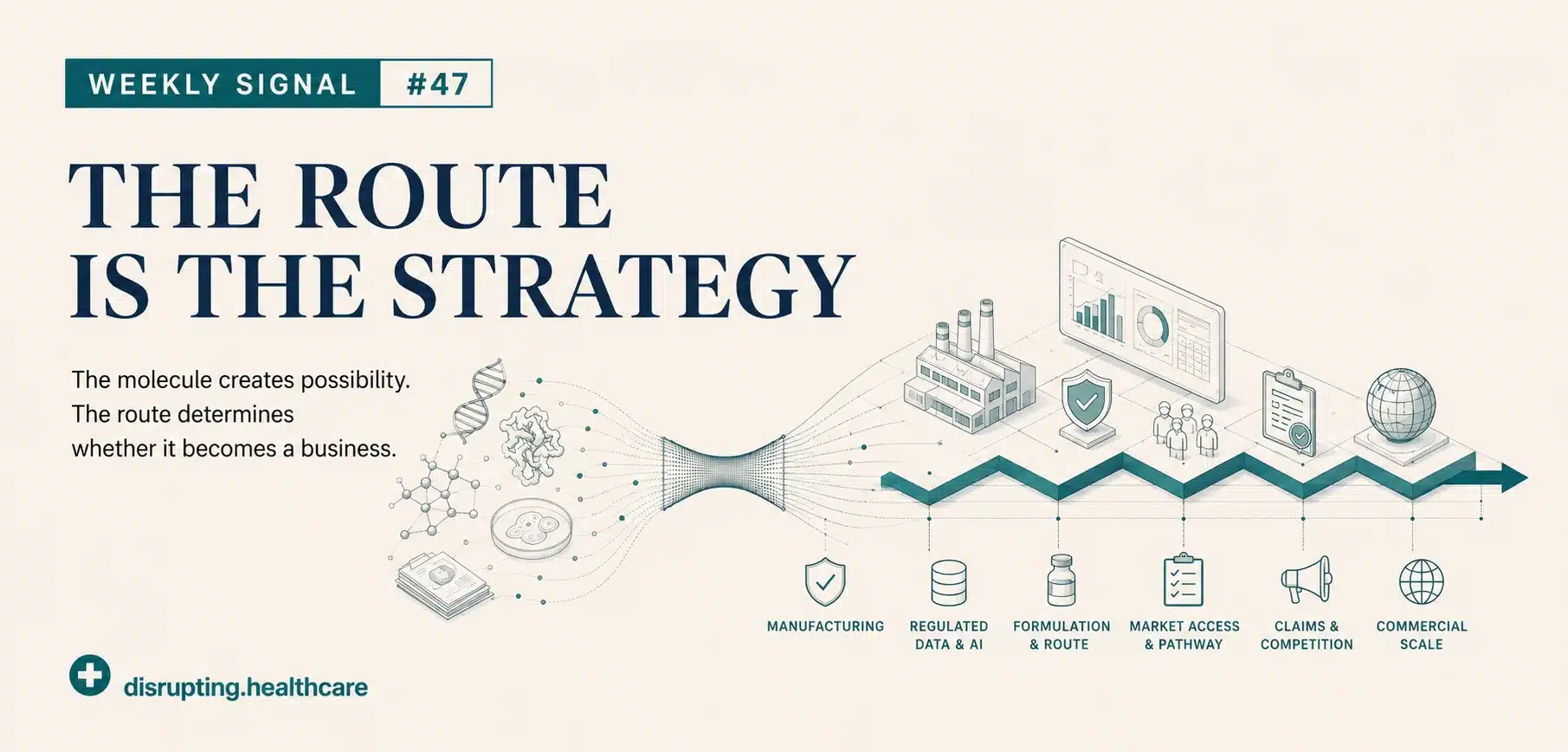
The molecule creates possibility. The route determines whether it becomes a business.
Last week’s signal argued that the machine converting external science, platforms and partnerships into scale is the moat.
This week showed what that machine must actually control.
Samsung Biologics offered CHF 1.46 billion for PolyPeptide, buying specialist manufacturing capability rather than waiting to build it. Roche’s half-year numbers showed formulation conversion becoming a visible commercial growth lever in Europe. Dassault Systèmes agreed to pay $1.8 billion for the regulated data and compliance workflows operated by ArisGlobal.
Sanofi made the opposite decision. It stopped development of a late-stage medicine because the total evidence did not support a meaningful enough improvement over the current standard of care.
The European Medicines Agency’s July recommendations added another dimension. Several of the commercially consequential medicines do not merely introduce new therapies. They change how treatment is taken, administered or integrated into the health system.
Novo Nordisk then demonstrated that the route includes communication as well as care delivery. Its US lawsuit against Eli Lilly centres on whether a competitor’s comparative claims remain valid after the available product and evidence have changed.
The molecule remains essential. It is no longer the whole product.
Key Signals
MANUFACTURING
Samsung is buying the specialist capability behind the peptide opportunity.
The proposed PolyPeptide acquisition adds peptide expertise, late-stage projects and a development-to-commercial manufacturing network across Europe, the United States and India.
COMMERCIAL EXECUTION
Formulation conversion has become a material European growth lever for Roche.
Ocrevus and Phesgo grew while Perjeta and Actemra declined. The numbers show how much commercial value now depends on patient switching, pathway readiness and lifecycle execution.
REGULATED AI
Dassault is buying workflow, data and compliance—not simply another AI model.
ArisGlobal operates inside safety, regulatory, quality and medical-affairs processes. That regulated operating position is what makes its data valuable.
PORTFOLIO DISCIPLINE
Sanofi stopped an asset that may have been active, but not sufficiently differentiated.
Amlitelimab showed maintenance of response in a long-term study. Sanofi nevertheless concluded that the overall evidence would not support a meaningful improvement in atopic dermatitis.
MARKET ACCESS
The July CHMP recommendations change routes as well as treatments.
Oral medicines, self-administered injections and a refillable ocular implant each create a different pathway, capacity requirement and commercialisation challenge.
CLAIM GOVERNANCE
Novo Nordisk is litigating over whether a comparative claim has expired.
Its case against Eli Lilly turns the speed of evidence and label updates into a competitive operating-model issue.
Commercial Moves
SAMSUNG BIOLOGICS · POLYPEPTIDE
Samsung Biologics is not buying more capacity. It is buying the right capability.
CHF 44.31 per share
Approximately CHF 1.46 billion equity value
55.65% shareholder tender commitment
On 20 July, Samsung Biologics announced an all-cash public tender offer for PolyPeptide Group, the Swiss-listed contract development and manufacturing organisation specialising in peptide active pharmaceutical ingredients.
The offer covers PolyPeptide’s fully diluted share capital at CHF 44.31 per share. Its independent board members recommended the transaction, while the largest shareholder (representing approximately 55.65% of outstanding shares) committed to tender its holding. Completion is expected towards the end of 2026, subject to the offer threshold, regulatory clearance and other conditions.
The obvious interpretation is GLP-1.
Peptide manufacturing has become strategically attractive because of obesity and diabetes demand. Samsung explicitly cited GLP-1 therapies, alongside oncology and other emerging peptide applications.
But the more important acquisition logic sits underneath the immediate demand cycle.
PolyPeptide brings more than 70 years of manufacturing heritage, over 1,000 therapeutic peptides produced, a late-stage project portfolio and sites across Sweden, Belgium, France, the United States and India. Its capabilities extend from research and process development into commercial manufacturing.
That is not simply physical capacity. It is accumulated knowledge about how to move a technically demanding modality between development stages, sites, customers and regulatory environments without losing control of quality or supply.
Samsung is buying three forms of strategic optionality: modality expansion beyond antibodies and antibody-drug conjugates; greater proximity to European and US customers; and specialist operating knowledge that would take years to reproduce internally.
The post-deal risk is equally clear. PolyPeptide’s value partly comes from specialist depth, customer intimacy and the ability to operate across different projects and scales. Samsung must connect that capability to its global platform without slowing it down or imposing a biologics manufacturing model on a modality that requires different expertise.
The offer buys entry into peptide manufacturing. The integration will determine whether Samsung acquires a durable capability or merely owns the facilities where that capability used to live.
SANOFI · AMLITELIMAB
Sanofi shows what portfolio discipline looks like when the medicine is not bad—just not good enough.
On 24 July, Sanofi announced that it would discontinue clinical development of amlitelimab in moderate-to-severe atopic dermatitis and would not submit the medicine for global regulatory review.
Sanofi said the totality of efficacy and safety evidence did not support further development in the indication. Its ESTUARY phase III extension study showed long-term maintenance of clinical response without relapse, but the company concluded that amlitelimab would not provide a meaningful improvement over the current standard of care. The decision did not change Sanofi’s full-year guidance.
That distinction matters. This was not presented as an asset with no clinical activity. It was an asset that did not appear differentiated enough to justify the next stage of investment.
Late-stage portfolio decisions are often reduced to technical gates: whether an endpoint was achieved, whether safety is manageable or whether regulators might accept the package. Commercial strategy adds another threshold.
Even if a medicine can be approved, does it create a sufficiently distinctive place in clinical practice? Does it improve efficacy, convenience, safety, sequencing or economics enough to persuade physicians, patients and payers to change established behaviour?
The cost of continuing is not limited to another clinical study. It includes medical preparation, regulatory resources, manufacturing planning, market-access work, launch capacity, senior attention and opportunity cost across the rest of the pipeline.
Most operating models are built to start initiatives. Far fewer are designed to stop them without leaving organisational ghosts behind.
Commercial Performance
ROCHE · NOVARTIS
Roche’s European results show that formulation conversion is becoming a commercial capability.
Roche reported first-half group sales growth of 6% at constant exchange rates and core operating-profit growth of 10%. European pharmaceutical sales reached CHF 4.52 billion, up 1% at constant exchange rates.
The regional product movements are more revealing than the group headline:
- Ocrevus grew 10% in Europe, with Roche attributing growth partly to the recently launched subcutaneous formulation in Germany, Italy, the United Kingdom and France.
- Phesgo grew 9% in Europe.
- Perjeta declined 14%, with Roche identifying conversion to Phesgo as a cause of lower sales.
- Tecentriq declined 3%, although Roche said the subcutaneous formulation mitigated the fall.
- Actemra declined 21% as biosimilar erosion advanced.
Conversion was not the only source of growth. Evrysdi, for example, increased 17% in Europe. But the numbers show that moving patients between formulations has become a material part of lifecycle performance. The detailed figures are in Roche’s half-year report.
That is not a conventional promotional task. Moving treatment from intravenous infusion to subcutaneous administration can require changes in capacity planning, pharmacy stocking, reimbursement, clinical workflow, nursing practice and patient support. The required sequence differs by market, provider setting and therapy.
A formulation strategy may be global. The conversion mechanism is local.
The concentration pattern also appears at Novartis.
Novartis reported second-quarter sales growth of 1% at constant currencies, while first-half sales declined by 2%. Its priority brands moved much faster: Kisqali grew 43%, Kesimpta 32%, Scemblix 89%, Pluvicto 43% and Leqvio 59% in the quarter.
That apparent contradiction is the portfolio signal. Growth is increasingly concentrated where evidence, indication expansion, access, supply and launch execution reinforce one another.
Calling something a priority is easy. Moving resources, decision rights and cross-functional capacity behind it early enough to alter the result is the harder discipline.
AI and Operating Models
DASSAULT SYSTÈMES · ARISGLOBAL
Dassault Systèmes decided that regulated data belongs inside the intelligence platform.
On 23 July, Dassault Systèmes agreed to acquire ArisGlobal for approximately $1.8 billion in cash, with up to $200 million in additional consideration linked to multi-year AI-related revenue milestones.
ArisGlobal provides technology across pharmacovigilance, regulatory affairs, quality and medical affairs. It serves more than 200 customers, including half of the world’s 50 largest biopharma companies, and processes more than 12 million patient-safety reports annually. It is expected to generate approximately $175 million in 2026 revenue.
Dassault already operates across modelling, discovery, clinical development and manufacturing. ArisGlobal brings the regulated operating layer surrounding those activities: submissions, safety cases, medical information, quality processes and real-world evidence.
The acquisition thesis is that those layers can be connected into a continuous evidence system spanning the therapy lifecycle. That is strategically compelling—and operationally difficult.
Life-sciences data is fragmented for reasons that are not merely technical. Different functions use different definitions, validation requirements, permissions and accountability models. A safety signal, clinical endpoint, quality event and commercial observation cannot simply be poured into a common data lake and treated as equivalent information.
Creating a useful intelligence platform therefore requires common semantics, traceable data lineage, permission structures, validated workflows and explicit rules governing when an AI-generated output may influence a consequential decision.
Dassault says ArisGlobal’s NavaX platform generates productivity improvements of more than 30% in regulated processes. That is a company-reported claim and will need to be evaluated against individual workflows and customer baselines.
The model attracts attention. The governed workflow creates defensibility.
Regulation and Market Access
EMA · JULY CHMP
The July CHMP opinions show why route of administration is part of commercial architecture.
At its 20–23 July meeting, EMA’s Committee for Medicinal Products for Human Use recommended 12 new medicines for approval, adopted three negative opinions and recommended eight extensions of indication. The positive opinions now move towards European Commission decisions; they are not yet final EU marketing authorisations.
Several recommendations are commercially important because of how treatment would be delivered:
- Icotyde, or icotrokinra, would be the first oral medicine targeting the interleukin-23 receptor for moderate-to-severe plaque psoriasis.
- Lyrokaul is a monthly self-administered injection for primary hypercholesterolaemia or mixed dyslipidaemia.
- Evlarco and Ubeslo are daily oral lipid-lowering formulations.
- Susvimo uses a surgically inserted, refillable ocular implant designed to release ranibizumab and be refilled every six months.
These are not interchangeable routes into the same care system. Each can change where treatment takes place, who initiates or administers it, what training is required, how patients are supported, and where capacity constraints emerge.
The precise financial consequences will vary by national reimbursement and provider model. But the general commercial principle is consistent: a new route of administration changes the pathway that must adopt the medicine.
Regulatory evidence establishes whether a medicine may enter the market. It does not ensure that the relevant part of the health system has the incentive, budget, confidence or capacity to use it.
The opinion gives the medicine a route towards authorisation. The operating model gives it a route towards the patient.
Commercial Governance
NOVO NORDISK · ELI LILLY
Novo Nordisk shows that comparative claims have a shelf life.
On 21 July, Novo Nordisk filed a US federal lawsuit against Eli Lilly, alleging that national advertising for Zepbound and Mounjaro used outdated studies and unequal dose comparisons to imply product-level superiority.
Novo argues that the campaigns compare Lilly’s highest doses with lower doses of Wegovy and Ozempic, while omitting newer FDA-approved alternatives—including the 7.2 mg dose of Wegovy, approved in March 2026. Novo is seeking an injunction and corrective advertising. These are allegations that have not yet been adjudicated.
The dispute is US-specific, but the operating-model lesson is global. Evidence, labels and portfolios evolve faster than the commercial material surrounding them.
When a dose, indication or formulation changes, the organisation must identify every affected field asset, payer deck, digital page, medical information response, training document and competitive comparison. It must update its own claims while also reassessing which competitor claims have become incomplete or misleading.
In many organisations, no single function owns that end-to-end interval. Regulatory owns the approved wording. Medical owns scientific accuracy. Legal and compliance govern permissible claims. Brand teams own campaign materials. Content operations manage implementation. Local markets control deployment.
Everyone owns a piece. Nobody owns the time between evidence change and market reality.
Whatever the court eventually decides, the case demonstrates that claim currency is not clerical maintenance. It influences how a product is understood in the market during periods when evidence, labels and formulations are changing quickly.
What Leaders Should Watch
Whether Samsung preserves the specialist capability it is paying for
The PolyPeptide offer makes strategic sense because of specialist peptide knowledge and its integrated network. Watch whether Samsung improves technology transfer and customer reach without replacing modality expertise with generic corporate process.
Where Sanofi reallocates resources after amlitelimab
The quality of the stop decision will be revealed by what receives the capital, talent and leadership attention next—and how quickly teams can disengage from the discontinued programme.
Whether Roche treats formulation conversion as a cross-functional programme
Subcutaneous and alternative formulations create value only when access, supply, medical engagement, provider workflow and patient support move together. Watch for market-level conversion capability, not just global lifecycle strategy.
Whether Dassault connects governed data rather than merely bundling software
The acquisition becomes transformative only when safety, regulatory, clinical and real-world information can reinforce one another while preserving validation, traceability and accountability.
Whether health systems prepare for the pathway before the launch
The CHMP recommendations create treatment options with different capacity requirements. Launch planning should identify the department, process and budget that must change before broad promotional investment begins.
Whether claim governance acquires an accountable owner
The Novo–Lilly dispute should prompt a practical question inside every commercial organisation: how many days pass between a material evidence or label change and the retirement of every superseded claim?
Practitioner’s Lens
There is a seductive way to read this week.
Samsung bought capacity. Dassault bought software. Roche reported earnings. Sanofi stopped a programme. EMA issued its monthly opinions. Novo and Lilly argued about advertising.
That reading is factually correct and strategically useless.
The more valuable interpretation is that every story concerns the route through which scientific value becomes operational reality.
Samsung does not merely need peptide capacity. It needs specialist knowledge to transfer molecules from development into dependable commercial manufacturing.
Roche does not merely need approved subcutaneous formulations. It needs health systems, providers and patients to move from one treatment model to another.
Dassault does not merely need more AI. It needs governed data inside the regulatory and safety workflows where consequential decisions already occur.
Sanofi does not merely need an active molecule. It needs enough differentiation to justify the entire organisation that would have to assemble around its approval and launch.
The CHMP recommendations do not simply add products. They introduce treatment models that can relocate work, capacity and responsibility inside health systems.
Novo does not merely need current evidence. It needs the commercial conversation to reflect that evidence before a competitor’s interpretation becomes the durable market narrative.
None of those problems belongs neatly to one function. They require cross-functional operating models with named accountability for the route—not merely ownership of individual handovers.
This is why life-sciences transformation so often looks more successful in strategy documents than in market results.
The asset is visible. The route is distributed.
The molecule has an owner. The interval between approval and adoption often does not.
When those decisions are not designed as one system, the organisation experiences the consequences as delay: a late technology transfer, a slow formulation switch, a fragmented evidence base, a launch waiting for pathway readiness, or a comparative claim that remains in circulation after its context has changed.
Management often describes those delays as execution problems. They are usually design problems.
The organisation designed clear ownership around the asset, but not around the route the asset must travel.
ONE THING TO REMEMBER
The molecule earns attention. The route earns scale.
Scientific differentiation remains the entry ticket.
But manufacturing capability, regulated data, formulation strategy, pathway readiness, claim governance and resource allocation determine whether the scientific opportunity becomes a repeatable business.
Do we have the right asset?
Have we designed and assigned ownership for everything that must happen after the asset works?
Sources are linked inline. Financial figures and performance claims attributed to companies are identified as company-reported. Legal allegations are described as allegations and have not been adjudicated. Interpretation is the author’s. This publication is independent and does not accept sponsored placement.
