
Europe Life Sciences Weekly Signal #53: MFN Drug Pricing Is Becoming an Enterprise Deal

WEEK OF 31 AUGUST-6 SEPTEMBER 2026 · 5-MINUTE READ
The nine new MFN agreements are not one pricing deal
Last week's Signal argued that a comparator is a variable and somebody has to own it. This week, the question became bigger: who owns the bargain around the comparator?
On 31 August, the White House announced nine new most-favoured-nation drug-pricing agreements. The administration says 26 manufacturers, representing 89% of the US branded-drug market, now have deals.
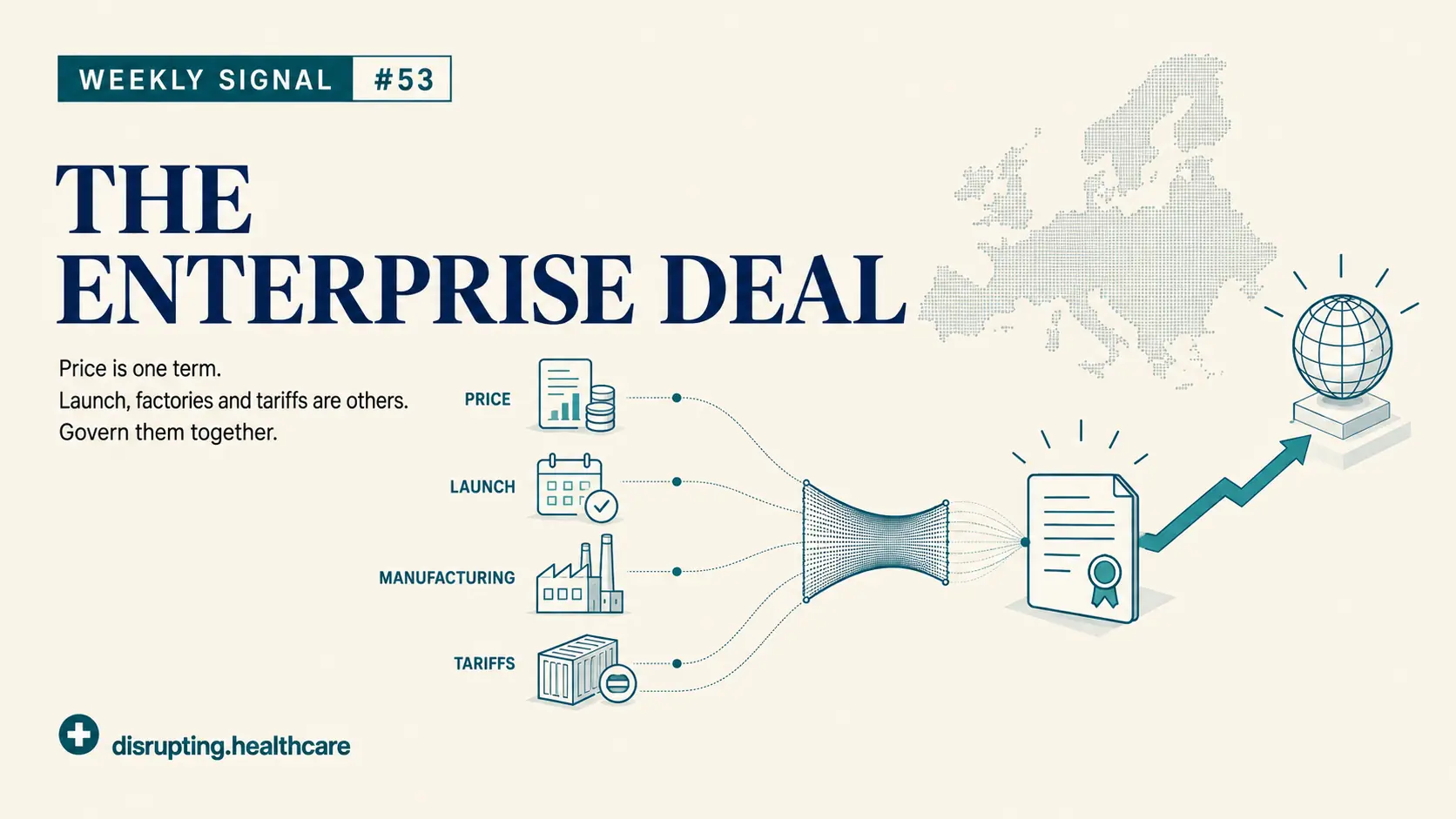
At first sight, this is another pharmaceutical pricing story. Read the tariff rules and company statements together, however, and a different structure appears. Washington is negotiating Medicaid access, future launch pricing, US manufacturing and tariff exposure as parts of one corporate package.
IN THIS ISSUE
The signal · The operator's take · Operating-model implication · One thing to remember
The signal
PRICING · ACCESS · MANUFACTURING · TRADE
The White House says every state Medicaid programme will gain access to MFN prices on products from the nine companies. It also says the agreements guarantee MFN prices on all new innovative medicines they bring to market. Alongside pricing, the companies committed at least $19.6 billion collectively to near-term US manufacturing, while several agreed to contribute active ingredients to a strategic reserve.
The trade mechanism is already public. Under the 2 April Section 232 proclamation, the default tariff on covered patented pharmaceutical imports is 100%. Products originating in the EU, Japan, South Korea, Switzerland and Liechtenstein receive a 15% rate unless a lower treatment applies. An approved onshoring plan can qualify a company for 20%. A qualifying onshoring plan combined with an MFN agreement can bring the rate to zero until 20 January 2029. The regime took effect for named large manufacturers on 31 July and reaches other companies on 29 September. Commerce can raise rates if commitments are not fulfilled.
The company announcements show why this should not be described as one universal price formula.
Astellas says it will lower Medicaid prices and align future medicine pricing with developed markets while reflecting international market conditions, innovation and patient value. Additional terms are undisclosed.
UCB describes a more balanced approach to future launch pricing, participation in the GENEROUS Medicaid programme and continued US manufacturing. It says the agreement removes Section 232 tariffs from its current products and exempts it from future pricing mandates.
BridgeBio says it will expand Medicaid access to Attruby but does not expect future pricing mandates. Its specific terms are also confidential.
Even the count needs attribution. The White House includes Teva among the nine, while Reuters reported that Teva said it was still in discussions. That discrepancy does not change the mechanism. It does show why an umbrella announcement should not be mistaken for identical contract terms.
The operator's take
The neat headline would be that Europe's lowest net price now sets the American price. The public evidence does not support that precision. The agreements are confidential, and the companies describe materially different commitments.
The defensible conclusion is more useful: European pricing and launch decisions now enter the US commercial equation by design.
The administration's own MFN framework says prospective MFN for new medicines is intended to apply across US markets and to combine lower US prices with upward pressure on prices in other wealthy countries. Tariff relief supplies the negotiating leverage.
The economics are asymmetric. IQVIA estimates that the US generates 68% of cumulative list-price revenue in an innovative medicine's first five years, against 16% from the five largest European markets. IQVIA also cautions that the recent decline in European launches began before the May 2025 MFN announcement and cannot yet be attributed to the policy.
My inference is that the pressure will be greatest where the portfolio is narrow. A company dependent on one or two growth assets has less room to absorb a local access concession, a delayed launch or a change in US economics. But delay is a scenario to model, not an outcome the evidence has already proved.
The operating-model implication
Treating MFN as a market-access workstream is now too narrow. The response needs three changes.
1. Appoint one executive owner
Global pricing, US market access, finance, manufacturing, tax and trade, government affairs and the relevant asset team need one decision forum. Coordination without a final decision right will simply move the conflict between functions.
2. Model the full bargain
For each asset and launch market, the scenario model should connect the international price corridor, US revenue, tariff exposure, manufacturing commitments and the patient-access cost of delay. The output should be cash and value at risk, not another colour-coded heat map.
3. Rewrite the decision rights
Affiliates cannot be held accountable for access speed while global teams retain an undefined right to reject the price required to achieve it. The floor, escalation threshold and veto owner need to be explicit before negotiations begin.
For the wider argument, see Who Controls the Route to Market? and the H1 2026 synthesis of European commercial transformation.
ONE THING TO REMEMBER
MFN is no longer just a pricing workstream. It is an enterprise deal.
When pricing, launch and manufacturing are negotiated together, they must be governed together.
