Europe Life Sciences Weekly Signal #46: The Machine Is the Moat

Week of 13–19 July 2026 · 11-minute read
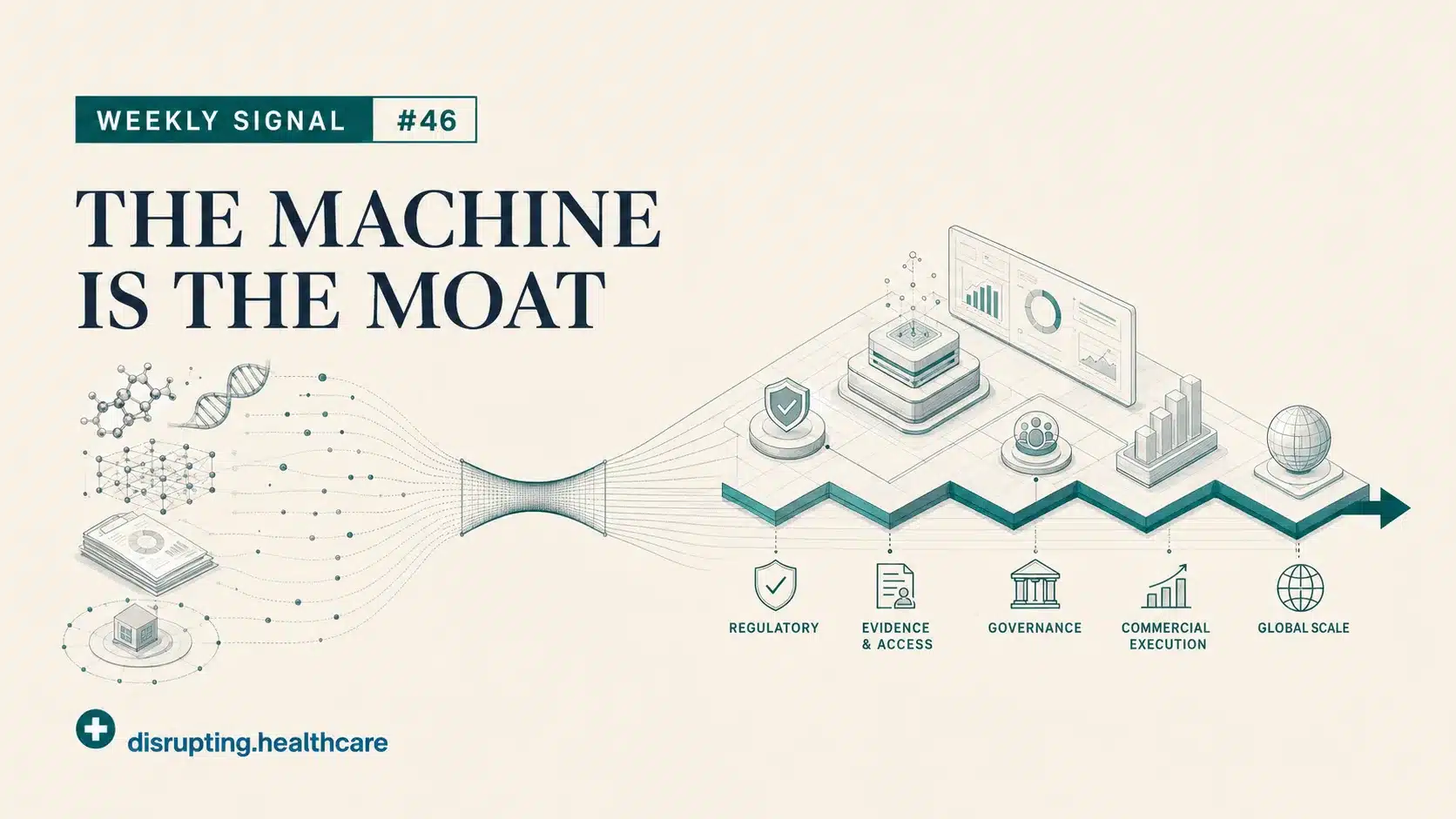
What companies source matters. What their operating model can convert matters more.
Last week’s signal asked who industrialises the science.
This week, the buyers answered.
AstraZeneca licensed a lung-cancer medicine discovered in China. Angelini Pharma completed a $4.1 billion acquisition that gives it a US rare-disease portfolio and commercial infrastructure. Novartis formalised access to an American AI platform after more than a year of technical engagement.
None of those moves delivered a finished advantage. Each moved an organisation closer to a source of something it did not want to build slowly in-house: science, commercial reach or intelligence.
They are about deciding which capabilities deserve to sit inside the organisation, which can be sourced, and where integration creates more value than ownership alone.
The public side of the market moved in the same direction. Portugal joined a cross-border network built around reviewed AI tools and real-time incident sharing: the early plumbing of continuous assurance.
Even Neko Health’s $700 million funding round points to the same conclusion from the opposite direction. Its proposition is not one scanner or one algorithm. It is a vertically integrated service—hardware, software, clinics, clinicians, data and a recurring customer relationship—that the company is choosing to build and control.
Set beside issue #45, the pattern becomes clearer. Last week showed originators handing the capital-intensive middle of the value chain to larger balance sheets. This week shows how industrialisers source what they will scale—and what they refuse to rebuild.
Assets can be licensed. Platforms can be accessed. Commercial reach can be acquired.
The machine that converts them into trusted, reimbursed and repeatable scale is the moat.
IN THIS ISSUE Commercial moves • AI & operating models • Regulation & governance • What leaders should watch • Practitioner’s Lens
Key Signals
AstraZeneca buys a de-risked asset and applies its global machine.
The $1.5 billion Zegfrovy licence shows the value of pairing differentiated external science with internal regulatory, access, launch and lifecycle capabilities.
Angelini buys US commercial reach rather than building it slowly.
Catalyst brings products, rare-disease expertise and an operating US commercial platform. The infrastructure is part of the asset.
Novartis gains platform access. Value still depends on workflow redesign.
The Chai collaboration spans multiple therapeutic programmes. It will matter only if decision rights, experimental loops and portfolio choices change around the models.
AI assurance is becoming shared infrastructure.
Portugal’s HealthAI move shifts governance from principles toward reviewed-tool directories, incident reporting and cross-border regulatory learning.
Commercial Moves
Zegfrovy shows what a global industrial machine is worth
$600m upfront
Up to $900m in milestones
Worldwide development and commercialisation rights
On 14 July, AstraZeneca announced an exclusive global licence for Zegfrovy (sunvozertinib) from Dizal Pharmaceutical. AstraZeneca will pay $600 million upfront, with up to $900 million in development, regulatory and sales milestones, plus tiered royalties. Closing is expected in the second half of 2026, subject to customary conditions.
This is not a discovery-stage option dressed up as a franchise.
Zegfrovy is already authorised in China and received US accelerated approval in July 2025 for adults with locally advanced or metastatic non-small-cell lung cancer carrying EGFR exon 20 insertion mutations whose disease progressed on or after platinum-based chemotherapy. The first-line WU-KONG28 phase III results were published in the New England Journal of Medicine in May.
AstraZeneca is therefore licensing an approved, clinically advanced asset with evidence that may support expansion into an earlier treatment setting. The remaining value will be created through regulatory execution, testing infrastructure, market access, launch sequencing and lifecycle development across multiple markets.
The discovery happened inside a Chinese biotech. The global compounding machine sits inside AstraZeneca.
That distinction matters more than the usual argument about whether large pharma should build or buy. A capable industrialiser does not need every asset to originate internally. It needs to make the asset worth more after it enters the system.
For commercial leaders, this reframes integration. The question is not how quickly a licensed product can be inserted into the portfolio. It is whether medical, regulatory, access, diagnostics, supply and commercial teams can jointly identify where the asset’s value will expand—and make those decisions before launch plans harden.
The licence buys the molecule.
The operating model determines how much franchise arrives with it.
Angelini did not only buy products. It bought a US commercial position.
On 16 July, Angelini Pharma completed its acquisition of Catalyst Pharmaceuticals. The transaction integrates Catalyst’s portfolio and commercial infrastructure with Angelini’s brain-health and rare-disease business.
The original agreement valued Catalyst at approximately $4.1 billion, or €3.5 billion. Its completion moves Angelini from a European company with US ambition to an organisation with an operating US rare-disease platform.
That is a more consequential shift than adding revenue from another portfolio.
Rare-disease commercialisation depends on capabilities that are expensive to reconstruct market by market: patient finding, specialist relationships, payer access, patient services, distribution and evidence generation after launch. Catalyst already has a system around its products. Angelini is buying entry into that system as well as the products themselves.
The strategic test now is integration without neutralisation. Acquirers often pay for specialist speed, customer intimacy and market knowledge, then bury them under the governance designed for a different scale of company. If Angelini preserves the local capabilities that made Catalyst valuable while connecting them to a broader global platform, the deal can compound. If it standardises first and learns later, part of the premium will evaporate into the org chart.
This is the buyer-side version of last week’s industrialisation argument.
Sometimes scale comes from building the machine.
Sometimes it comes from recognising that the machine is what you are buying.
AI & Operating Models
Access to an AI platform is not the same as acquiring an advantage
This week, Chai Discovery announced a collaboration with Novartis that gives the company access to Chai’s latest AI models, including Chai-3, for antibody discovery across multiple therapeutic programmes.
The financial terms were not disclosed. No targets or candidate assets were named. The announcement says the agreement follows more than a year of technical engagement, including early access to Chai’s next-generation folding model last spring.
Those facts support a cautious interpretation: this is broader access to capabilities, not a conventional licence for a single molecule. They do not tell us how Novartis will govern the platform, what economics apply or what performance thresholds it has set.
The operating-model point is nevertheless clear.
An AI model creates value only when the organisation changes the work around it: which programmes enter the model, who decides which designs advance, how experimental results feed back, how evidence is compared with conventional methods and when teams stop pursuing a machine-generated option.
Without those decisions, the platform becomes an impressive second opinion.
More than one year of prior technical engagement is therefore more interesting than AI language. It suggests that Novartis tested fit before broadening deployment. That is what serious capability adoption looks like: validate the workflow and decision model, not only the model output.
The same discipline applies in commercial functions. As argued in AI-Powered Commercial Operating Models in Life Sciences, a next-best-action engine, content agent or targeting model is not an outcome. It becomes useful when data flows, decision rights, approval logic, incentives, and human accountability are redesigned around it.
The platform may be external.
The accountability for the decisions it changes cannot be outsourced.
The platform is not the transformation. The redesign around it is.
Neko’s $700m round is a bet on vertically integrated prevention
On 15 July, Swedish-founded Neko Health announced a $700 million Series C round ahead of its US launch. The company says more than 350,000 people have joined its waitlist or registered for a scan, more than 100,000 have completed one in Sweden and the UK, and around 75% of members book and prepay for the following year’s scan before leaving their appointment.
Those uptake and retention numbers are company-reported. They are commercially striking, but they are not a substitute for independent evidence of population-level clinical value.
That distinction is important because Neko is not simply selling a diagnostic device. It owns much of the hardware, software, physical clinic environment, clinical encounter, customer experience and longitudinal data relationship. The recurring scan turns a one-off diagnostic interaction into something closer to a membership model.
Vertical integration gives Neko control over the experience and the learning loop. It also concentrates risk. The company must prove that expansion does not outrun clinical utility, that detection creates useful action rather than unnecessary follow-up, and that a self-pay model can move beyond affluent early adopters.
That is why the round matters beyond digital health funding. It tests whether a European HealthTech company can scale a complete service model internationally rather than exporting one component and relying on somebody else to operate the pathway.
As with digital health commercialisation more broadly, the durable advantage will not come from regulatory permission or attractive technology alone. It will come from the system that earns trust, fits clinical decisions, generates evidence and retains the relationship.
Read beside Angelini, Neko represents the opposite answer to the same strategic question. Angelini decided a working route into the US market was worth buying intact. Neko is betting that its route to the customer is the differentiator and must be owned. One bought an operating machine. The other is trying to become one.
Regulation & Governance
AI governance starts to look like operating infrastructure
Portugal became the first EU member state to join HealthAI’s Global Regulatory Network. Under the agreement, INFARMED gains access to a directory of regulator-reviewed AI health tools and a real-time warning system for harmful incidents.
This is more concrete than another responsible-AI principle.
Directories, incident exchange and shared regulatory learning are the beginnings of continuous assurance. They recognise that healthcare AI cannot be judged once at launch and then treated as static. Models, data, deployment settings and user behaviour change.
That has a commercial consequence. Post-market monitoring, incident response, version control and explainability are becoming part of the product promise. A company that cannot show how its system behaves after deployment will struggle not only with regulators, but with hospital procurement, clinical governance and payer confidence.
The timing matters. The Commission’s consultation on draft high-risk AI classification guidelines closes on 23 July. Under the politically agreed AI Omnibus timetable, standalone systems in specified high-risk areas move to 2 December 2027, while qualifying AI embedded in regulated products moves to 2 August 2028.
But the longer runway does not reset duties already in force. AI literacy obligations have applied since February 2025 and governance and general-purpose AI obligations since August 2025. Much of the remaining regime, including important transparency provisions, arrives from August 2026.
The practical priority is not waiting for the last deadline. It is building a reliable inventory of systems, intended purposes, owners, data, vendors, decisions influenced and monitoring obligations.
The deadline moved.
The need to know what is running inside the organisation did not.
What Leaders Should Watch
Whether acquisition integration protects the capability being bought
Angelini–Catalyst is the clearest test. Watch reporting lines, decision rights, US-market autonomy and how quickly global standardisation arrives. Integration creates value only if it connects specialist capability without flattening it.
Whether AI platform partnerships disclose evidence, not just access
The next useful signal from Novartis–Chai will not be another model announcement. It will be evidence that the platform changed cycle time, candidate quality, decision confidence or portfolio productivity—and clarity about where human accountability remained.
Whether preventive-health retention translates into clinical value
Neko’s rebooking rate supports a strong consumer proposition. The harder test is whether longitudinal scanning improves decisions and outcomes without producing avoidable investigation. Commercial retention and clinical utility need to converge.
Whether AI governance becomes interoperable across markets
Portugal is the first EU member state in the HealthAI network, not the last. Watch whether shared directories and incident reporting begin to influence national procurement, post-market expectations and the evidence vendors must supply.
Practitioner’s Lens
The lazy reading of this week is that large companies went shopping while regulators added more process.
The more useful reading is that each organisation was deciding where value should be created.
AstraZeneca does not need to discover every molecule if its regulatory, access and commercial system can globalise the right external asset better than anyone else. Angelini does not need to assemble US rare-disease infrastructure function by function if it can acquire a working platform and integrate it intelligently. Novartis does not need to own every foundational model if it can test one rigorously, embed it into discovery decisions and retain accountability for the consequences.
Portugal and HealthAI are making the same choice on the public side. They are building shared machinery around innovation: reviewed-tool visibility, incident learning and a more continuous form of assurance.
Neko is the useful counterexample because it is choosing to own almost the whole experience. That makes sense only if vertical integration improves the evidence loop and customer relationship faster than it increases cost and risk.
There is no universal answer to build, buy or partner. There is a universal requirement to know which capability makes an input worth more inside your organisation than outside it.
Build disproportionately around that capability. Source the rest deliberately, while you still have leverage.
That is the VP-level operating question hiding underneath every transaction and AI announcement this week.
Not: what can we own?
But: what must we be unusually good at converting?
Products change. Partners change. Platforms change. Regulation changes.
The operating model is the mechanism that allows the organisation to absorb those changes without restarting transformation every eighteen months.
ONE THING TO REMEMBER
Innovation becomes an advantage only after the organisation converts it.
The molecule can be licensed. The model can be accessed. The commercial platform can be acquired.
What cannot be bought ready-made is the operating model that makes every sourced input worth more after it enters the organisation.
Sources are linked inline. Transaction terms and operating metrics attributed to companies are identified as company-reported. Interpretation is the author’s. This publication does not accept sponsored placement.
