
European Life Sciences Commercial Transformation: What H1 2026 Actually Changed

H1 2026 SYNTHESIS · 13-MINUTE READ
The product did not become less important. It became less sufficient.
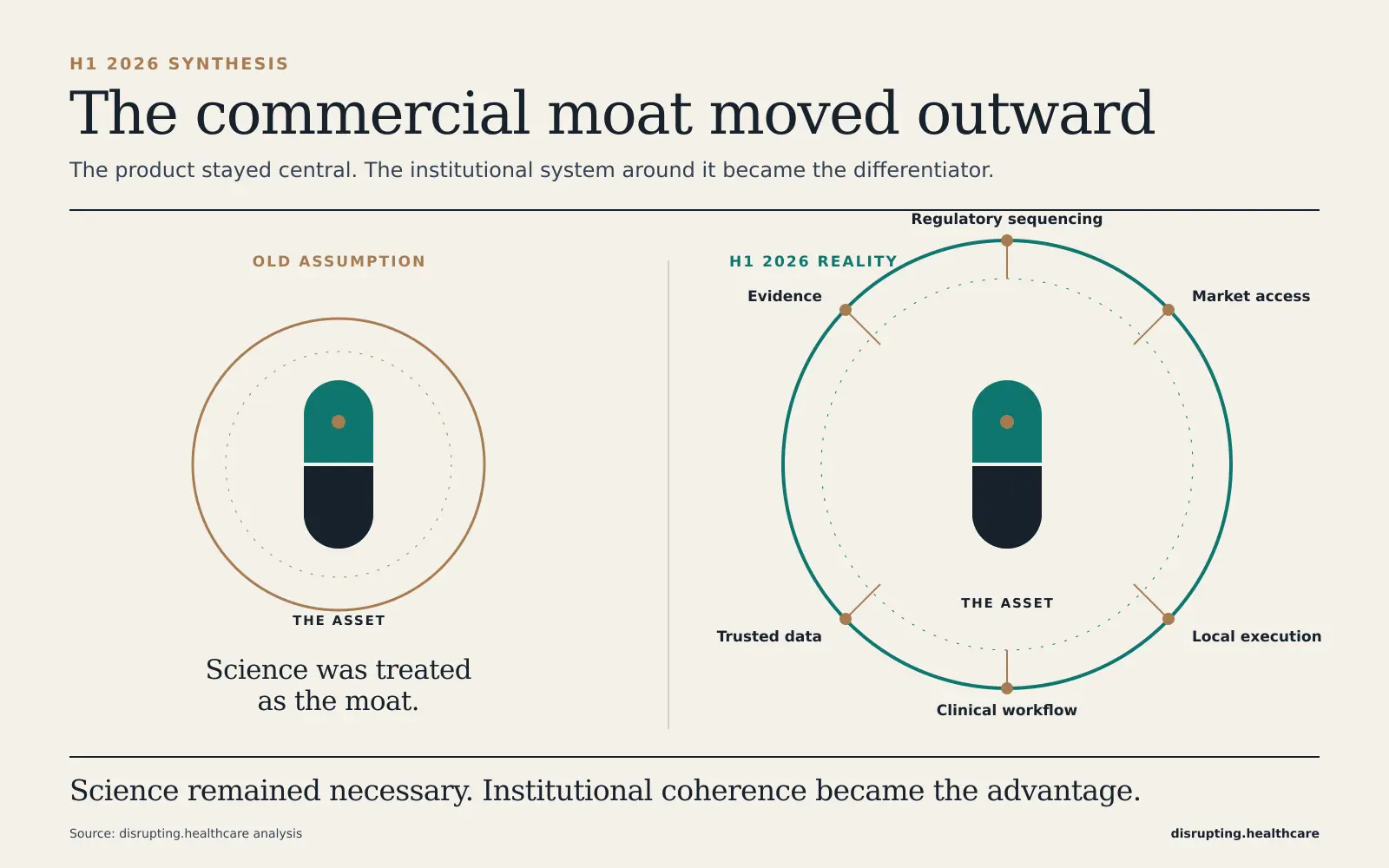
The first half of 2026 did not make the molecule, device or algorithm less important. It made them less sufficient. Across pharma, MedTech and digital health, advantage moved towards the institutions able to connect evidence, regulation, access, data and workflow into one coherent commercial system.
Week by week, the first half of 2026 looked like a run of unrelated stories: a licensing cheque here, a regulatory deadline there, another AI pilot somewhere else.
Read together, they describe one structural shift.
Advantage in European life sciences is moving away from what a company owns and towards what its institution can reliably do.
The asset still matters. Obviously. A coherent operating model cannot rescue an ineffective medicine, an unsafe device or a useless algorithm. But H1 showed that the molecule, device or model is increasingly the beginning of the commercial proposition rather than the whole of it.
What separates stronger organisations is their ability to generate the right evidence on schedule; hold a regulatory, pricing and market-access sequence across jurisdictions; maintain trusted product data; integrate into clinical workflow; govern AI inside consequential decisions; and execute locally without rebuilding the model market by market.
This is not a softer version of “innovation matters”. It is a harder one. Innovation has become the entry ticket. The differentiator sits underneath it, in the layer many organisations still treat as somebody else’s job.
That is what H1 2026 actually changed in European life sciences commercial transformation.
IN THIS ANALYSIS Three assumptions • Pharma launch • MedTech • AI governance • Capital • H2 decisions • Practitioner’s Lens
The three assumptions H1 invalidated
Every half-year produces noise. What made this one useful was how consistently very different events challenged the same three assumptions.
Assumption one: the asset is the moat
For a long time, the logic was persuasive. Own the molecule, the device or the platform and advantage should follow.
H1 complicated that logic. Bristol Myers Squibb’s agreement with Hengrui covered 13 early-stage programmes across oncology, haematology and immunology, with a potential total value of approximately $15.2 billion. GSK agreed to pay $10.6 billion for Nuvalent, including two late-stage lung-cancer assets already under FDA review.
One deal bought breadth. The other bought late-stage certainty. Both make the same point: attractive science and reduced development risk can be purchased by organisations with sufficient capital.
Certainty is now purchasable. That does not make the asset unimportant; it means owning one no longer guarantees differentiation. The harder-to-buy advantage lies in what happens next: portfolio choices, evidence generation, regulatory sequencing, market preparation and integration into the commercial system.
The asset creates the opportunity. Institutional capability determines how much of it is captured.
Certainty is now purchasable. Operating coherence is not.
Assumption two: approval means the product is launch-ready
Approval remains essential. It is simply not the same as readiness.
NICE’s June recommendation of AbbVie’s Elahere made that distinction unusually visible. The decision opened NHS access to the first new treatment in more than 20 years for a particular form of platinum-resistant ovarian cancer. Yet NICE estimated that around 270 people would be eligible in year one, rising to approximately 420 by year three as access to the diagnostic test required to confirm eligibility becomes more widely available.
The medicine was approved. The commercial and clinical pathway still had to catch up.
The same applies in MedTech. A CE mark permits competition; it does not identify a budget owner, integrate data, redesign a clinical workflow, train users or establish a service model. In digital health, a validated algorithm does not automatically create interoperability, reimbursement or frontline trust.
Launch readiness therefore has to include the label and evidence package, but also diagnostics, site capacity, reimbursement mechanics, product-data quality, supply resilience, training and local pathway ownership.
The milestone earns the announcement. The system earns the adoption.
Assumption three: capability can be acquired or deployed as fast as it can be operated
H1 was rich in transactions, partnerships and AI deployments that promised new capabilities. But a transaction transfers ownership, not organisational muscle.
Roche’s agreement to acquire PathAI for $750 million upfront and up to $300 million in milestones brings digital pathology tools, AI-enabled workflow and clinical-development services into an organisation already strong in diagnostics and companion diagnostics. The strategic logic is compelling precisely because the pieces can reinforce one another.
But the value will not be created by ownership alone. It depends on connecting data, product teams, diagnostic platforms, evidence plans, regulatory accountabilities and customer workflows. The same test applies to an AI platform deployed across commercial or medical functions: the licence may arrive in weeks; decision rights, validation, adoption and accountability do not.
Technology can be purchased. Assets can be licensed. Market reach can be borrowed through a partner. A coherent way of working across functions and markets cannot be installed by contract.
This was the quiet commercial risk of H1: the widening gap between capability owned and capability operational.
What changed in pharma launch strategy
The traditional sequence—develop, approve, reimburse, activate—was always tidier in PowerPoint than in reality. H1 made it look positively quaint.
Commercial strategy moved upstream because decisions about evidence, regulatory sequence, delivery model and supply began determining the available launch long before a launch team would traditionally receive the asset.
The first shift was from evidence as a submission requirement to evidence as a lifecycle capability.
Novartis withdrew its application to extend Pluvicto into an earlier prostate-cancer setting after EMA concluded that unresolved issues remained. Although the trial improved radiographic progression-free survival, the regulator questioned whether the comparator was adequate, whether the delay represented meaningful patient benefit and noted that the treatment had not improved overall survival against that comparator.
That is not a late regulatory inconvenience. Comparator choice, endpoint strategy and the interpretation of clinical benefit shape the commercially available label years before launch.
Tavneos showed the same principle after approval. In June, EMA recommended revoking its EU marketing authorisation after concluding that data from the pivotal ADVOCATE study could no longer be relied upon to demonstrate effectiveness. The agency’s position was stark: the medicine’s benefits were no longer proven to outweigh its risks.
Evidence does not merely get a product onto the market. It keeps it there.
The second shift was from one launch sequence to several jurisdiction-specific ones.
Sanofi received an FDA complete response letter for tolebrutinib in December 2025. Six months later, the European Commission approved the same asset as Cenrifki for secondary progressive multiple sclerosis without relapses in the previous two years, with liver monitoring and a risk-management programme central to introduction.
The important lesson is not that Europe was permissive and the United States was restrictive. It is that one global evidence package can produce different regulatory outcomes, labels, safety narratives and market opportunities. Regulatory divergence is no longer an exception to be managed after the fact. It is a portfolio and market-sequencing variable.
The third shift was that the delivery architecture became part of the product strategy.
Oral obesity medicines, subcutaneous oncology regimens and therapies designed for community or outpatient delivery do more than improve convenience. They change site capacity, prescriber reach, monitoring, persistence, reimbursement, staffing and cost-to-serve. A formulation choice can expand or constrain the addressable market years before brand planning begins.
And supply moved into the commercial proposition. The EU’s Critical Medicines Act explicitly uses public procurement to incentivise resilient supply chains. For affected categories, manufacturers increasingly have to explain not only why a medicine works and what it costs, but whether supply can be sustained when the system needs it.
This changes the role of commercial leadership. Commercial, medical, market access, regulatory and country perspectives need to shape trial design, comparator selection, diagnostics, formulation, supply and market sequence while those decisions remain changeable.
The practical shift is from launch excellence to launch architecture.
Launch excellence asks whether the organisation can execute the plan. Launch architecture asks whether earlier decisions created a plan worth executing.
What changed in MedTech regulation and procurement
European MedTech spent much of the previous few years treating regulation as a defensive exercise: survive MDR and IVDR, secure notified-body capacity, protect the portfolio and keep certificates moving.
H1 introduced a more demanding model. Europe required stronger operating discipline across the installed portfolio while creating earlier support for selected innovation.
On 28 May, four EUDAMED modules became mandatory: actor registration, UDI and device registration, notified bodies and certificates, and market surveillance. The European Commission’s EUDAMED framework moved product identity, certification and surveillance further into shared infrastructure.
That turns master data into a commercial-readiness issue. Poor product data will not remain politely inside regulatory affairs. It appears in distributor queries, portfolio changes, market surveillance, tender documentation and launch delays.
At the same time, EMA launched a breakthrough medical-device pilot offering expert-panel support on designation, clinical-development strategy, investigations and post-market follow-up. The direction is important: selected high-impact devices receive earlier dialogue, but in return need an evidence architecture credible enough to support adoption as well as conformity assessment.
The policy debate also shifted from administrative burden towards predictability and competitiveness. MedTech Europe’s May position argued that slow and unpredictable conformity assessment, administrative burden and divergent interpretation were affecting access, availability and investment. Its central formulation is the useful one: a simpler and more predictable system is not a shortcut on safety; it is a condition for timely access and continued innovation.
The United Kingdom added another sequencing variable. The MHRA consulted on indefinite recognition of CE-marked devices in Great Britain while existing transitional arrangements remain in place. This was a proposal, not yet a final rule, but it showed how recognition policy can alter market-entry economics before a company changes anything about the device itself.
Procurement and funding moved in the same direction. EIT Health’s 2026 Innovation Validation Call targeted digital and AI-enabled medical technologies ready for clinical validation and market launch. It funded pivotal studies, real-world evidence, regulatory submission and commercialisation—and required projects to aim for market entry and revenue. The criteria joined clinical proof, regulatory readiness and a route to market in one plan.
For MedTech leaders, the commercial unit is no longer the device alone. It is the device plus evidence, integration, training, service, cybersecurity, trusted data and workflow change.
Hospitals do not procure innovation in the abstract. They procure a manageable implementation burden with a defensible clinical and economic outcome.
WATCH THE REGULATORY DEBATE
Medical Devices: Innovation and Patient Safety
The European Commission’s March 2026 conference examined predictability in conformity assessment, evidence-based regulation and breakthrough-device pathways—the institutional questions behind Europe’s MedTech competitiveness.
Why AI moved from tooling to governance
At the start of the generative-AI cycle, life sciences asked where the technology could help. By mid-2026, the more consequential question was what the organisation must become if it does.
The shift occurred because AI moved closer to real decisions: trial design, evidence generation, pharmacovigilance, competitive intelligence, medical information, content review, next-best action and diagnostic support.
Once AI influences those workflows, model performance is only one part of the operating question. The organisation also needs an inventory of systems and intended uses; named owners; data lineage; validation thresholds; human-review rules; escalation paths; and post-deployment monitoring. That is the distinction between adopting AI and redesigning the commercial operating model around it.
European institutions began building the same machinery. In June, the Commission appointed a 60-member Scientific Panel and a broader Advisory Forum to support implementation and enforcement of the AI Act. EMA and the Heads of Medicines Agencies published their 2025 AI Observatory report, identifying gaps in model validation, audit frameworks, regulatory-grade acceptability and monitoring while feeding the 2026–2028 work programme.
The organisational signal was just as telling. Sanofi appointed Paulo Fontoura—previously chief medical officer of AI-native Xaira Therapeutics—as global head of pharma R&D and a member of its executive committee. The appointment moved AI-native experience from the perimeter of the industry into ownership of an end-to-end enterprise function.
Then, on 29 June, the Council gave final approval to an AI Act simplification package that delayed application of high-risk rules to December 2027 for stand-alone systems and August 2028 for systems embedded in regulated products. That creates more runway. It does not remove the work.
The tempting interpretation is that companies can wait. The operator interpretation is the opposite. System classification, governance and evidence are slow to reconstruct after deployment. The revised timetable is valuable precisely because it creates time to build them before a portfolio of pilots becomes a portfolio of unmanaged dependencies.
Generic enterprise AI governance will not be enough. A model embedded in a diagnostic device, an assistant summarising pharmacovigilance cases and a commercial next-best-action engine do not create the same risk or evidence burden. Central principles matter, but control must follow intended use and decision impact.
H1 did not end AI experimentation. It ended the excuse for treating experimentation as strategy.
FURTHER CONTEXT
AI in health: navigating the future of European healthcare
This European Policy Centre discussion examines the data, infrastructure, regulation and organisational conditions required to move health AI beyond isolated pilots. It is included as background context, not as evidence of an H1 2026 event.
Where capital concentrated
Capital did not retreat from life sciences in H1. It became more explicit about the uncertainties it was willing to finance.
Selected H1 2026 transactions
| Transaction | Disclosed value | Capability acquired | Uncertainty reduced |
|---|---|---|---|
| BMS–Hengrui | Up to $15.2bn | 13 early-stage oncology, haematology and immunology programmes | Portfolio breadth and discovery sourcing |
| GSK–Nuvalent | $10.6bn | Two late-stage targeted lung-cancer assets | Clinical validation and time to market |
| Roche–PathAI | $750m upfront; up to $300m milestones | Digital pathology workflow, AI and biopharma services | Workflow position and diagnostic integration |
| Lilly–Kelonia | Up to $7bn; $3.25bn upfront | In-vivo CAR-T platform | Delivery complexity and manufacturing burden |
| Angelini–Catalyst | $4.1bn | US rare-neurology portfolio and commercial infrastructure | Market access and commercial reach |
Three concentrations were visible.
The first was validated or near-market assets. GSK’s $10.6 billion Nuvalent agreement included two targeted lung-cancer assets already under FDA review and expected to contribute to growth from 2027. The premium was not simply for clever chemistry. It was for clinically validated targets, compressed time and fewer unanswered questions.
The second was science capable of changing the operating architecture around a therapy. Lilly agreed to acquire Kelonia for up to $7 billion, including an upfront payment of $3.25 billion. The strategic attraction of in-vivo CAR-T is not only therapeutic. It could remove some of the patient-specific manufacturing, logistics, pre-treatment and access burden associated with ex-vivo cell therapy.
Capital was willing to pay for science that might redesign the system required to deliver it.
The third concentration was infrastructure embedded in decisions and markets. Roche–PathAI bought a position in pathology workflow, companion diagnostics and biopharma services. Angelini Pharma’s proposed $4.1 billion acquisition of Catalyst Pharmaceuticals bought entry into the United States, a rare-neurology portfolio and an established commercial infrastructure.
One transaction acquired workflow. The other acquired market machinery.
The pattern is not that investors stopped funding early science. They did not. It is that the strongest premiums clustered where an asset was already connected to proof, workflow, delivery advantage or commercial infrastructure.
Capital paid for fewer unanswered questions.
That raises the bar after acquisition. When certainty and capability can be bought, they stop being sufficient differentiators. Advantage shifts to how well the buyer integrates evidence, access, data, decision rights and local execution around them.
What leaders should change in H2
H2 should not begin with another transformation portfolio. Most organisations already have enough initiatives to supply a respectable archaeological site.
It should begin with five operating decisions.
1. Redefine launch readiness around the pathway
Add diagnostics, site capacity, data, training, reimbursement mechanics, supply and local workflow ownership to launch-readiness reviews. If the product is ready but the pathway is not, the forecast should reflect the pathway.
2. Move commercial and access decisions upstream
Put commercial, medical, access and country leaders into evidence, comparator, formulation and regulatory-sequencing decisions early enough to change them. Attendance is not influence; define the decisions in which their input changes the design or their sign-off is required.
3. Build one evidence spine across the lifecycle
Connect clinical, regulatory, medical, HTA, real-world evidence and post-market responsibilities. Pluvicto and Tavneos were unusually visible examples of different evidence failures, but the broader lesson is that quality, traceability and interpretation remain commercial assets after approval.
4. Govern AI by intended use and decision impact
Create a usable inventory of AI systems, owners, data, affected decisions and human controls. Do not govern every use case identically, and do not let each function invent its own miniature constitution.
5. Measure integration, not acquisition
For acquired assets, partnerships and platforms, track the milestones that show institutional absorption: shared data, aligned evidence plans, clear decision rights, local access readiness, workflow adoption and realised outcomes.
Closing a deal is an event. Operating the capability is the strategy.
Practitioner’s Lens
The easy conclusion from H1 is that life sciences became more complex.
It did. That is not yet an insight.
The useful conclusion is that complexity migrated into the interfaces between functions and institutions.
Evidence meets regulation. Regulation meets HTA. Product data meets market continuity. AI meets decision rights. Formulation meets site capacity. Acquisition meets integration. Approval meets workflow.
Those interfaces are where many organisations are weakest because they sit between established accountabilities. Everyone owns part of the outcome; nobody owns the conversion from scientific potential to repeatable adoption.
That is why commercial transformation in European life sciences can no longer be reduced to omnichannel, field-force design or launch execution. Those remain important. But the higher-value task is designing the operating environment in which evidence, access, technology and execution reinforce one another across markets.
The fast movers in H1 were not necessarily the companies with the boldest announcements. They were the ones whose operating layer could convert those announcements into outcomes—the broader shift behind the observation that the system is becoming part of the product.
ONE THING TO REMEMBER
H1 2026 did not move the moat away from the product.
It widened the moat to include everything required to make the product commercially usable.
Sources are linked inline. Transaction terms and operating metrics attributed to companies are identified as company-reported. Interpretation is the author’s. This publication is independent and does not accept sponsored placement.
