
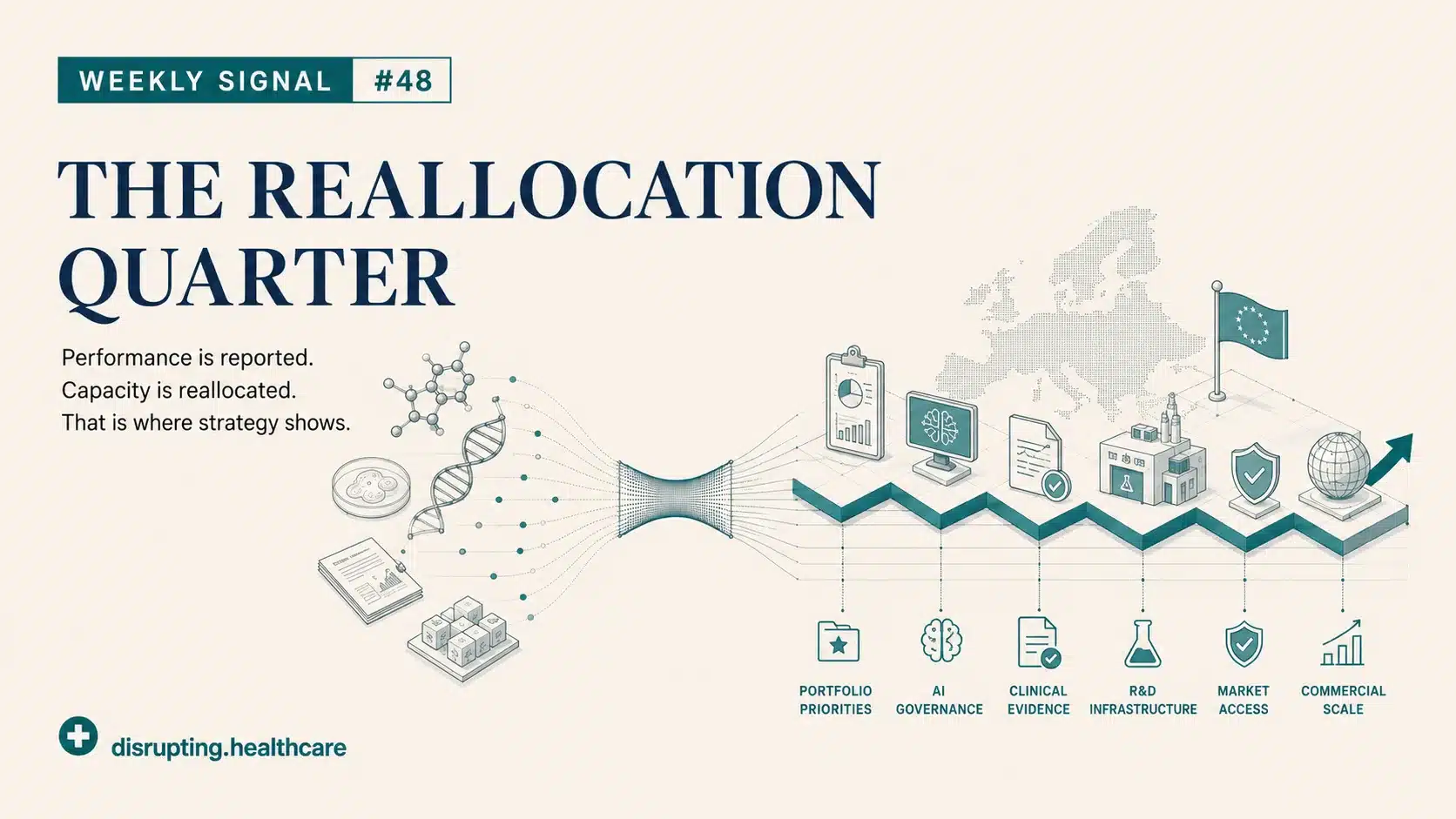
Europe Life Sciences Weekly Signal #50: Who Controls the Route to Market?

WEEK OF 10–16 AUGUST 2026 · 15-MINUTE READ
This week, the decisive choices sat outside the product team.
Switzerland offered the clearest warning. An industry survey found that companies had withheld seven of 22 new medicines from reimbursement submission because a Swiss price could affect their economics in the United States. In three further cases, companies did not submit the medicine for Swiss regulatory approval at all.
The same pattern appeared in less defensive forms elsewhere. Lilly secured the first European authorisation for orforglipron, but UK market creation now passes from the MHRA to private channels and, eventually, NICE. Novo Nordisk already holds EU-wide authorisation for its rival oral Wegovy, but still faces national access decisions. The European Medicines Agency began reviewing a Lyme disease vaccine for a category that does not yet exist commercially. Abbott connected its Lingo glucose sensor to Google Health, exchanging some control of the daily customer interface for scale, AI capability and richer data. Sobi and Innate Pharma designed a deal in which rights move as evidence and capability needs change. Zealand Pharma sold economics tied to a product whose commercial decisions sit with Takeda.
Different markets. Different assets. One operating truth.
The molecule creates the opportunity. A chain of decisions about price, recommendation, channel, evidence, rights and capital determines when that opportunity becomes a market, and who captures the value.
Last week’s Signal asked whether the operating model could convert assets into repeatable outcomes. This week moves to its boundary: who controls the decisions that make execution matter?
IN THIS ISSUE
Life Sciences Route to Market: The Week in Figures
| Signal | Reported event | The decision underneath |
|---|---|---|
| Switzerland reimbursement | 7 of 22 innovative medicines not submitted for reimbursement; 3 further medicines not submitted for approval | When does a local price create more global risk than local access creates value? |
| Lilly / Foundayo | UK became the first European country to authorise orforglipron for weight management and type 2 diabetes | How does approval become equitable access when private and public channels open at different speeds? |
| Pfizer / Valneva | EMA validated the application for PF-07307405 after more than 70% efficacy reported in Phase III | Who creates demand and recommendation for a vaccine category with no incumbent product? |
| Abbott / Google Health | Multi-year partnership will place Lingo glucose insights in Google Health with AI coaching | What should a device company trade for reach, and which part of the customer relationship must it retain? |
| Sobi / Innate Pharma | $75m upfront; up to $505m in further payments as commercial and development rights move in stages | Which capability should control the asset at each evidence threshold? |
| Zealand / Royalty Pharma | $100m for most of Zealand’s future rusfertide economics | When is capital you control worth more than upside dependent on another company’s execution? |
The figures are not directly comparable. The control problem is.
Pharmaceutical Market Access in Switzerland
A national price is no longer a national decision.
Interpharma reported on 13 August that its member companies had not submitted seven of 22 new innovative medicines for reimbursement between January 2025 and June 2026 because Switzerland sits inside the US most-favoured-nation reference framework. In three further cases, companies did not submit the medicine to Swissmedic for approval at all.
Reuters supplied a useful baseline: 15 medicines were submitted for reimbursement in the period, against an average of 24 in comparable 18-month periods from 2019 to 2025.
The limitations matter. The survey is anonymised, the sample is small and the causal attribution comes from an industry association advocating for policy change. It cannot establish how many missing applications would otherwise have proceeded, or whether every decision was driven by US policy.
It still makes a critical mechanism visible.
If the price agreed in Switzerland can reduce the price available in the United States, a concession made to secure Swiss access is no longer a Swiss decision. It becomes a global revenue decision. The rational manufacturer response may be to delay reimbursement, avoid establishing a visible price or not enter the market at all.
The patient waits in Switzerland. The economic exposure sits elsewhere.
This breaks the comfortable assumption that a country team can optimise a launch against local evidence, price and demand. The affiliate may own the submission but not the cross-market consequence. Global pricing may protect enterprise value while appearing locally as delay. Medical teams may face clinician demand for a product the company has chosen not to submit. Policy teams may be asked to solve a Swiss access problem whose commercial cause is American.
The operating response is not another coordination committee. It is explicit decision design. For each launch market, leaders need to know:
- where its published or net price can travel;
- which larger revenue pools become exposed;
- whether confidential agreements contain the risk;
- who can accept the trade-off between local access and global economics;
- when that decision will be revisited.
The risk is no longer only a slow negotiation. It is silent non-entry before negotiation begins.
Obesity Market Access and Channel Design: Eli Lilly in the UK
Lilly won the UK orforglipron race. Novo already holds the EU-wide oral lead.
On 10 August, the UK Medicines and Healthcare products Regulatory Agency authorised Foundayo, Lilly’s once-daily oral GLP-1 orforglipron, for weight management and type 2 diabetes. The UK became the first European country to authorise the medicine.
The regulatory milestone does not yet equal broad access. Reuters reported that Foundayo was not available through the NHS and was expected to launch later in August through private prescription. The medicine remains under EU review.
Novo Nordisk is further ahead at European Union level. On 15 July, the European Commission granted marketing authorisation for oral Wegovy, making once-daily oral semaglutide 25 mg the first GLP-1 tablet authorised for weight management across EU member states. Novo has regulatory breadth; Lilly has a fresh UK entry. Neither position removes the need for country-level reimbursement, launch sequencing and patient-support decisions.
This is not simply the injectable obesity contest in tablet form.
Oral medicines can alter initiation, persistence, pharmacy flow, manufacturing economics and the role of digitally enabled private channels. Foundayo can be taken without food or water restrictions, a practical difference from oral semaglutide. But convenience is not a segment on its own. It becomes commercially meaningful only when linked to a defined patient, prescriber, access route and support model.
Novo Nordisk chief executive Mike Doustdar argued this week that obesity will not be a winner-take-all market. His point is directionally right: a very large chronic-disease market should fragment by route, efficacy, tolerability, comorbidity, willingness to pay and readiness to remain on treatment.
The UK launch will show whether companies can turn that theoretical segmentation into an operating model.
A private-first launch creates speed and learning. It can reveal demand, prescriber behaviour and persistence before public reimbursement. It can also produce a two-speed pathway in which access depends on ability to pay, while the brand, data and service model become optimised for a channel that may not resemble the future NHS pathway.
The commercial question is therefore not which pill wins. It is whether the manufacturer can move patients coherently across private and public routes while building evidence that matters to NICE, clinicians and long-term users.
Approval is permission to compete. Reimbursement and channel design determine the addressable market.
Lyme Disease Vaccine: Europe’s First Market Will Be Built Country by Country
PFIZER · VALNEVA
On 14 August, Pfizer and Valneva announced that the EMA had validated the marketing authorisation application for PF-07307405, a six-valent outer surface protein A Lyme disease vaccine candidate. Validation means that the dossier is administratively complete and assessment can begin. It is not a regulatory opinion on the data.
The application is supported by efficacy of more than 70% reported in the Phase III VALOR study in participants aged five years and older. There is currently no approved human Lyme disease vaccine. The programme has PRIME designation in Europe, and Pfizer holds exclusive manufacturing and commercialisation rights if the candidate succeeds.
A product with no incumbent can look like the easiest possible market. In vaccines, it is often the opposite.
EMA approval would establish safety, efficacy and quality. It would not determine whether national immunisation advisory groups recommend the vaccine, which populations should receive it, whether use should be regional or seasonal, how payers value a prevented infection, or how delivery fits existing vaccination infrastructure.
Europe’s epidemiology makes those decisions especially granular. Tick exposure, surveillance, public awareness and delivery systems vary across countries and within them. The value case in a high-incidence region of Sweden or Germany will not be identical to the case in a lower-incidence setting. A single European authorisation could therefore lead to many different commercial markets.
Pfizer and Valneva need the recommendation pathway mapped before approval, not after it. For each priority country, that means naming:
- the advisory and funding bodies that must decide;
- the population and geography for which the evidence is strongest;
- the health-economic argument for preventing an event that never becomes a treatment claim;
- the surveillance and real-world evidence required after launch;
- the time between authorisation, recommendation, funding and delivery.
This is the cleanest expression of the week’s thesis. The regulator can allow the product to enter. Other institutions decide whether the category scales.
AI and Digital Health Platforms: Abbott and Google Health
Abbott bought reach. The price may be a thinner direct relationship.
On 11 August, Abbott and Google Health announced a multi-year partnership linking glucose insights from Abbott’s over-the-counter Lingo biowearable with Google’s consumer-health technology and AI.
Lingo users will be able to view glucose trends alongside other health and wellness metrics in the Google Health app. Google Health Coach is intended to use those signals to provide personalised guidance on nutrition, activity, sleep and recovery. The companies also plan a large real-world metabolic-health study combining continuous glucose, wearable, laboratory and survey data. Product integrations are expected to roll out later in 2026; Google said that fuller feature and availability details would follow.
Lingo is currently available in the United States and the United Kingdom, giving this otherwise global partnership a direct European beachhead.
Read the agreement as a boundary decision, not an AI announcement.
Abbott gains distribution into an installed consumer ecosystem, a coaching layer it would struggle to build at comparable scale, and the prospect of a richer research dataset. Google gains a continuous biological signal that can make a general health interface more specific and useful.
The trade-off is control of interpretation and habit. If the user sees the glucose curve, receives the recommendation and pays for the coaching experience inside Google’s environment, the platform may become the primary relationship while Abbott supplies the sensor and data.
That conclusion is an inference, not a disclosed commercial term. Abbott may preserve a strong direct relationship through Lingo, and the final product design is not yet public. The risk should nevertheless be measured from launch: acquisition source, cross-app usage, subscription ownership, retention, data permissions and the ability to move the experience if the partnership changes.
The question for every device and digital-health leader is not whether to partner with a platform. It is which layer must remain proprietary. Hardware, data, interpretation, workflow and customer relationship carry different strategic value. Reach is valuable. So is the ability to learn directly from the people using the product.
Life Sciences Partnering: Staged Rights, Capability and Capital
Two European transactions showed how companies can separate asset ownership from the capabilities and economics needed at each stage.
Sobi and Innate Pharma: Rights Move with the Evidence
Sobi and Innate Pharma announced a strategic partnership for lacutamab, an investigational treatment for cutaneous T-cell lymphoma. The transaction remains subject to closing conditions.
The deal was announced under Sobi chief executive Guido Oelkers, who is due to take over as BioNTech CEO in 2027, a transition covered in Issue #49. The partnership will therefore outlast the executive sponsor who launched it, making institutional governance and knowledge transfer more than administrative detail.
Innate will run the confirmatory Phase III TELLOMAK-3 study. Sobi will receive exclusive global commercialisation rights upon a potential accelerated approval and can assume full development rights after positive Phase III results. The economics include $75m at closing, $40m in near-term development milestones and up to $465m connected to the option and later regulatory and commercial events, plus tiered double-digit royalties.
The design avoids pretending that the same organisation must control every stage. Innate retains responsibility while its disease and development knowledge is critical. Sobi’s rare-disease commercial reach becomes decisive closer to launch. Full development control can move after the main evidence threshold.
The contract can allocate rights in stages. The operating model cannot wait for those stages to arrive.
Medical, market-access and country preparation need to begin before commercial rights formally activate. Data standards, evidence narratives and decision forums need to work across both companies while responsibility is divided. Otherwise the deal will have allocated financial risk precisely and launch time poorly.
The principle is useful beyond licensing: transfer control when the next capability becomes decisive, but transfer knowledge before the trigger.
Zealand Pharma and Royalty Pharma: Capital for Decisions Zealand Controls
On 12 August, Zealand Pharma sold most of its economic interest in rusfertide to Royalty Pharma for $100m, with $50m due at closing and $50m one year later.
Royalty Pharma receives a 1% royalty on potential global net sales and related milestone interests. Above $1.5bn in annual sales, Zealand retains 0.25% and Royalty Pharma holds 0.75%. Takeda, which licensed rusfertide from Protagonist Therapeutics, remains responsible for global commercialisation.
The important fact is not only that Zealand monetised a future stream. It did so before the regulatory decision, converting uncertain upside tied to another company’s execution into known capital for its own metabolic pipeline.
Zealand could not decide rusfertide’s filing, launch sequence, price or commercial investment. Takeda controls those choices. Royalty Pharma’s model is designed to diversify precisely that kind of risk. The same claim can therefore have different strategic value to each owner.
Portfolio focus should extend beyond programmes and headcount. Companies should examine legacy royalties, milestone rights and settlement interests with the same discipline. A passive claim can be financially attractive and strategically irrelevant. Capital redeployed into a priority whose decisions the company controls may be worth more than a larger nominal upside it cannot influence.
Three secondary signals worth retaining
| Signal | Why it matters |
|---|---|
| Novartis defended UK protection for Entresto | The ruling preserved a supplementary protection certificate to 2028 for a product representing about 10% of company sales. Regulatory permission starts the market; legal durability determines how long differentiated economics survive. |
| MoonLake reported positive Phase III IZAR-1 topline results | The study met its stated endpoints, but the shares fell as investors looked for a clearer comparison with an established competitor. Protocol success, regulatory evidence and commercial differentiation are not the same test. |
| A US executive order changed the childhood vaccine recommendation | The order narrowed universal childhood recommendations to 11 diseases and moved several others towards risk-based or shared decision-making without changing product authorisations. Implementation remains legally contested. For European vaccine manufacturers with US exposure, recommendation and coverage can move demand even when regulatory status does not. |
These signals reinforce the main argument without requiring three more essays. Protection, evidence benchmarks and clinical recommendations are additional external constraints on the route to market.
What leaders should watch
Whether Switzerland’s survey becomes visible in product-level data
Watch Swissmedic submissions, Specialities List applications and named launch decisions. The mechanism is credible; its scale still needs independent confirmation.
How Lilly and Novo convert authorisation into access
For Lilly, track private pricing, prescribing channels, NICE’s assessment, persistence and patient-support design. For Novo, watch launch sequencing and reimbursement across EU member states. A regulatory lead matters only if it becomes usable market access.
Which European countries move first on a Lyme vaccine
The sequencing will reveal whether category creation is driven by national epidemiology, regional risk, vaccination infrastructure or payer readiness.
Whether Google expands Lingo’s relationship or absorbs it
Watch where users enrol, which brand delivers the recommendation, who owns the subscription and whether Abbott retains a direct learning loop.
Whether staged deals begin launch work before formal rights move
Sobi and Innate will provide a practical test of whether contractual optionality can coexist with early commercial readiness.
What Zealand funds with the proceeds
The $100m creates strategic value only if it produces a better risk-adjusted outcome in programmes where Zealand controls the key decisions.
Practitioner’s Lens: Map the Decisions You Cannot Make
Most companies can produce an internal decision map. It shows who approves the evidence plan, signs the price corridor, allocates the field force and owns the forecast.
Few maintain the other map.
The external decision map lists the choices that determine the commercial result but sit outside the organisation: regulators, payers, immunisation committees, courts, platform partners, licensees, distributors and governments in other markets.
This week shows why the distinction matters.
A Swiss affiliate can own a reimbursement application but not the US price exposure. Lilly owns Foundayo but not the NICE recommendation. Pfizer can submit a vaccine dossier but cannot write the national immunisation schedule. Abbott owns the sensor but shares the user experience with Google. Zealand retained economic exposure to rusfertide without control of its launch. Sobi and Innate deliberately split decisions until the evidence changes.
The internal machine sets the ceiling. The external decision layer sets the date.
For every material asset, build one route-to-market control map with seven fields:
| Field | Question |
|---|---|
| Decision | What exactly must be decided, and by when? |
| Holder | Which named institution, partner or role has formal authority? |
| Trigger | What evidence, price, event or political condition moves the decision? |
| Lever | What can the company genuinely influence? |
| Latency | How long does the decision and the organisational response take? |
| Exposure | Who bears the patient, revenue and reputation consequence? |
| Spillover | Which other market, partner or capability changes as a result? |
Three disciplines make the map useful.
01 · Separate influence from hope
If there is no credible lever, the item belongs in scenario planning, not in an influence plan. The forecast should carry a range rather than a disguised point estimate.
02 · Measure response latency
For the last three external decisions that moved against the plan, calculate the time from disclosure to the first substantive change in resourcing, message, evidence plan or forecast. Do not count the first meeting. Many organisations will discover that a response measured in weeks is still governed in quarters.
03 · Name every boundary trade
When the organisation trades control for reach, capability or capital, record what it gives up, what it gains, how long reversal would take and what would trigger reconsideration. If bringing the capability back would take more than 18 months, the arrangement is part of the operating model, not a supplier decision.
For a deeper treatment of these interfaces, see AI-Powered Commercial Operating Models in Life Sciences and the H1 2026 synthesis of European commercial transformation.
Authorisation is permission to compete. Recommendation, access and reach are permission to scale.
The leadership question is not only whether the organisation can execute.
It is whether leaders know who holds the decisions that make execution matter, what moves those decisions, and how quickly the organisation can respond when they move without it.
Sources are linked inline. Financial, clinical and operating metrics attributed to companies are company-reported unless otherwise stated. The Swiss non-submission figures come from an anonymised Interpharma member survey and are presented with that limitation. Interpretation and operating-model conclusions are the author’s; material inference is identified in the text. This publication is independent and does not accept sponsored placement.
