Europe Life Sciences Weekly Signal #51: The Price of Time-to-Market

WEEK OF 17-23 AUGUST 2026 · 12-MINUTE READ
The most expensive commodity in European life sciences this week was not a molecule. It was time.
Last week’s Signal asked who controls the route to market. This week showed how decisions made months or years earlier determine how long that route takes.
Scholar Rock protected an American regulatory clock but not a European one. argenx created another potential market from an established therapeutic platform. LEO Pharma and Sandoz paid to avoid development time they did not want to recreate. NICE moved an appraisal ahead of licensing, while EMA continued moving regulatory work into a more structured digital workflow.
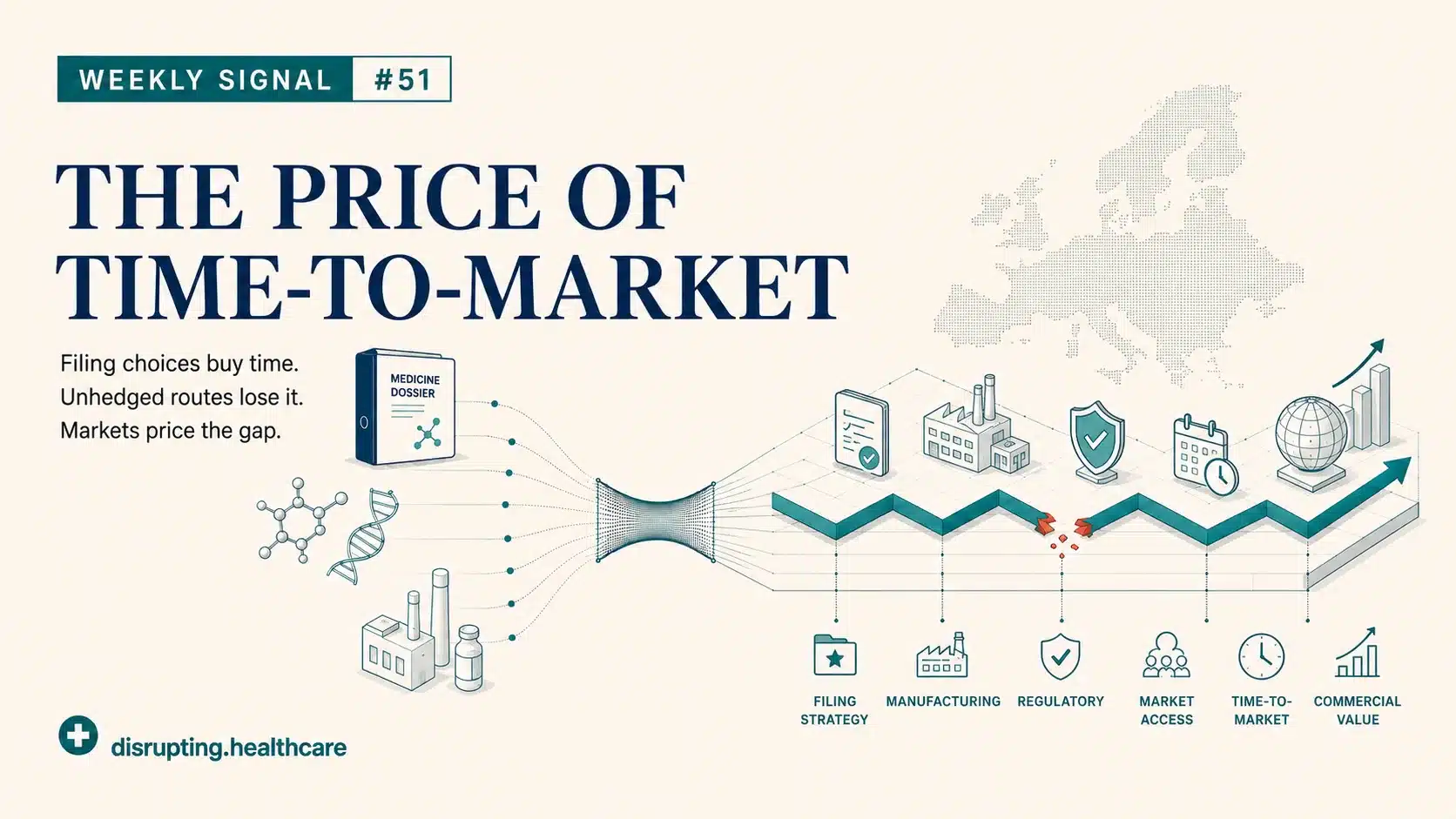
These are different mechanisms, and that distinction matters. What connects them is not a slogan about speed. It is a harder commercial fact: time-to-market is usually reported as an outcome, but stronger organisations treat it as something they can protect, buy or waste through upstream choices.
This week put a visible price on those choices.
Regulation and market access: the filing was the hedge
SCHOLAR ROCK · APITEGROMAB
One product, two dossiers, two clocks
Scholar Rock’s apitegromab case is the week’s clearest lesson because the scientific asset and the supplier problem were the same. The filings were not.
The company’s European withdrawal letter was dated 13 August and cited one reason: lack of GMP compliance at the Catalent Indiana drug-product site, now part of Novo Nordisk. The CHMP written procedure recording the withdrawal concluded on 20 August. On 21 August, Scholar Rock said it would remove the site from the European application and resubmit with its alternative facility. No new European opinion date has been published.
The US review kept its 30 September PDUFA action date. That was not evidence of a more forgiving regulator. The March BLA resubmission already contained two fill-finish facilities after a Type C meeting with FDA. When the Indiana site was classified Official Action Indicated, Scholar Rock could remove it from the US application and continue the review through the second site.
Europe had not reached the same point. Scholar Rock’s 20 July update said the MAA included Catalent Indiana and described the second facility as something the company would work with EMA to add if needed. In early August, it was still discussing that addition.
The alternative site was not an untested backup. Scholar Rock says it had recent successful FDA and EMA inspections and commercial vials were available. But the inspected is not filed. A site can be qualified, validated, and full of stock and still fail to protect a market if the application in that market cannot use it.
That turns what looks like a manufacturing detail into a commercial design choice. Filing strategy is one of the instruments that protects the launch plan. A second source only has market value when it creates a second executable route through the relevant regulatory process.
The practical question is no longer simply, “Do we have another supplier?” It is, “If this site disappeared tomorrow, which priority markets could still complete review, release product and launch without rebuilding the regulatory route?”
XSPRAY PHARMA · DASYNOC
The option you cannot buy after the crisis
Xspray Pharma supplied the harsher counterfactual. On 19 August, the Swedish company received another FDA Complete Response Letter for Dasynoc, citing outstanding GMP observations at its Italian contract manufacturer, NerPharMa, and a request for additional commercial-scale batch data. FDA raised no questions about clinical data, bioequivalence or stability, and Xspray said the medication-error issue raised previously had been resolved.
This is the fourth publicly documented Dasynoc CRL since July 2023. Earlier letters in 2023, 2024 and 2025 also referenced the third-party manufacturing site, although the earlier reviews included other issues as well.
NerPharMa says its remediation work is complete, but FDA has not yet decided whether another inspection is required. Xspray can produce the requested batches. What it cannot control is the regulatory status of someone else’s factory.
In an investor call, chief executive Blake Leitch said establishing a replacement facility would take roughly 18 months or more. That is the commercial cost of discovering too late that an alternative route was only theoretical. A second manufacturing path is an option, and like most useful options, it is cheapest before the problem is visible.
Commercial moves: creating time
ARGENX · ALKIVIA
A reusable platform creates a different kind of speed
On 17 August, argenx reported positive Phase 3 results from ALKIVIA, evaluating VYVGART Hytrulo in autoimmune myositis. In the combined immune-mediated necrotising myopathy and dermatomyositis population, treatment produced a 15.4-point greater improvement in mean Total Improvement Score at week 52 than placebo, with p=0.0011.
The subgroup detail matters. The result in immune-mediated necrotising myopathy was significant, with a 14.8-point difference and p=0.0048. Dermatomyositis showed a similar 14.5-point numerical improvement, but did not reach statistical significance in the smaller cohort.
That creates work for regulatory, medical and access teams. It does not weaken the wider commercial signal.
The advantage is reuse. argenx is not building an entirely new commercial institution around every clinical opportunity. The molecule, disease-area knowledge, evidence capabilities and much of the surrounding infrastructure can travel with the platform. Each new indication still has to earn its own regulatory and access case, but the organisation does not start from zero.
In a sector that often measures pipeline strength by the number of assets, repeatability deserves more attention. A platform that can generate another credible market without recreating the full route to market can compress time in a way a single-product success cannot.
Deals and consolidation: buying time
LEO PHARMA · TANABE PHARMA
LEO pays to enter after the slowest work has been done
On 18 August, LEO Pharma agreed to acquire worldwide rights to dersimelagon from Tanabe Pharma. The once-daily oral therapy for erythropoietic protoporphyria and X-linked protoporphyria has completed Phase 3 development, and an FDA application was submitted in June.
LEO will pay up to US$435 million in upfront and near-term milestone payments, with further downstream milestones and tiered royalties. If approved, the company is preparing for a potential 2027 launch.
This is external innovation doing exactly what it is supposed to do. LEO is buying an asset after much of the slowest development work has already been completed, then placing it into an organisation that already understands specialist dermatology markets. Part of the transaction value is therefore the time LEO does not have to recreate internally.
SANDOZ · SHANGHAI HENLIUS
Sandoz buys portfolio cadence and keeps the operating-model question open
Also on 17 August, Sandoz and Shanghai Henlius announced a collaboration covering up to ten proposed monoclonal-antibody or antibody-drug-conjugate biosimilar products or components. The first group includes a cetuximab biosimilar already in Phase 1, earlier-stage evolocumab and belimumab biosimilars, and an option on a recombinant human hyaluronidase.
Consideration can reach US$322 million, with Henlius expecting up to US$100.5 million to be invoiced in 2026. Henlius retains development, manufacturing and supply. Sandoz brings registration, market access and commercialisation reach outside China, with exact territories varying by asset.
Most of these programmes are early, so this is not near-term revenue. It is a portfolio architecture decision. Sandoz is paying for future launch cadence without building every molecule and manufacturing capability itself.
The efficiency comes with a dependency. As each asset approaches filing, the value of the model will depend on what has been designed into the agreements around manufacturing transfer, inspection visibility, regulatory support and second-site readiness. An asset-light model can be strategically elegant, but only if the parts left outside the company remain controllable when the clock starts to matter.
Access and the operating layer: compressing the gap
NICE · INSULIN EFSITORA ALFA
NICE moved before the licence
On 20 August, NICE issued final draft guidance recommending Eli Lilly’s once-weekly insulin efsitora alfa for adults with type 2 diabetes, explicitly subject to MHRA licensing. NICE says the treatment could reduce injections by 85% while providing glucose control comparable with established daily basal insulins.
The commercial signal is the sequencing. HTA work is being positioned to land close to licensing rather than waiting until the regulatory process has finished. That can remove dead time between authorisation and funded use, but it also raises the standard for readiness before approval.
And speed does not remove economics. NICE’s draft asks clinicians and patients to choose the least expensive suitable option after dosage, administration costs and price are considered. Convenience earns attention; value still determines access.
EUROPEAN MEDICINES AGENCY · IRIS
EMA is changing the front door, not just the software
EMA’s August cutover moved more pre-submission work from ServiceNow into IRIS. The agency’s IRIS transition notice describes a phased go-live beginning on 18 August for eligibility, letters of intent, accelerated-assessment requests and human pre-submission interactions, with veterinary pre-submission interactions following later in the week. EMA’s industry page records the broader move as taking effect on 19 August.
The same IRIS notice lists initial human and veterinary marketing-authorisation applications as the next major go-live on 1 September. Updated electronic application forms are already mandatory for new centrally authorised applications, with changes intended to improve usability, data quality and alignment with the ISO IDMP model.
This is administrative infrastructure, but it has strategic consequences. A regulatory process built around documents, email and knowledge stored in people’s heads can be digitised. A process built around structured identifiers, explicit states and accountable users can eventually be orchestrated.
That is the useful AI lesson. The limiting factor in regulated automation is often not whether a model can perform a task. It is whether the organisation has made the workflow, data and decision rights explicit enough for software to participate without losing traceability or accountability.
Structure the process first. Intelligence becomes more useful afterwards.
What leaders should watch
How much time Scholar Rock actually loses in Europe
The US action date remains 30 September. Europe has no published resubmission or opinion date. The interval between withdrawal, resubmission and eventual CHMP opinion will put a real number on the cost of adding a manufacturing route after the primary site becomes unusable rather than before.
Whether portfolio deals start pricing resilience as well as assets
LEO is paying for late-stage development time. Sandoz is paying for pipeline cadence. As partnered products approach filing, watch the terms that govern alternate sites, technology transfer, inspection transparency and regulatory support. Those clauses determine how much of the purchased time survives a supplier problem.
Whether faster interfaces produce faster decisions
NICE is aligning appraisal with licensing and EMA is structuring more of the submission front end. Sponsors that still run regulatory, evidence, access and data work as sequential hand-offs can easily give back the time those systems are designed to save.
Practitioner’s Lens
Time-to-market is not owned by the launch team. It is accumulated or lost years earlier in filing design, evidence strategy, partner contracts and the choice of which capabilities to own. Scholar Rock protected one regulatory path because the alternate site was already inside that filing; LEO and Sandoz paid for development time they did not want to recreate; argenx showed the compounding value of a platform that can carry evidence and commercial infrastructure into another opportunity. The practical test is simple: when a plan claims a launch date, ask which upstream assumptions could move that date by six or twelve months, who owns them, and whether the cost of protecting them has been compared with the value of the lost time.
For the wider operating-model argument, see AI-Powered Commercial Operating Models in Life Sciences and the H1 2026 synthesis of European commercial transformation.
ONE THING TO REMEMBER
Time-to-market is not a launch metric. It is an upstream investment decision.
A second site, a late-stage asset, an evidence package or a better regulatory interface only creates commercial value when it removes months from the path to the market.
Sources are linked inline. Financial, clinical and operating figures attributed to companies are company-reported unless otherwise stated. Interpretation and operating-model conclusions are the author’s. This publication is independent and does not accept sponsored placement.
Editorial note: This article was developed and edited with AI assistance used for research, source checking, challenge and copy refinement. The final framing, source selection and conclusions are the author’s.
