
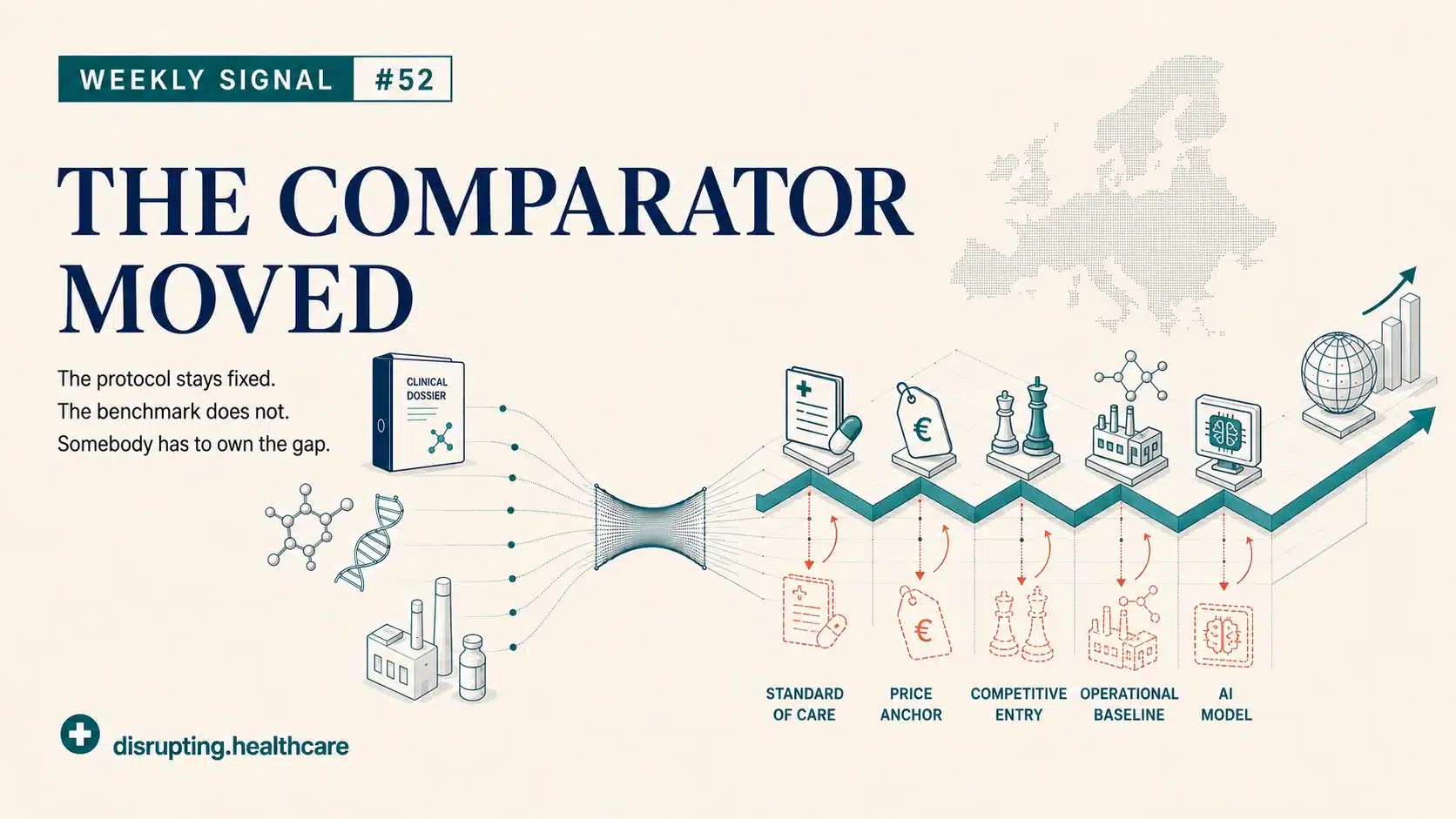
Europe Life Sciences Weekly Signal #52: The Comparator Moved

WEEK OF 24-30 AUGUST 2026 · 12-MINUTE READ
Every plan is measured against something. That something is rarely anybody’s job.
Last week’s Signal argued that time-to-market is accumulated or lost years before launch. This week showed the other half of that problem. A plan does not depend only on what the organisation does. It depends on what the plan will be compared with when the decision arrives.
At ESC Congress in Munich, CARDIO-TTRansform missed its primary endpoint after background treatment changed substantially during the study. On the same stage, ACACIA-HCM succeeded where no disease-specific therapy is approved, but its secondary outcomes and safety data complicated the commercial story.
In the United States, two medicines launched within two days at $39,800 and $35,000 per 30 days. One created a public price anchor while its European review was still underway. The other changed the competitive benchmark for a European company’s programme ten days after that programme reported mixed subtype data.
Elsewhere, a cyber incident disrupted Boston Scientific’s ability to process and ship orders. EMA made a shared manufacturing exposure visible across medicines marketed by nine companies. Lundbeck expanded an external AI platform across four commercial functions without disclosing the baseline against which success will be measured.
Different mechanisms, one operating truth. A comparator is not background. It is a variable, and somebody has to own it between the plan and the outcome.
IN THIS ISSUE
Trial design · ACACIA-HCM · Launch sequence · Competitive entry · Operational baseline · AI operating layer · Watch list · Practitioner’s Lens
Trial design: one protocol, two treatment environments
IONIS · ASTRAZENECA · EPLONTERSEN
The headline was known in July. The full evidence arrived on 28 August.
CARDIO-TTRansform randomised 1,432 patients with wild-type or hereditary transthyretin amyloid cardiomyopathy to monthly eplontersen or placebo on top of available care. Over 140 weeks, cardiovascular death and recurrent cardiovascular events produced a rate ratio of 0.89, with a 95% confidence interval of 0.73 to 1.09 and p=0.277. Circulating transthyretin was suppressed. The primary clinical outcome did not show a statistically significant improvement in the overall population.
The strategic exposure sits in the treatment environment. At baseline, 57% of participants in each arm were already receiving a transthyretin stabiliser. A further 24% started one during the trial.
Among participants already receiving a stabiliser at baseline, no additional benefit was observed on the primary endpoint. The prespecified subgroup without baseline stabiliser treatment showed fewer primary events with eplontersen and reached nominal statistical significance.
Honesty about what this does and does not prove matters.
It does not prove that changing standard care caused the trial to fail. The incremental biological benefit of adding a silencer to a stabiliser may be smaller than expected. The monotherapy subgroup may not withstand further scrutiny. A different population, duration or endpoint might have produced a different answer. Nominal subgroup significance is a hypothesis, not confirmatory evidence.
What the result does establish is narrower and more useful: the trial did not operate against a constant treatment environment throughout its life. Standard care entered both arms after randomisation and at scale. A protocol can freeze a statistical plan. It cannot freeze clinical practice.
That is a portfolio-governance problem before it is a clinical one. Every long programme contains a forecast of future care: which competitors will be approved, how rapidly background treatment will be adopted and what payers will consider adequate incremental benefit. Ownership of that forecast often dissolves once the protocol is signed.
The answer is not to redesign a pivotal study whenever the market changes. It is to decide in advance which external changes trigger a formal review of the evidence strategy, commercial forecast and access hypothesis, who convenes that review, and which decisions remain possible without compromising trial integrity.
The contrast: ACACIA-HCM won, but the package is not simple
CYTOKINETICS · AFICAMTEN
On the same day, ACACIA-HCM reported a positive result in symptomatic non-obstructive hypertrophic cardiomyopathy. Cytokinetics says the study randomised and treated 517 participants outside Japan.
Both primary endpoints met their prespecified significance threshold at Week 36. The Kansas City Cardiomyopathy Questionnaire Clinical Summary Score improved by 11.4 points with aficamten and 8.4 with placebo, a difference of 3.0 points, with p=0.021. Peak oxygen uptake increased by 0.64 ml/kg/min with aficamten and declined by 0.03 with placebo, a difference of 0.67, with p=0.003.
There is no approved therapy that directly addresses the underlying disease in symptomatic non-obstructive HCM. That gave ACACIA-HCM a cleaner clinical comparison than CARDIO-TTRansform, although it does not explain the positive result by itself.
The full package is less comfortable than the headline. Left atrial volume index did not reach significance, with p=0.058, and neither did time to first cardiovascular event, with p=0.678. Left ventricular ejection fraction below 50% occurred in 10.5% of participants taking aficamten and 0.8% on placebo. Serious adverse events occurred in 20.2% and 14.7%, respectively. These findings do not erase the two primary wins, but they matter for positioning, monitoring and value assessment.
Aficamten also enters Europe with history. As MYQORZO, it has been authorised in the EU since February for symptomatic obstructive HCM, with echocardiographic monitoring during dose adjustment and at regular intervals thereafter. The UK approved it in July, alongside a NICE recommendation based on cost comparison with mavacamten.
That existing indication does not automatically become the formal HTA comparator for non-obstructive HCM. The relevant standard care and evidence question are different. But the earlier approval creates a price, safety and monitoring precedent around the same molecule. Cytokinetics will not introduce the non-obstructive indication onto a blank commercial page.
The lesson is not to search only for empty markets. It is to recognise that the evidentiary threshold changes with the benchmark. Where no disease-specific therapy exists, the first question is whether a medicine works. Once the sponsor has established a price and delivery burden elsewhere in the same disease, the next questions become what the new indication adds and whether the existing commercial architecture still fits.
Launch sequence: the first public price arrives before Europe decides
REVOLUTION MEDICINES · RASONQUE
On 26 August, the FDA approved Rasonque, or daraxonrasib, for adults with metastatic pancreatic adenocarcinoma who had received at least one prior systemic therapy or could not receive multi-agent treatment.
In the 500-patient trial, median overall survival was 13.2 months with Rasonque and 6.7 months with chemotherapy. The application was submitted on 22 July and approved roughly six and a half months before its user-fee deadline under the Commissioner’s National Priority Voucher pilot.
The medicine was available at approval and does not require a companion diagnostic. Revolution Medicines set the wholesale acquisition cost at $39,800 for a 30-day supply, about $478,000 over twelve months before discounts, interruptions or assistance.
EMA, meanwhile, is reviewing daraxonrasib in phases ahead of a complete marketing-authorisation application.
The US price will not determine European reimbursement. National HTA bodies will examine comparative benefit, local care, budget impact and negotiated economics. But sequence matters. The first visible price shapes investor expectations, internal ambition and public debate months before European assessors reach a decision.
Approval speed, launch readiness and price were not three independent workstreams. Together, they established the first commercial benchmark around the medicine.
Competitive entry: ten days changed dermatomyositis
PRIOVANT · ROIVANT · ARGENX
On 27 August, the FDA approved Lisraya, or brepocitinib, for adults with dermatomyositis. It is the first FDA-approved oral treatment specifically indicated for the disease and became commercially available immediately. Roivant subsequently disclosed a wholesale acquisition cost of $35,000 for a 30-count bottle of 30 mg tablets.
Ten days earlier, argenx reported Phase III ALKIVIA results for efgartigimod in autoimmune myositis. The combined population met the primary endpoint, as did the immune-mediated necrotising myopathy subgroup. In the smaller dermatomyositis cohort, a 14.5-point difference favoured efgartigimod but did not reach statistical significance, with p=0.1093.
The comparison should not be exaggerated. ALKIVIA was positive overall, its subtype analysis was smaller, and the two mechanisms may ultimately occupy different positions. But a future dermatomyositis filing now faces an approved once-daily oral option, immediate availability and a visible price.
Ten days did not change the science. They changed what the science will be compared with commercially.
The unwritten baseline: the factory runs and the network is available
BOSTON SCIENTIFIC · EMA · PALIPERIDONE
Not every benchmark appears in a protocol or brand plan. Some are so basic that nobody writes them down.
Boston Scientific identified a cybersecurity incident on 25 August that disrupted operations globally. The company said access to information systems and business applications had been limited, including those supporting the processing and shipping of customer orders. At the time of the filing, the restoration timeline and full operational and financial effects were unknown.
For a device business, availability runs through one value stream: inventory, order, shipment, hospital schedule and procedure. The customer does not experience those as separate departments. Restoring systems is an IT objective. Restoring order fulfilment is a commercial one, requiring prior decisions about account communication, constrained inventory and authority to use manual workarounds.
On 27 August, EMA published a shortage notice for long-acting injectable paliperidone palmitate in several member states. The affected medicines are marketed by nine companies. EMA attributed the shortage to manufacturing problems at Pharmathen International, said it was not related to a product quality or safety issue, and gave no expected end date.
The notice makes a shared exposure visible at system level. It does not show what each company knew about other users of the manufacturer, nor whether every affected product came from one physical site. The defensible conclusion is not that nine companies suddenly discovered one factory. It is that resilience depends on aggregate capacity that no individual buyer may be able to see.
These are not conventional comparators. They are operational baselines. When the network is unavailable or shared capacity fails, the plan is suddenly measured against an assumption nobody thought needed an owner.
AI: measure the operating model before replacing it
LUNDBECK · EVERSANA
On 25 August, Lundbeck and EVERSANA expanded their strategic partnership to scale AI-powered commercialisation across Lundbeck’s US organisation. The programme covers strategy development, content creation, omnichannel engagement and commercial execution, with capabilities spanning marketing, medical communications, market access and media operations.
The meaningful word is not AI. It is “across”.
Four functions with different budgets, owners, and regulatory exposure will use one external platform. That can reduce the latency between insight, decision, approved content, and action in the market. It also creates a shared operating layer across vertical accountabilities.
No adoption levels, cycle times, cost figures or commercial outcomes were disclosed. The absence of public metrics is not evidence of poor performance. It exposes a more general test for every AI transformation.
An AI programme is measured against the operating model it replaces. If the organisation did not establish the baseline before scaling, in cycle time, content reuse, review burden, decision quality or customer outcomes, later gains will be difficult to prove. The programme will be defended with anecdotes because the comparator was never instrumented.
The governance questions follow. Which decisions remain inside Lundbeck? Which workflows stop if the platform stops? Where does reusable institutional knowledge live? Who is accountable when an AI-supported recommendation is compliant but commercially poor?
The partner can operate the platform. It cannot inherit the sponsor’s accountability.
What Leaders Should Watch?
- Whether future ATTR-CM protocols control, stratify, or pre-specify changes to background therapy more explicitly.
- How European assessors treat Rasonque’s evidence and price after an unusually fast US approval and immediate launch.
- Whether Lundbeck reports measurable changes in cycle time, reuse, decision quality or commercial outcomes from its expanded AI operating layer.
Practitioner’s Lens
Most organisations can name the comparator in a trial protocol or brand plan. Few can say who owns it after the plan is approved.
For each major asset or launch, name the scientific comparator, commercial alternative, price benchmark and operational baseline assumed by the plan. Give each an accountable owner, an early-warning signal, a review cadence and a threshold that triggers a decision. That decision may legitimately be to do nothing.
The point is not permanent replanning. It is recombining the picture before the remaining options become expensive.
If Clinical watches the standard of care, Commercial watches competitors, Market Access watches price, Supply watches the manufacturer and Digital watches the platform, the organisation does not own its comparator. It owns five fragments of it.
For the wider operating-model argument, see AI-Powered Commercial Operating Models in Life Sciences and the H1 2026 synthesis of European commercial transformation.
ONE THING TO REMEMBER
The comparator is not background. It is a variable, and somebody has to own it.
A trial, price, label, launch plan and operating model are all built against assumptions about the alternative at the moment of decision. If nobody tracks those assumptions between the plan and the outcome, the organisation discovers they moved when the remaining choices are most expensive.
